
Political essay
Should Republicans Be Bullied?
Mr Peyman Bakhshayesh on monarchists, republicans and Iran’s shared future: national cohesion, mutual respect and the discipline to keep sight of the goal.
English article
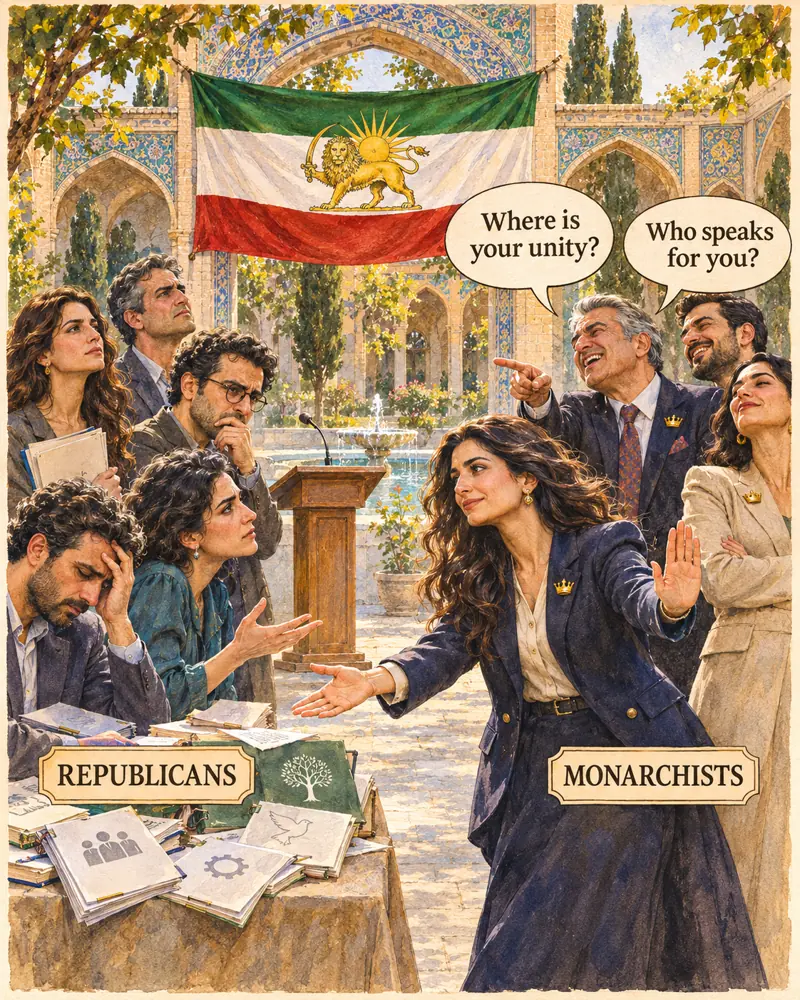
Republicans should not be bullied for their beliefs. I say this as a constitutional monarchist who sees Crown Prince Reza Pahlavi as the strongest available figure for bringing Iranians together. My support for him comes from my concern for Iran’s future. That same concern obliges me to respect the Iranian who disagrees with me.
We want a modern, prosperous country in which our people can live with dignity. We need national cohesion to reach that destination. Every time we humiliate a fellow Iranian over a political difference, we make the work of bringing the nation together more difficult. We should be capable of defending our convictions without turning our compatriots into enemies.
To understand the tension between monarchists and republicans, we need to look at the history that has shaped both.
The Constitutional Revolution of 1906 opened a new chapter in Iran’s struggle for government under law. Parliament, public accountability and limits on arbitrary power became central national demands. Iranians wanted a country capable of governing itself, managing its finances responsibly and dealing with the outside world from a position of independence and dignity. [1]
Those ambitions encountered a weak state, foreign interference and deep internal conflict. The country struggled to turn constitutional aspiration into effective government. In my reading of this period, Iran’s need for national cohesion and functioning institutions became urgent. A constitution needed a country strong enough to give it practical meaning.
Reza Shah’s rise brought the consolidation of central authority and an extensive programme of modernisation. Administration, infrastructure, education and the authority of the national state developed. He strengthened Iran as a country capable of acting as a whole, while political pluralism remained restricted. Following his abdication in 1941, his son, Mohammad Reza Shah Pahlavi, succeeded him. [2][3]
Modernisation continued under Mohammad Reza Shah. Expanding oil income supported industrial development, including manufacturing and the motor industry. Universities, education and urban life grew. Land reform, women’s suffrage and literacy programmes formed part of the wider transformation associated with the White Revolution. For me, this period represents an Iran trying to join the modern world and build the material foundations of prosperity. [2]
The Shah also faced powerful opponents. Soviet influence and revolutionary Marxism shaped parts of the left, while Islamist opponents drew on Iranian religious networks and wider currents of political Islam. Nationalists and liberals had their own criticisms. These groups differed considerably, but opposition to the monarchy brought forces with incompatible ambitions into the same revolutionary moment. [4]
The revolution of 1979 therefore carries different meanings for different Iranians. For many on the revolutionary left, the promise of liberation was captured by clerical power. The political histories associated with the Fadaiyan, Peykar, Komala, Rah-e Kargar and other organisations reflect different responses to that upheaval and its aftermath. For many monarchists, the revolution broke Iran’s historical course of development. Some also interpret the Shah’s fall through the hostility, abandonment or intervention of powerful Western interests. These interpretations continue to shape how people remember their own choices.
Forty-seven years later, we are still arguing from those different memories. Too often, each camp approaches the other as though the entire purpose of politics were to secure a final verdict on 1979. Meanwhile, another generation of Iranians waits for the opportunity to live.
Republican organisations have often placed great importance on ideological consistency. They have preserved principles, defended causes and maintained political identities through difficult years. Yet, in my judgement, the insistence on protecting each organisation’s particular interpretation has also contributed to fragmentation. Disagreement has too readily produced another party, another committee or another organisation. Shared opposition to the Islamic Republic has repeatedly failed to become a lasting common direction.
The monarchist movement has had a different advantage: a recognisable national figure around whom people with different priorities can gather. Crown Prince Reza Pahlavi provides continuity and a centre of political recognition. That advantage gives his supporters a responsibility to bring others in.
Within Pahlavism, I see two broad tendencies. One is romantic, rooted in memory, historical affection and the dignity associated with the Pahlavi era. The other is pragmatic and directed towards the future. It asks how we can rebuild the country, restore competent administration, develop industry and secure constitutional freedoms. Both have stood beside one another because Crown Prince Reza Pahlavi connects historical belonging with the possibility of national renewal.
My own preference is for that practical, future-oriented Pahlavism. What I have called Pahlavi Plus should carry forward the achievements of national reconstruction while strengthening democratic institutions and the capacity to learn from mistakes. Respect for the past should give us confidence to improve the future.
Some monarchists now ridicule republicans because they have not produced a unifying figure of comparable recognition. I believe this reaction misunderstands the problem. Organisational weakness is a subject for serious criticism. It is no justification for treating people as culturally inferior or less Iranian.
Part of the explanation lies in what I call the Iranian spirit: our long memory of kingship, our attachment to national continuity, our pride and our powerful individual convictions. These are habits and associations shaped through history. They help explain why a familiar national figure can bring together people who would otherwise struggle to agree on almost anything.
Republicans belong to that same history. They carry the same national pride and often the same determination to defend their own judgement. They should not be bullied for being Iranian in their temperament while republican in their politics. Understanding our inherited political culture should help us work with one another more intelligently.
We Iranians can be stubborn. We stand by an idea long after circumstances have changed. We find it difficult to admit that an earlier judgement may have been mistaken, because we fear that admitting a mistake diminishes the person we are. So we spend years proving that we were always right. We cannot all have been right about everything. We must give one another room to learn without demanding humiliation as the price of changing course.
This matters when people approach the national movement. It should not matter whether someone supported Crown Prince Reza Pahlavi decades ago or began listening to him yesterday. The useful question concerns the responsibility that person is prepared to accept now. We need their knowledge, their work and their willingness to cooperate. A movement seeking to bring a country together must be open to people whose political journeys differ.
I ask republicans to listen seriously to the national feeling expressed around Crown Prince Reza Pahlavi. When Iranians invoke the Pahlavi name or chant “Javid Shah”, there is an experience behind those words that deserves to be understood. It may carry memory, disappointment, hope for order or a longing for a country that respects its people. Intellectual disagreement does not relieve us of the responsibility to listen.
At the same time, cooperation does not require a republican to pretend to be a monarchist. We can work together to establish the conditions in which both convictions can compete freely. Crown Prince Reza Pahlavi has publicly described a transition based on territorial integrity, equal citizenship and individual freedoms, separation of religion and state, and the people’s right to choose their future government. He has explicitly included monarchists and republicans within that common endeavour. [5]
His supporters should make that invitation credible through their own conduct. A republican who approaches us should encounter a serious conversation about the future. If that person instead meets insults, suspicion and demands for ritual declarations of loyalty, we have made the invitation harder to trust.
Nationalism begins with respect for our own nation. The nation consists of people, including people whose conclusions trouble us. Their dignity, their intellectual work and their freedom to think belong within the country we claim to love. If we cannot respect one another as Iranians, our talk of national renewal remains incomplete.
The problem is particularly visible on X, Instagram and Facebook. A provocative statement appears. People pursue its author across comment sections. An argument becomes an exchange of insults, then a contest over who can display the greatest outrage. Hours and days disappear. Very little has been achieved for the person inside Iran whose life we say we want to improve.
Some of that provocation comes from opponents of monarchy, including elements of the left. I have no wish to excuse deliberate obstruction or bad-faith argument. But we remain responsible for our own response. A provocation becomes a successful distraction when we surrender our attention to it and forget why we entered politics in the first place.
We should answer a false claim with evidence and explain our disagreement with a political proposal. Persistent harassment, ridicule and attempts to make someone afraid to speak serve a different purpose. They damage the culture of citizenship we need. The person on the receiving end may later be our colleague in rebuilding the country, our parliamentary opponent or our neighbour.
The goal must remain visible. Does this exchange help us understand a problem, correct an error or bring another person into useful cooperation? Does it strengthen our ability to help Iranians? If it does none of these things, we should have the discipline to leave it and return to our work. Every argument does not require our participation.
I have argued in my earlier writing that loyalty should be measurable through service. A person who helps an injured Iranian, contributes professional knowledge or creates a working relationship across political divisions is doing something of value. Such work builds confidence in the movement. Aggression towards a republican critic cannot serve as a substitute for it.
My political judgement remains that the Islamic Republic is the central obstacle to Iran’s freedom and prosperity. I do not believe its ideological structure can be reformed into the secular democracy our people need. Our national effort should remain directed towards ending that system of repression and preparing a credible democratic future. A fellow Iranian who favours a republic is not, by that fact, part of the machinery we oppose.
The future must have room for political competition. I want a parliament in which the left, right and centre can seek support through fair and free elections. Religious citizens and non-religious citizens must enjoy equal standing, with no religious authority placed above the constitution. People should be able to organise, criticise a government and replace it without fearing for their liberty.
Constitutional monarchy can belong fully within such a democracy. The United Kingdom, Belgium, the Netherlands, Spain and the Scandinavian monarchies offer familiar examples. My preference is for a parliamentary constitutional monarchy in Iran, with a national figure who can represent continuity while elected institutions govern. I want that preference to earn the people’s confidence. Republicans must have the same freedom to present their alternative.
When I speak about the Japanisation or Israelisation of Iran, I am thinking about qualities I admire in those societies: national confidence, education, productive work, technology and engagement with the outside world. I see useful points of comparison for a proud people determined to survive and modernise. Iran should learn from achievements elsewhere and apply that knowledge to its own circumstances.
The Iran I want should create wealth through the abilities of its citizens. It should offer the scientist a laboratory, the entrepreneur a fair opportunity, the worker security and a voice, and the young person a reason to build a life at home. It should seek constructive relations with its neighbours, Israel, Europe, America and the wider world. Our national identity should support our ability to contribute and cooperate.
Iran has proud, capable and creative people. What we need is enough trust to bring those abilities into a common national effort. That trust grows when people can offer an idea without being insulted, acknowledge an error without being disgraced and join a shared project without surrendering their dignity.
For me, Crown Prince Reza Pahlavi is the cohesive figure around whom this effort can gather. My support for him is connected to a united country, the Lion and Sun flag, secular democracy and a future in which Iranians can feel at home. The strength of that vision depends on how widely it can embrace our people.
Republicans should not be bullied for their beliefs. They should be engaged as fellow citizens whose participation matters. Monarchists should be confident enough in their own argument to welcome disagreement. Both should remember the people who bear the cost of our continued division.
Whether the Iranian people ultimately choose constitutional monarchy or a democratic republic, they deserve a secular parliamentary order governed by law. I will argue for the constitutional monarchy I believe can best serve them. I also want every republican to know that their rights, dignity and place in Iran are secure.
That is the national home we must build together. Let us keep our eyes on the goal, treat one another with respect and give Iran the cooperation its future requires.
Download the editable Word version
Sources and related writing
Historical references support the chronology and reforms discussed in the article. The political judgements and interpretation of Iranian national character are the author’s.
[1] Saïd Amir Arjomand, Constitutional Revolution iii. The Constitution, Encyclopaedia Iranica.
[2] M. Hashem Pesaran, Economy ix. In the Pahlavi Period, Encyclopaedia Iranica.
[3] United States Holocaust Memorial Museum, Iran during World War II.
[4] Ahmad Ashraf, Islamic Political Movements in Twentieth-Century Iran, Encyclopaedia Iranica.
Related articles by the author
National Cohesion, 10 November 2026.
Can a Marxist Support Crown Prince Reza Pahlavi?, 10 November 2026.
Measurable Loyalty, English edition, 9 November 2026.
Reconciliation, 18 October 2026.
From a Crisis of Image to a Strategy of Unity. Author’s Google Drive archive.