Political essay
National Cohesion
Crown Prince Reza Pahlavi and the strength of a nation that stands together. An illustrated essay by Mr Peyman Bakhshayesh on shared purpose, equal citizenship and Iran’s democratic future.
English article
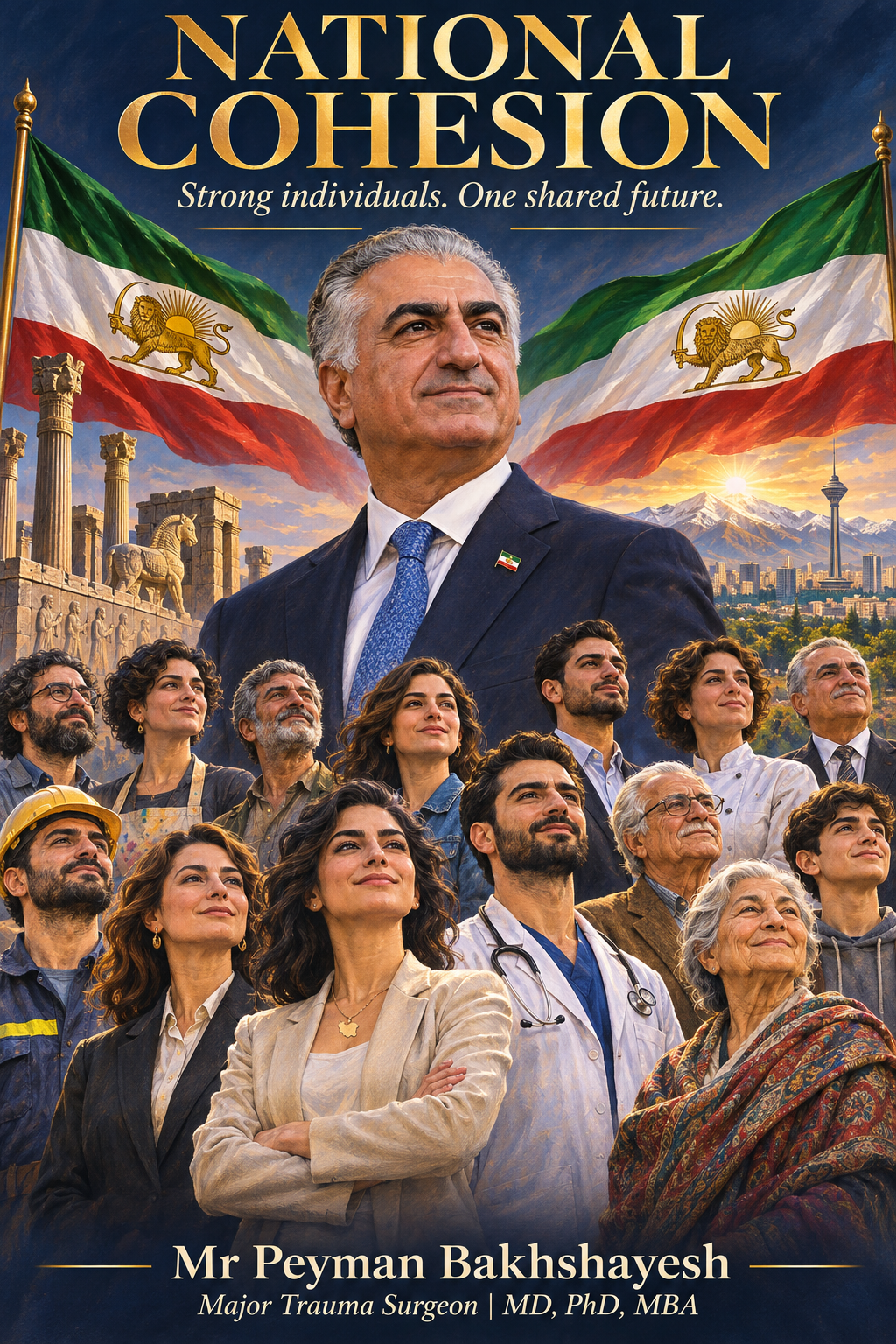
Crown Prince Reza Pahlavi and the strength of a nation that stands together
Iranians are strong individuals. We argue, create, endure, question and begin again. Across generations, we have carried our language, our memories and our ambition through upheaval and exile. Yet individual strength becomes national power only when people learn to act together. A nation can possess extraordinary talent and still lose its future through fragmentation.
National cohesion is something we must learn, practise and defend.
My argument is clear: Iran needs a recognisable national centre capable of bringing its scattered strengths into a common democratic endeavour. For me, Crown Prince Reza Pahlavi is that centre. His importance lies in the possibility of joining historical continuity to a future chosen freely by the people: one Iran, equal citizens, a secular state and government accountable to the ballot box.
1. The country is larger than the faction
A civilisation does not survive for millennia by remaining unchanged. It survives because successive generations recover a sense of belonging after conquest, upheaval, defeat and renewal. Iran's continuity has never meant an absence of conflict. Religion, foreign invasion, dynastic rivalry, disputes over succession and failures of leadership have repeatedly tested its cohesion.
History therefore gives us both an inheritance and a warning. We can preserve a country while disagreeing intensely about its government. We can also weaken a country by treating victory over our compatriots as more important than its survival.
Iran is larger than any party, class, dynasty, doctrine or generation. Persian culture is central to its historical life, but Iranian citizenship belongs equally to every community that makes the country its home. No citizen should have to surrender a language, a peaceful belief or a regional identity to belong fully to Iran.
The common commitment must be strong enough to hold our differences: territorial integrity, equal citizenship, freedom of conscience and a lawful democratic process. These principles give political rivalry a boundary. We may compete over the direction of the country while remaining responsible for its common future.
2. The lesson of 1979: division can become a machinery of exclusion
The revolution of 1979 brought Ruhollah Khomeini to power amid promises of liberation and a better life. In March of that year, after the monarchy had fallen, his promises included free water and electricity for the poor. The distance between revolutionary assurance and the subsequent exercise of power is central to understanding our national catastrophe.[1]
Four senior military officers were executed at Tehran's Refah School on 15 February 1979. The following years brought widening repression: mass executions and the assault on opposition movements in 1981; the repression of Tudeh and Fedayeen Majority activists in 1982-83; and the prison massacres of 1988, whose victims included members and supporters of the People's Mojahedin and leftist organisations. In July 1999, student demonstrators were again attacked.[2][3][4]
These victims did not share one political philosophy. Some had opposed the revolution; others had participated in it. That is precisely the lesson. Once a state makes ideological belonging the condition of protection, yesterday's ally can become tomorrow's condemned enemy.
I draw a direct conclusion from this history: freedom cannot be secured by defending only the people who agree with us. A monarchist's rights cannot depend on a republican's sympathy. A republican's rights cannot depend on a monarchist's generosity. Their rights must belong to them as citizens, protected by institutions that neither faction can confiscate.
Our response to the Islamic Republic must therefore overcome the habit of dividing the nation into people entitled to a future and people who may be discarded.
3. The birth of a new Iran
During my years in Germany, studying politics, philosophy and economics at Humboldt University and reading Marxism line by line in Berlin's libraries, I wrestled with the relationship between human action and historical change. Those reflections remain part of my intellectual journey. They did not teach me to worship a doctrine; they taught me to examine the conditions in which a society can transform itself.
As a surgeon, I return to an image from medicine. Think of the country as a mother carrying a new Iran. Our responsibility resembles that of a conscientious obstetric team: sustain the mother, recognise distress, prepare carefully and protect the life that is coming into the world.
In this political metaphor, nourishment means solidarity. Hydration means the continuing flow of trust and communication. Preparation means civic organisation, professional competence and a credible democratic destination. A family facing hunger, an injured protester without care and a bereaved household abandoned to isolation are all reminders that a movement's work begins with people.
We cannot manufacture a healthy birth by announcing a date. Nor can we excuse neglect by invoking patience. History offers no automatic delivery of freedom. We must prepare, judge conditions and act responsibly, without confusing impatience with readiness or passivity with wisdom.
The new Iran I seek is secular and democratic. Its birth will be measured in the lives its citizens can lead: women free to choose their appearance and future; children able to learn without ideological coercion; workers able to organise; believers and non-believers equal before the law.
4. Why Crown Prince Reza Pahlavi matters
A fragmented society needs a point of recognition. It needs a figure around whom people can coordinate without first resolving every argument about the past. For many Iranians, the Pahlavi name carries memories of national statehood, modernisation, cultural confidence and engagement with the wider world. Those associations help explain its force in the present.
My support for Crown Prince Reza Pahlavi is forward-looking. I see in his role the possibility of converting that historical recognition into a broad national partnership. His publicly stated principles include Iran's territorial integrity, equal rights and individual liberties, separation of religion and state, and the people's right to choose their future government through free and fair elections.[5]
These commitments offer common ground to people who will later campaign against one another. A constitutional monarchist can support his transitional leadership and argue for a parliamentary monarchy. A republican can cooperate in securing the same free political space and campaign for a republic.
I believe he is the strongest available focus for that cooperation. This is my political judgement and the case I put before the world. It does not require pretending that every Iranian agrees, or that a free national vote has already taken place. The authority of the future constitution must come from the Iranian people themselves.
As I argued in Nation Building, the constructive inheritance of Pahlavism must be carried forward into accountable institutions. My understanding of Pahlavi Plus joins national confidence and modern reconstruction to stronger constitutional restraints, political inclusion and the capacity to correct mistakes.[6]
Cohesion around Crown Prince Reza Pahlavi should make the people's choice possible. Its success will be proved when that choice is free.
5. An open challenge to democratic republicans
Republicans have opposed the Islamic Republic, endured exile and imprisonment, and contributed to the struggle for freedom. Their sacrifices deserve recognition. My criticism concerns the failure to turn a wide range of convictions into a durable common political direction.
In my judgement, too much of our opposition politics has allowed factional identity to take precedence over national purpose. This criticism applies wherever it occurs, including among monarchists. Forty-seven years of opposition should make us more willing to cooperate, more exacting about results and less interested in protecting the prestige of our own circle.
My invitation to democratic republicans is direct: keep your convictions and help build the free arena in which they can be tested. Cooperation around Crown Prince Reza Pahlavi's democratic commitments need not be a pledge to the final restoration of monarchy. It can be a pledge to reach a point at which no Iranian is imprisoned for advocating either constitutional alternative.
Supporters of the Crown Prince carry a corresponding duty. We must welcome competence, allow honest criticism and resist the temptation to make personal access or ritual declarations of loyalty the measure of citizenship. A national centre earns its meaning by bringing people in.
The test is whether we can build together while remaining free to disagree.
6. A crown can belong within democracy
Iran's long monarchical memory is a cultural and political resource. It is neither a defect requiring foreign correction nor a command that binds future generations without their consent.
Japan and several European democracies, including the United Kingdom, Sweden, Norway, Denmark, Belgium and the Netherlands, demonstrate that a monarchy can coexist with democratic government. Their histories and constitutional arrangements differ. What matters is the distribution of authority: elected government, lawful limits and a head of state whose national role does not displace popular sovereignty.[7]
Iran must choose its own settlement. My preference is a parliamentary constitutional monarchy in which a unifying crown stands above ordinary party competition and government remains accountable to elected representatives. The crown's powers must be defined, constrained and public. Historical affection can support an institution; it cannot exempt that institution from the constitution.
To international observers, I offer a simple request: understand the political work a familiar national symbol can perform before dismissing it as nostalgia. Listen to the people who see continuity as a source of confidence for democratic change.
7. January 2026 and the responsibility to remain vigilant
The January 2026 killings made the human cost of this struggle unbearable. The UN High Commissioner for Human Rights reported thousands killed in a crackdown that intensified on 8 January. Iran Human Rights subsequently documented more than 4,200 deaths during the January protests, with killings heavily concentrated on 8 and 9 January; it stresses that its figures are minimum documented totals, not a final count.[8][9]
Crown Prince Reza Pahlavi had called for mobilisation, and people answered.[5] Responsibility for the unlawful killings belongs to those who ordered and carried them out. The duty of the movement is to honour the victims through care, truthful documentation and a strategy that takes the lives of those inside Iran seriously.
On 28 February 2026, the United States and Israel launched a new military campaign against Iran.[10] Whatever damage military action inflicts on a regime, democratic institutions still have to be built. External force cannot supply a nation's trust, organise its civil society or cast its votes.
A wounded apparatus of repression can remain dangerous. We must avoid confusing damage with disappearance, or expectation with victory. Vigilance means maintaining solidarity, protecting civilians and preparing the institutions through which an opening can become a lasting freedom.
8. Cohesion must be visible in what we do
In Measurable Loyalty, I argued that loyalty must be judged through service, accountability and results.[11] National cohesion requires the same discipline.
Doctors can help sustain care. Engineers can prepare for the continuity of water, power and infrastructure. Lawyers can develop credible protections for due process. Economists and administrators can examine the practical demands of recovery. Artists and teachers can keep a common future imaginable. Citizens abroad can contribute expertise and advocacy while respecting the knowledge, consent and risks of people inside Iran.
Political leadership must give these contributions a common direction. That requires clear responsibilities, honest reporting, the ability to hear unwelcome evidence and the courage to correct failure. A movement becomes stronger when its supporters can ask what has been achieved without being accused of disloyalty.
Reconciliation also requires justice. We should preserve evidence, support survivors and establish individual responsibility through fair proceedings. Collective revenge would reproduce the logic that wounded the nation. Iran's future must be broad enough to include citizens who did not march beside us.
9. Our message to the world
We Iranians possess strength in abundance. What we must build is the trust that allows our strengths to work together.
Crown Prince Reza Pahlavi represents, for me, the national connection between a civilisation that remembers itself and a people determined to govern their future. I support him because I believe that connection can hold a broad democratic movement together through the dangers of transition.
I ask the outside world to recognise that aspiration: a sovereign Iran, whole and free; a secular state protecting every citizen; a constitutional future decided by the people; and a country able to contribute to peace, science and prosperity.
We owe our dead more than remembrance. We owe our children more than another generation of division. We owe one another the disciplined work of becoming a nation capable of acting together.
Let our individual strength become a common purpose. Let our historical memory become confidence. Let our cohesion carry Iran towards freedom.
For me, the national focal point for that journey is Crown Prince Reza Pahlavi.
Sources and related writing
Political essay by Mr Peyman Bakhshayesh, Major Trauma Surgeon, MD, PhD, MBA. 10 November 2026. Personal recollections and political judgements are the author's. Historical and contemporary factual passages are supported by the sources below.
- IranWire. Khomeini Factcheck: Forty Years of False Promises in Iran, 4 February 2021. Includes the dates and scope of the 1979 utilities promises.
- Abdorrahman Boroumand Center. Omid memorial entries for Nematollah Nasiri, Mehdi Rahimi, Reza Naji and Manuchehr Khosrodad, executed at Refah School, 15 February 1979.
- Amnesty International. Blood-soaked Secrets: Why Iran's 1988 Prison Massacres Are Ongoing Crimes Against Humanity, index MDE 13/9421/2018, especially sections 3.2 and 7.1. See also Human Rights Watch, 8 June 2022.
- Amnesty International. Iran: Fear for Safety: student demonstrators, 8 July 1999, MDE 13/015/1999.
- Crown Prince Reza Pahlavi. Speech at the Foreign Affairs Committee of the Dutch House of Representatives, 6 July 2026. Cited for his stated principles and account of his mobilisation call, not as independent measurement of public support.
- Peyman Bakhshayesh. Nation Building, 15 October 2026.
- Comparative constitutional sources: Constitution of Japan, Articles 1 and 4; and The role of the Monarchy, official UK Royal Household account; and the Royal Court of Sweden.
- United Nations, OHCHR. High Commissioner Volker Türk's briefing to the Human Rights Council special session on Iran, 23 January 2026.
- Iran Human Rights. List of More Than 4,200 People Killed in January 2026 Protests Published, 17 September 2026.
- Reuters. Report on the US-Israel strikes launched on 28 February 2026, updated 1 March 2026.
- Peyman Bakhshayesh. Measurable Loyalty, English edition, 9 November 2026.
This essay also develops themes in the author's Drive archive: Crown Prince Reza Pahlavi, National Reconciliation, and the Centrist Transition Thesis; Reza Pahlavi as a Unifying Figure in the Iranian Opposition; and Pahlavism, Technocracy, and National Reconciliation in Iran's Transition. These earlier papers inform the argument; the sources above support the factual chronology.