
Political essay
Can a Marxist Support Crown Prince Reza Pahlavi?
Mr Peyman Bakhshayesh makes the case for national cohesion, productive reconstruction and workers’ rights, asking whether historical understanding can open a path to democratic cooperation around Crown Prince Reza Pahlavi.
English article
Begin with the country as it is
Can a Marxist support Crown Prince Reza Pahlavi? My answer is yes: a Marxist can support his role in a national, democratic transition without abandoning concern for workers, inequality or social justice. Support for transitional leadership, support for constitutional monarchy and agreement with a particular economic programme are related but separate choices. None requires surrendering the right to think critically.
To answer the question properly, we must first ask what we mean by Marxism. I understand its attraction as an ambitious attempt to connect the world: material conditions, production, social classes, political power, culture and historical change. It asks how human societies develop, why contradictions arise within them and why established institutions eventually face challenges. Marx’s 1859 account of historical development places productive forces and social relations at the centre of that inquiry.[1]
This ambition should not be confused with a finished scientific theory of everything. Marx’s analysis of society, Engels’s attempt to examine the dialectics of nature and the discoveries of natural scientists are distinguishable projects. The work of Linnaeus and Darwin belongs to the history of science; it is not simply a set of illustrations proving a political doctrine. Engels drew on the scientific knowledge of his time, and his interpretations must also be open to criticism.[2]
Likewise, the familiar sequence of thesis, antithesis and synthesis is too simple to serve as a universal machine explaining every historical event. Dialectical thinking is more useful when it directs our attention to relationships, tensions and change. Marx himself criticised the mechanical treatment of economic history through abstract categories.[3] A living method must remain capable of learning from circumstances.
In his eleventh thesis on Feuerbach, Marx wrote: “Philosophers have hitherto only interpreted the world in various ways; the point is to change it.”[4] For me, that sentence establishes a practical test. Does our philosophy help people understand their condition and improve it? An intellectual who merely complains that society has chosen the wrong symbols, the wrong language or the wrong leader has not yet answered that question.
My argument is a political judgement informed by historical thinking. It is not a claim that Marx endorsed monarchy, or that every serious Marxist must agree with me. I am asking whether inherited hostility to the Pahlavi name should prevent cooperation in rebuilding Iran. I believe it should not.
A living philosophy must be able to learn from the society it seeks to serve.
History is not a life sentence
Critics of the Pahlavi period point to restrictions on political pluralism, censorship, political imprisonment and torture. These concerns deserve serious examination. My response is that history must be studied in context and used to improve the future. Acknowledging abuses does not require treating a family name, a political tradition or the possibility of constitutional monarchy as permanently disqualified.
When I place the Pahlavi period between the late Qajar state and the Islamic Republic, I see a major effort to build a modern country: stronger public institutions, industry, education, urban development and wider participation in modern professional life. Scholarship documents substantial social and economic transformation, alongside inequalities and uneven development.[5] The late Qajar period also contained constitutional aspirations; no era can be reduced to a single adjective.
Nor should we describe Pahlavi Iran as a society in which every religion enjoyed full equality. The position of the Baha’is, including the state-supported persecution of 1955, contradicts that claim.[6] Recognising this strengthens the case for a future secular state that protects every citizen. We should preserve achievements and correct failures, rather than demand that patriotism deny the historical record.
Mohammad Reza Shah governed in a difficult international setting. The Soviet Union was Iran’s northern neighbour. The pro-Soviet Tudeh Party and revolutionary Marxist organisations formed part of the opposition; Islamist movements challenged the direction of social and cultural change. These currents were not identical, and neither all leftists nor all religious opponents can be placed in one organisational category. Nationalists, liberals and other critics also existed.[7]
Chronology matters. The Fadaiyan guerrilla organisation opposed the monarchy before 1979, but the Majority faction emerged after the revolution. It should not be projected backwards as a separate Shah-era organisation.[7] The same care is needed when discussing Islamist influences: Iranian movements had their own histories and cannot all be explained as branches of the Muslim Brotherhood.
Security pressures help explain decisions; they do not make repression inevitable or remove responsibility for it. The constructive question is what institutions could preserve modernisation while preventing the concentration of unchecked power. My preference is parliamentary constitutional monarchy, equal citizenship, independent institutions and political competition. I support the modernising inheritance associated with the Pahlavis as material for a better future, not as a demand to reproduce every feature of the past.
History is not a life sentence. It offers lessons, and the responsibility to move forward.
Build the capacity to prosper
A future transition beyond the Islamic Republic would confront an immediate material question: how can Iran produce more value, more useful employment and a more secure life? A government cannot distribute prosperity that its society has no capacity to create. Anyone who takes the development of productive forces seriously should therefore care about industrial renewal, knowledge, infrastructure and competent economic institutions.
My concern is the factory that appears productive only because energy, credit or other inputs are subsidised indefinitely, while the real cost is borne elsewhere in society. That is a warning about an economic model, not a statistical verdict on every Iranian factory. A responsible transition would need sector-by-sector evidence: which enterprises are competitive, which can be modernised, which provide essential public value and which absorb resources without a credible route to improvement.
The classical economists offer useful questions. Adam Smith’s The Wealth of Nations, published in 1776, examines the sources of wealth and the organisation of productive activity. David Ricardo’s On the Principles of Political Economy and Taxation, first published in 1817, examines distribution and trade.[8], [9] Neither book supplies a ready-made diagnosis of contemporary Iran. Their value is to encourage disciplined attention to productivity, costs, incentives and the uses of scarce resources.
Iran needs a revolution in its productive outlook: room for new businesses, technological renewal, practical research and skills that connect education to useful work. Diaspora professionals and entrepreneurs could contribute investment, experience, contacts and access to markets. Their participation should be invited through credible institutions and equal rules, alongside the knowledge and effort of people already working inside Iran. Neither residence abroad nor wealth is a certificate of competence or patriotism.
Confidence will depend on predictable rules, enforceable contracts, transparent decisions and protection from arbitrary confiscation. Economic reform must also recognise the human cost of restructuring. Closing an unviable enterprise without retraining, income protection or alternative employment transfers the burden to families least able to carry it. Reform should build capacity while protecting people through change.
This is where my reading of historical materialism becomes practical. The task is to understand the country’s actual productive capacity and remove the obstacles to its development. That does not mechanically prove the case for monarchy. It does explain why a Marxist might support a broad national reconstruction programme rather than insist on an immediate attempt to impose an ideal social order.
Production, social protection and accountable institutions must develop together.
Workers belong at the centre of reconstruction
Productive renewal is not permission to silence workers. Iranian workers must be able to organise independent unions, choose their representatives, bargain collectively and pursue better wages and conditions. Pensions, protection against unemployment, sickness support and safe workplaces belong within a serious account of national prosperity. They must not be treated as rewards to be considered only after investors are satisfied.
My objection is to the assumption that the end of the Islamic Republic must immediately be followed by a second revolution in which one class, party or council claims exclusive political power. Repeating an inherited revolutionary formula is not the same as understanding historical conditions. An attempt to force society into that formula could fracture the coalition needed to restore security, public services and confidence.
There is a clear difference between defending labour’s independent voice and claiming that political authority belongs exclusively to organisations acting in labour’s name. Workers are citizens with diverse convictions. They must be free to support socialist, liberal, conservative, monarchist or republican parties without having their interests defined for them by a self-appointed ideological authority.
Lawful strikes and collective bargaining can be legitimate ways to defend rights. My criticism concerns a predetermined project of monopolising state power, not every protest or industrial dispute. National cohesion should never become an excuse for suppressing workers’ grievances. Equally, economic disagreement should not automatically become a campaign to make the country ungovernable.
The practical meeting point is a democratic settlement in which productive enterprise can operate, workers can organise, governments can be replaced and disputes can be resolved without political persecution. A Marxist who helps construct that settlement has not ceased to care about social justice. Such a person has accepted that people need institutions capable of delivering it.
| Shared task | Practical commitment |
|---|---|
| Productive renewal | Innovation, investment, skills and fair competition |
| Workers’ dignity | Independent unions, bargaining and safe work |
| Security through change | Pensions, income protection and retraining |
| Democratic authority | Equal citizenship, free elections and accountable power |
A worker’s rights and a country’s productive capacity are responsibilities to be held together.
A common country, an open horizon
What Iran needs is national cohesion: the capacity to work together across differences around a future that belongs to everyone. In the Pahlavism I support, secular government, modernisation and the rebuilding of national confidence form a common direction. By national renewal I mean strengthening Iran as a shared civic home; I do not mean that every enterprise must become state-owned or that cultural diversity should disappear.
Crown Prince Reza Pahlavi can, in my judgement, help provide a recognisable centre for that cooperation. This is an argument about his potential political role, not a declaration that every Iranian already accepts the same leadership or constitutional outcome. The cry of “Javid Shah” matters. It deserves to be heard as a serious expression of hope, memory and political preference. It cannot, by itself, substitute for a free national vote.
In his Toronto speech of 19 September 2026, Crown Prince Reza Pahlavi set out four principles: territorial integrity, separation of religion and government, individual freedoms and equal citizenship, and the people’s right to choose their system through a free and fair vote. He expressly included both monarchists and republicans, and people of the right and left.[10] This offers a stated basis for cooperation without requiring everyone to become a monarchist.
My earlier papers on national reconciliation and a Pahlavi-centred transition develop a similar distinction between transitional leadership and the eventual constitutional settlement.[11], [12] In Measurable Loyalty, I connect political commitment with service, accountability and the widening of cooperation.[13] The test is what we build together: trust, institutions, knowledge and a capacity to govern responsibly.
National cohesion also requires an outward-looking Iran. I favour friendship and constructive cooperation with Israel, the Arab states of the Persian Gulf, Europe and the United States. Relations with Russia and China should likewise be judged by Iran’s national interests, on terms that preserve independence. No foreign capital should become the substitute for an Iranian political conscience.
An ancient culture need not fear contact with others. Confidence can make us more open to learning, trade, science and cultural exchange. A nation can preserve its identity while valuing its own internal diversity and extending friendship beyond its borders. This is the international outlook I want for Iran: cooperative, self-respecting and free from the habit of turning ideological hostility into national policy.
Cooperation does not require identical beliefs. It requires shared commitments that people can trust.
Stand with the people, and help build their future
What should a philosopher do when the people use a language that does not fit the philosopher’s expectations? First, listen. Popular feeling can contain experience that a theory has overlooked: humiliation, lost opportunity, memories of order and the desire for dignity. An intellectual should investigate that experience rather than dismiss it as ignorance.
When I insist that we should stand with our people, I mean respecting their agency and lived judgement. That does not make a crowd infallible or entitle a majority to deny minority rights. The people are not one voice. Free discussion and credible elections matter precisely because citizens can disagree, learn and change their minds.
The philosopher has two duties: solidarity and intellectual honesty. Stand beside people facing repression, but do not flatter them with false claims. Respect their choices, but explain consequences and offer criticism openly. A useful philosophy improves public judgement while accepting that political legitimacy belongs to citizens.
This is why I reject dogmatism. Insisting that Iran must repeat a prescribed sequence of revolutionary stages, regardless of what its people need and freely choose, places theory above society. The same criticism applies to a monarchist who excludes republicans, or an entrepreneur who treats reconstruction as permission to remove workers’ rights.
My answer remains yes. A Marxist can support Crown Prince Reza Pahlavi as a figure of national cooperation and democratic transition, support productive reconstruction, and defend independent unions and social protection. Whether that person ultimately votes for constitutional monarchy is a further political choice. Understanding these distinctions strengthens cooperation.
For my part, I support constitutional monarchy and the modernising, secular direction I associate with a future-oriented Pahlavism. I want that preference to earn trust through institutions and results. Iran needs workers and entrepreneurs, scientists and teachers, doctors and engineers, people at home and in the diaspora. Our differences should become part of democratic life, not a reason to deny ourselves a common future.
History gives us responsibilities as well as memories. Learn from it. Listen to the nation. Defend the freedom through which the nation can speak. Then put knowledge to work. That is how philosophy becomes useful, and how national cohesion becomes more than a slogan.
May Iran endure. Javid Shah, with freedom, equal citizenship and the people’s right to choose.
References and related writing
Karl Marx, Preface to A Contribution to the Critique of Political Economy (1859).
Productive forces, social relations and historical change. The contemporary political application is the author’s interpretation.Friedrich Engels, Dialectics of Nature, Introduction (manuscripts of the 1870s and early 1880s).
The extension of dialectical analysis to natural science; a historical philosophical work, not current scientific consensus.Karl Marx, The Poverty of Philosophy (1847), Chapter II, The Metaphysics of Political Economy.
Criticism of abstract, mechanical treatment of economic categories and historical development.Karl Marx, Theses on Feuerbach (1845), thesis XI.
The brief quotation uses the Cyril Smith translation displayed by the Marxists Internet Archive.Ahmad Ashraf and Ali Banuazizi, “Class System vi. Classes in the Pahlavi Period,” Encyclopaedia Iranica (1992; updated 2015).
Economic and social transformation, changing class structures and uneven development.Peter Smith, “Bahaism iv. The Bahai Communities,” Encyclopaedia Iranica (1988; updated 2013).
Incomplete civil rights and episodes of persecution under the Pahlavis, followed by intensified persecution under the Islamic Republic.Peyman Vahabzadeh, “Fada’ian-e Khalq,” Encyclopaedia Iranica (2015; updated 2016).
Origins of the pre-1979 organisation, political repression and the later Majority–Minority division.Adam Smith, An Inquiry into the Nature and Causes of the Wealth of Nations (1776), Econlib edition.
Correct attribution and publication date; a classical framework, not evidence about current Iranian industrial performance.David Ricardo, On the Principles of Political Economy and Taxation (1817), Econlib edition of the third edition (1821).
Correct attribution and publication history; distribution and trade in classical political economy.Official website of Crown Prince Reza Pahlavi, speech at the Cyrus the Great II event, Toronto, 19 September 2026.
Source for his stated four principles and inclusion of monarchists, republicans, the right and the left; not independent evidence of the extent of public support.Author’s Google Drive archive, Crown Prince Reza Pahlavi, National Reconciliation, and the Centrist Transition Thesis.
Working paper consulted for continuity of the author’s argument. Archived filename: Reza_Pahlavi_National_Reconciliation_Centrist_Transition_Paper.docx. Not independent empirical evidence.Author’s Google Drive archive, From Opposition to Alternative: Pahlavi Centre Strategy, version 2.
Working paper consulted for the distinction between transitional leadership, constitutional choice and an inclusive coalition. Private archive links are not published.Peyman Bakhshayesh, Measurable Loyalty, English edition, 9 November 2026.
Earlier published essay connecting commitment with practical service, accountability and national cooperation.
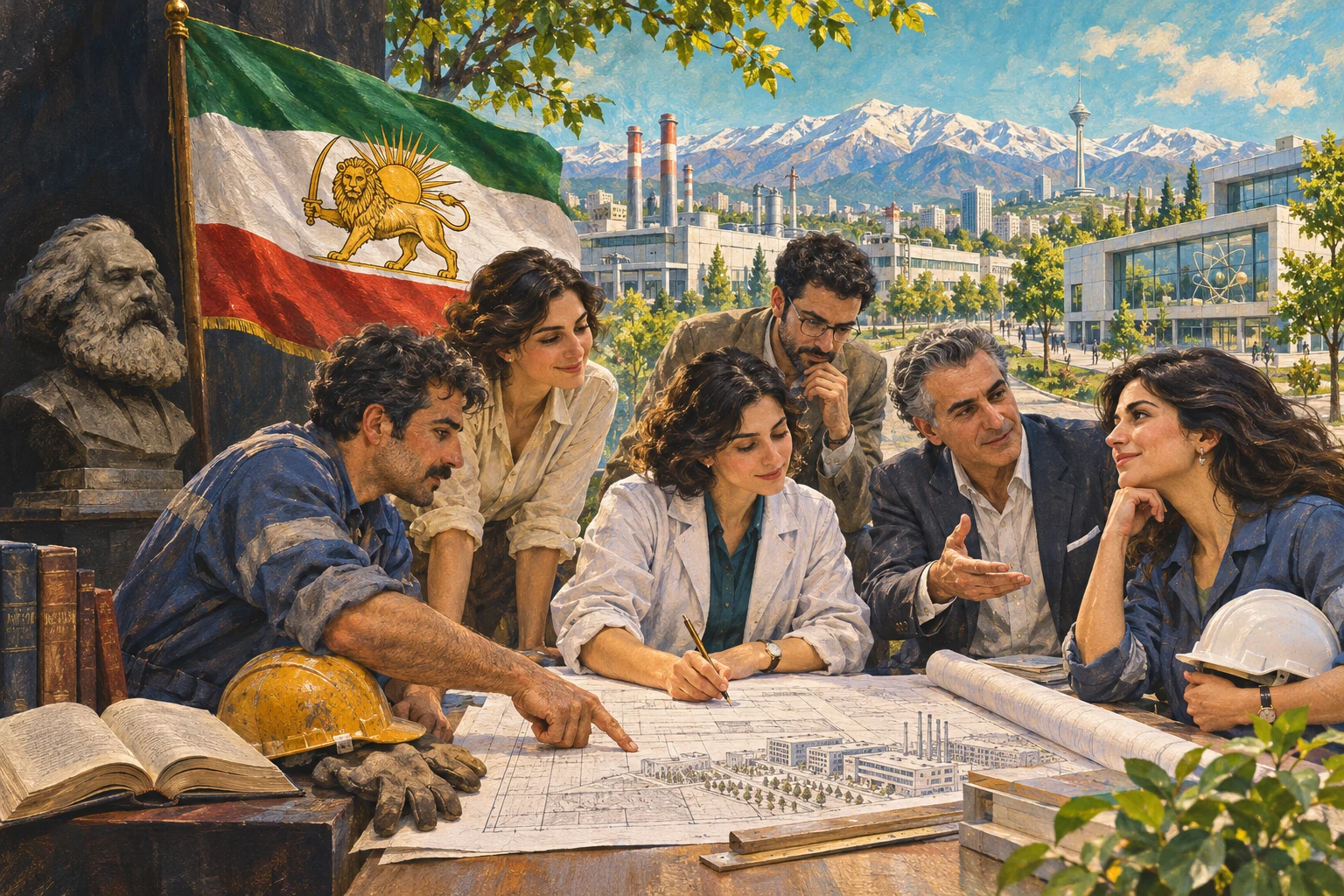
This is an authored political essay, developed from the author’s dictation. It presents his case for national reconstruction and constitutional monarchy while distinguishing political judgement from documented history. References were checked on 10 November 2026. The cover is a symbolic AI-generated illustration, not a historical photograph or an endorsement by a depicted historical figure.