Political essay
Induced Poverty
Poverty begins long before an empty wallet: it begins when people are denied the knowledge, tools, capital and freedom to build an independent life.
English article
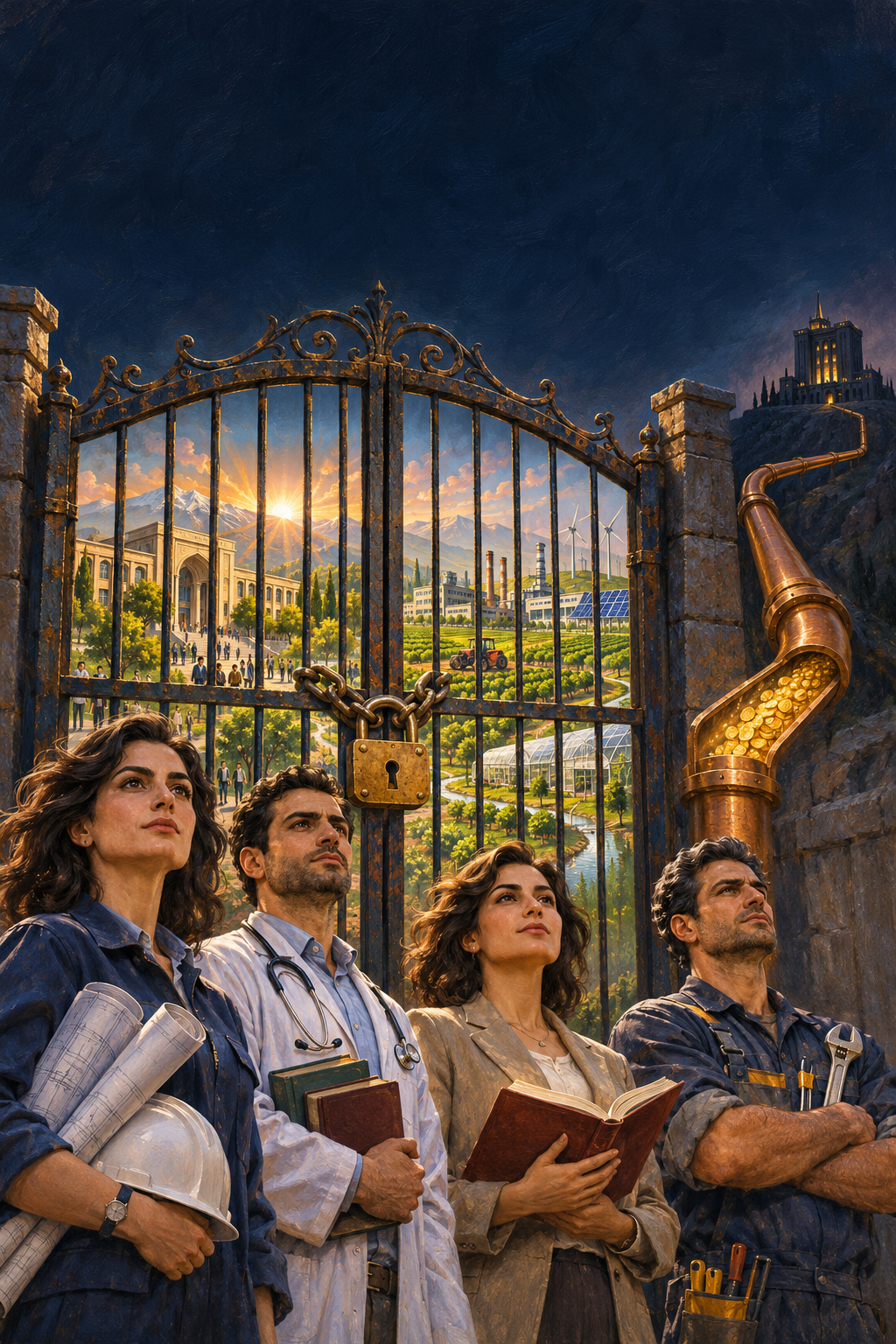
A nation can possess the resources to prosper while its people are denied the freedom to use them.
Poverty is usually described through what a person cannot afford: food, shelter, clothes, clean water, electricity or essential care. These are the immediate needs of life. When a family cannot meet them, the suffering is real and urgent. But if we want to understand why that family remains poor, we must look beyond the empty wallet.
How did the wallet become empty? What prevents it from being filled through useful work? Does the person lack education, tools, capital or access to a market? Or does the person possess knowledge and ability but live under a government that blocks the opportunity to use them?
These questions bring us to the distinction I want to make. Poverty can arise from severe scarcity. It can also be produced and prolonged by the organisation of power. I call the second condition induced poverty. In the Islamic Republic of Iran, I regard it as an essential part of the relationship between an ideological state and the citizens it seeks to control.
In my earlier study, Reconsidering Poverty, Class Inequality and Socialism in the Contemporary Era, I examined the difference between lacking income and lacking the means of production, opportunity and independence. In Liberation of the Resources, I described what becomes possible when the barriers around human ability are removed. This article examines the process that keeps those barriers in place.
1. The poverty we see, and the poverty that produces it
There are two related dimensions of poverty. The first is a shortage of the income, savings or material goods required for a decent life. The second is a shortage of effective access to the resources through which a person can sustain that life: knowledge, skills, health, tools, land, capital, energy, information, customers and enforceable rights.
A person may receive money from employment, a business, an inheritance, a pension or public support. That money meets today's needs. The ability to earn, save, learn and plan determines much of tomorrow's security. Someone can therefore be helped out of immediate hunger while remaining trapped in a structure that offers no realistic route towards independence.
International measurement already recognises part of this wider picture. The World Bank's Multidimensional Poverty Measure considers education and basic infrastructure alongside monetary deprivation. My concern goes further into the political conditions that determine whether people can put their abilities to work. [1]
Consider a trained mechanic who cannot obtain a workshop, affordable equipment or a fair licence. Consider a scientist who can conduct useful research but cannot obtain an appointment without demonstrating ideological loyalty. Their capacities exist. The means of turning those capacities into a livelihood have been withheld.
Induced poverty is deprivation created or prolonged when those in power restrict people's access to the knowledge, tools, capital, institutions and freedoms through which they could build a secure and independent life.
2. The tools that turn ability into a livelihood
Take a fisherman who knows the sea but cannot afford a boat. Giving his family food may be necessary today. Helping him acquire a suitable boat can change what becomes possible tomorrow. Yet even that requires more thought. He needs access to the water, somewhere to land his catch, refrigeration, insurance and customers. If an official can withdraw his permission at will, his independence remains fragile. One missing link can leave all the others useless.
A tailor faces a similar problem. A sewing machine, a dependable electricity supply and a small workspace can give skill a productive outlet. The tailor must also be free to choose designs, reach customers and receive payment. A graduate needs the equivalent foundations: reliable information, a fair appointment process, colleagues, equipment and room to develop. These are ordinary examples of how ability becomes income. They show why handing out money alone cannot repair a system that keeps closing the routes through which people could earn it.
We should ask what prevents each person from moving forward. Sometimes the answer is training. Sometimes it is transport, childcare, an affordable tool or access to a bank account. Sometimes the obstacle is a monopoly that controls the market. A useful government listens closely enough to distinguish these situations. It then makes the necessary public services and fair rules available, allowing people to decide what they can do with them.
There must also be room for an honest attempt to fail. Somebody who opens a small business may make a mistake, lose a customer or discover that demand is weaker than expected. Clear bankruptcy rules and a chance to begin again allow people to take manageable risks. Permanent humiliation or arbitrary punishment teaches them to remain passive. The country then loses ventures that might have succeeded because people never dared to start them.
This is the practical meaning of productive freedom. It gives a person a route from knowledge to work, from work to income, and from income to a more secure life. A nation becomes wealthier when many such routes remain open.
3. Natural scarcity and induced poverty
By natural poverty, I mean hardship rooted in severe physical constraints: inadequate water, difficult geography, a destructive earthquake or a limited initial stock of productive resources. A community may need roads, reliable electricity, schools and investment before its people can produce enough to live well. These are practical problems requiring knowledge, cooperation and resources.
The distinction concerns the origin of the obstacle. A shortage of rainfall is a physical constraint. Refusing an irrigation project because its qualified engineer is politically unacceptable is an institutional choice. Illiteracy and poor infrastructure may be inherited disadvantages; whether a government overcomes or perpetuates them depends on its priorities.
| Question | Poverty arising from scarcity | Induced poverty |
|---|---|---|
| What is missing? | Essential physical resources or productive capacity. | Fair access to existing or attainable resources and opportunities. |
| What blocks improvement? | Constraints such as drought, remoteness or destroyed infrastructure. | Discrimination, political gatekeeping, protected monopolies and coercive dependence. |
| What would help? | Education, infrastructure, technology, investment and practical cooperation. | Equal rights, accountable institutions and the removal of barriers to productive work. |
These conditions can exist together. The responsibility of government is to reduce hardship and enlarge people's options. When officials protect obstacles because those obstacles preserve their authority, poverty becomes politically useful. It is this use of poverty that I am criticising.
Iran's resources include far more than the oil and gas beneath its land. They include the people who could design a water system, teach a child, repair a machine, establish a company or develop a treatment. The question is who is allowed to contribute, on what terms, and for whose benefit.
4. When ability is subjected to an ideological interview
I know something of this from my own life. I grew up taking education seriously, competed at national level in mathematics and physics Olympiads, and studied medicine in Shiraz. I came from a modern, progressive family without an anchor in the Islamic Republic's political structure. I experienced the discrimination that follows when a family's independence counts against a person's prospects.
I wanted my knowledge and work to speak for me. Under an ideological system, other questions enter the room. Is your family connected? Do you display the required beliefs? Can you be trusted to repeat the correct language? A professional interview becomes an examination of political acceptability.
This problem has a documented institutional basis. In 2013, the United Nations Committee on Economic, Social and Cultural Rights identified the gozinesh selection process as an obstacle to equal employment opportunity for minorities and laypersons in public employment and state-funded organisations. It called for employment to be freed from conditions based on political opinion or religious affiliation. [2]
The economic damage extends beyond the rejected applicant. A hospital loses a capable clinician. A university loses a researcher. A public service appoints someone whose strongest qualification may be obedience. The person who remains learns to be careful, while the person who leaves takes years of education elsewhere.
When an Iranian can make a productive life abroad after being obstructed at home, we should examine what changed around that person. The rules, the opportunities and the freedom to work may have changed far more than the person's intelligence or determination.
5. Privilege is the other side of exclusion
Discrimination always has a beneficiary. If an appointment is closed to an independent applicant, it becomes available to somebody considered more dependable by those in power. If a contract depends on political access, the connected firm gains an advantage before the quality of its work has even been examined.
The citizen watching this process receives a lesson: competence may help, but proximity to power can matter more. Some people respond by displaying beliefs they do not hold. Others withdraw, leave the country or accept a smaller life. A system that rewards imitation of loyalty teaches people to conceal themselves.
Iran's para-governmental foundations, known as bonyads, have long raised questions about economic power and accountability. Ali Saeidi's study of these institutions examined how they strengthened the financial authority of religious leadership while weakening accountability and reform. That analysis remains useful for understanding the institutional roots of the problem. [3]
I see an oligarchic arrangement in which public authority and economic privilege reinforce one another. Wealth can accumulate within the protected circle while ordinary citizens are lectured about sacrifice. An independent entrepreneur has to satisfy customers and survive competition. An enterprise protected by power can seek favours from the same authority that controls its competitors.
This arrangement gives the rulers a reason to fear prosperity outside their control. An independent employer, professional association or prosperous household can acquire the confidence to ask questions. Economic independence makes obedience less certain. Induced poverty helps preserve a relationship in which the citizen must keep asking for permission.
6. The loss of savings, time and confidence
Induced poverty can develop quietly in a household that still appears to be managing. The parents continue working. The children continue going to school. Bills are paid, although with increasing difficulty. Then the savings intended for a home, further education or an emergency begin to disappear. The family works harder while the distance to its ambitions grows. A life can become smaller long before anybody describes that household as poor.
Inflation is especially destructive in this way. A wage or pension arrives as a number, but what matters is what that number can buy. When prices rise faster than income, previous effort loses value. A family that has carefully saved may discover that the deposit for a home has moved further away. Planning gives way to constant adjustment. The people with assets or privileged financial access may be better placed to protect themselves, while those living from one payment to the next have little room to move.
There is also a poverty of time. Every unnecessary queue, repeated application, arbitrary refusal and broken connection consumes hours that could have been spent learning, caring or producing. Consider a small business owner who spends a day finding someone able to resolve a payment problem. The work remains unfinished, a customer waits and tomorrow begins with another burden. These losses rarely appear in a political speech, yet they accumulate across ordinary lives.
Over time, uncertainty changes behaviour. People postpone an investment, a marriage, a course of study or a decision to have a child. They become reluctant to trust a promise because experience has taught them how easily circumstances can change. Rebuilding that confidence requires dependable rules and institutions that keep their word. No speech about national greatness can substitute for a salary that retains its value, a contract that can be enforced or an application decided within a reasonable time.
Economic recovery must therefore reach the household calendar as well as the national accounts. People should be able to look beyond the next bill and make a credible plan for their own lives.
7. Knowledge exists, but access can be closed
In 2026, a young person can learn from lectures, books and scientific work produced across the world. A student in Iran should be able to exchange ideas with a student in Sweden, Britain, Israel or America. The possibilities are extraordinary. Yet an internet connection, a university place and the freedom to ask a question remain subject to political decisions.
During the United Nations Human Rights Council's January 2026 special session on Iran, UN officials described the near-total internet and telecommunications shutdown imposed from 8 January and called for it to end. A government can close a channel through which its people communicate, learn and work. [4]
Think of the ordinary consequences. A teacher cannot reach her students. A small business cannot speak to its customers. A researcher cannot exchange a document with a colleague. Each interruption consumes time, trust and opportunity. Knowledge somewhere in the world is of little practical use to a person who is prevented from reaching it.
In The Future of Education in Iran, I argued for an education that gives young people access to the evidence and the confidence to examine it. A country gains when a student develops an independent mind. An ideological state can regard the same development as a threat. That conflict reaches directly into the economy.
8. The abilities a country leaves unused
Whenever a woman is prevented from using her education or choosing her occupation, the loss spreads beyond her own income. Her family loses possibilities. Her profession loses a colleague. Her country loses work that she might have completed. To spend years educating a capable person and then restrict her freedom to contribute is an extraordinary waste of national effort.
Women's freedom belongs at the centre of economic reconstruction. Fair recruitment, safe workplaces, accessible childcare and equal treatment before the law have direct consequences for what a woman can do with her knowledge. She should be able to establish a business, develop a profession and organise her life with the same security that any citizen is entitled to expect. Her ambitions deserve to be taken seriously in their own right.
Young people face another form of waste when the years they should be using to develop are consumed by waiting. A degree may be followed by an endless search for an appointment, a connection or permission to progress. Talent needs practice. A researcher needs to investigate, a designer needs to create and a young doctor needs to learn from capable colleagues. Interrupted development cannot always be recovered simply by opening a door many years later.
Emigration carries part of this loss across a border. I know what it means to build a professional life outside Iran. The country that receives an educated Iranian may gain years of preparation for which another society has paid. Those who leave still carry their language, relationships and concern for Iran with them. Their contribution can return through teaching, investment, collaboration and shared experience when credible opportunities exist.
That return must be a partnership with the people who have remained. A specialist abroad should be able to work alongside a specialist inside Iran without either being treated as less Iranian. We need to connect the knowledge accumulated in different circumstances. Every barrier removed between them expands the country's capacity to rebuild.
9. Sanctions, scarcity and the people who can still get through
Sanctions impose real costs. Restrictions on trade and finance make transactions more difficult, raise uncertainty and narrow the opportunities available to businesses and households. Families experience these pressures through prices, employment and the difficulty of planning a future. Their hardship should never be reduced to an argument between governments.
The World Bank's October 2026 assessment describes conflict compounding Iran's existing weaknesses in investment, productivity, infrastructure and finance. It also identifies the importance of restoring trade and financial links. The economy's difficulties have several interacting causes; the government's responsibility includes the domestic institutions and choices that make those difficulties harder to escape. [5]
The costs are also distributed unequally. Someone with privileged access to an intermediary, a foreign company or a protected financial channel operates in a different world from a small business owner whose payment has been blocked. Scarcity creates a price for access. Those able to provide that access can find a profitable position within an otherwise damaging system.
In April 2026, the US Treasury described shadow banking networks through which Iranian state and military interests, including the IRGC, could receive oil payments and use international financial channels. Its shipping advisory also describes concealed ownership, false documentation and ship-to-ship transfers used to obscure Iranian oil movements. These are the mechanisms identified in official US sanctions actions and guidance. [6, 7]
My conclusion is that some intermediaries can profit from navigating restrictions while much of the country becomes poorer. They may have an interest in preserving their privileged role. The national loss and an insider's gain can occur at the same time.
The Islamic Republic presents sanctions as an explanation that should settle every question. I refuse to accept that escape from responsibility. Foreign restrictions do not require ideological recruitment, closed accounts or the exclusion of independent expertise. Officials still decide who receives a position, which activity is protected and whether citizens may challenge the decision.
10. How suffering becomes useful to an ideology
The language of the oppressed can express an honourable commitment to helping people. Under the Islamic Republic, I believe it has also become a means of preserving power. The suffering citizen is presented as evidence of the wickedness of foreign enemies, while the institutions governing that citizen demand protection from criticism.
The system's international ideological mission appears in its own constitution. The preamble provides for the continuation of the revolution beyond Iran and gives the armed forces an ideological role extending beyond the defence of national borders. Article 5 places leadership within a framework of the occultation and anticipated return of the Imam. These are political foundations with consequences for the allocation of power. [8]
My objection is to the priority that follows when a revolutionary or apocalyptic mission governs the present. A family needs affordable food this week. A young graduate needs a future within her lifetime. Their needs can always be postponed by rulers who invoke a struggle without an end date.
Martyrdom then offers an especially dangerous political language. The death of a young person can be presented as proof that the cause must continue. The suffering caused by that continuation produces the next appeal for loyalty. Survival of the mission becomes the measure by which human lives are judged.
I reject that measure. As a surgeon, I want a person to survive, recover function, return to a family and live with dignity. A child should grow up. A worker should come home. A government should be ashamed of preventable suffering and determined to reduce it.
There is a revealing inequality in a system that asks ordinary people to endure deprivation while protected institutions accumulate resources. The sacrifice is demanded from one part of society and administered by another. I regard the maintenance of that arrangement as induced poverty, even when it is surrounded by the language of justice.
11. The export of victimhood
The same argument is directed abroad. The Islamic Republic presents itself as a victim of America, Israel and the West, then asks the world to treat support for its power as solidarity with the Iranian people. The distinction between a population and its rulers disappears at the very moment it matters most.
A foreign observer may be moved by images of hardship and still fail to ask who restricts employment, who controls information and who decides the country's priorities. This is how sympathy for people can be recruited to defend the institutions that obstruct them.
I am particularly critical of those on the Western left who treat hostility towards America as sufficient proof of progressive politics. Anyone who excuses clerical domination, ideological discrimination and repression on that basis has abandoned the people whose freedom they claim to support. When I use the expression useful idiots, I mean the political role performed by people who allow their own convictions to become cover for somebody else's authoritarian power.
The suffering of Palestinians should be judged by the same human standard. Iranian support for regional armed groups is among the activities described in the US Treasury's account of the regime's financial networks. My criticism is that the politics of permanent confrontation can turn grief into propaganda and every new tragedy into a reason to perpetuate the struggle. [6]
A Palestinian child's death is a human catastrophe to prevent. So is the death of an Israeli child or an Iranian child. The test of concern is whether it helps keep children alive and gives their families a future. No clerical establishment should acquire moral authority by displaying suffering while promoting a politics that keeps people trapped within it.
12. The Iranian people are larger than their government
The Iran I know contains educated, ambitious and outward-looking people who want to work, travel, create, love and enjoy their lives. I meet Iranians who want friendship with Americans, Europeans and Israelis, who see cooperation as a source of possibility. Their hopes are poorly represented by the hostility spoken in their name.
Iranian identity reaches far beyond the Islamic Republic. For me, the Zoroastrian ethical inheritance of good thoughts, good words and good deeds expresses an enduring part of the Iranian spirit. It directs attention towards the quality of our thinking, the honesty of our speech and the consequences of our actions. [9]
I want that ethic to have practical meaning. Good thought should help a doctor make a sound decision. Good words should allow a citizen to tell the truth without fear. Good deeds should leave a school, a home, a business or another person's life better than it was before.
Iranians should have the freedom to live by their own convictions. The state should have no authority to turn private faith, family background or a refusal to perform ideological loyalty into a barrier to livelihood. Citizenship must give each person a secure place from which to build.
13. Recovery, disability and the right to a decent life
My work as a trauma surgeon makes this question very concrete. Saving a limb or repairing a fracture can be one stage in a much longer recovery. The person may still need rehabilitation, pain treatment, a prosthesis, accessible transport or changes to the home. A successful operation can be followed by years of exclusion if the services that make ordinary life possible are missing.
Consider a worker whose injury makes climbing stairs difficult. Treatment may restore enough function to work, but the workplace remains inaccessible and transport is unreliable. The person's remaining ability has little opportunity to find an outlet. Reasonable adjustments, rehabilitation and a supported return to employment can make a considerable difference. Poverty in such a situation is shaped by the environment around the injury as well as the injury itself.
Families can also be drawn into deprivation when care falls entirely on them. Somebody reduces working hours to help an injured relative; income falls just as additional expenses arrive. Support for carers, suitable housing and dependable community services help protect the whole household. These are part of the infrastructure of a functioning society, as necessary to many families as a road or an electricity supply.
Some people will always need substantial assistance. Their right to food, housing, treatment and companionship stands independently of what they can earn. A humane society accepts that responsibility without requiring a performance of gratitude or political loyalty. It also recognises the preferences and decisions of the person receiving care. Dependence on assistance should never give an institution ownership of somebody's conscience.
This is why the liberation of resources must include the freedom to receive help with dignity. A person should have the support to develop whatever independence is possible, and security where independence has limits. I want a future Iran in which surviving an illness or injury is followed by a serious effort to restore a life.
14. Reconstruction must reach the citizen
Ending the present system's control over opportunity creates an enormous responsibility. Public assets, contracts and appointments must be handled in a way that ordinary Iranians can examine. Otherwise, the people closest to a new administration may inherit advantages previously enjoyed by the old circle. The names change while the citizen continues waiting outside.
Before major public enterprises are sold or reorganised, their assets, debts and ownership should be established through credible scrutiny. Buyers and decision-makers should disclose their interests. A business should win a public contract through an open process whose result can be challenged. Courts, auditors and journalists need the independence to investigate uncomfortable questions, including questions about people who supported the transition.
The first months would also require attention to the necessities that keep society functioning. Families need food and medicine. Hospitals need supplies, workers need wages and pensioners need dependable payments. Maintaining these services while reform proceeds helps give people confidence that political freedom will improve the conditions of life. Any changes to subsidies or other support must be planned around the households that rely on them, with protection available when it is needed.
We should measure progress in ways that people can recognise. Can a qualified applicant obtain a fair hearing? Can a new firm enter a market without a patron? Can a patient obtain rehabilitation? Are wages retaining their value? Can a young person study and work without being asked to imitate somebody else's beliefs? Published information about these questions would allow citizens to judge performance and demand improvement.
This discipline also applies to those of us who support Crown Prince Reza Pahlavi. Our support should help assemble the knowledge, trust and practical organisation that reconstruction requires. Capable people must have a place even when they disagree about the final constitutional arrangement. Iran will need their work, and its citizens will need institutions strong enough to protect disagreement. That is the foundation on which the resources of a nation can serve the lives of its people.
15. Release the resources and let people live
My answer to induced poverty is the liberation of resources. Give people access to the tools of independence and protect their right to use them. The objective is an economy in which knowledge, productive work and useful cooperation determine opportunity.
Start with recruitment and education. End ideological tests for university places, professional appointments and public employment. Publish the criteria, assess competence and allow an independent appeal. A qualified applicant should be able to understand why a decision was made and challenge it without risking a livelihood.
Open the economy to fair participation. Protect lawful property, make contracts enforceable and disclose who receives public money. Put foundations, state enterprises and private firms under credible standards of accounting and scrutiny. Give a new business a chance to compete without first finding a political patron.
Build the shared foundations: reliable water and electricity, transport, digital access, schools and healthcare. Make it possible for a person with little inherited wealth to acquire skills and equipment. A worker should have a fair wage and the freedom to organise; an entrepreneur should have a fair opportunity to establish and expand a business.
Social protection belongs within that future. Illness, disability, childhood, unemployment and old age can make support essential. A decent welfare system provides it as an entitlement governed by fair rules. The recipient's dignity must never depend on a public declaration of loyalty. The ambition is security with freedom, including for those who will always need care.
Restore useful relations with the world. Let Iranian scientists collaborate, companies trade and families form friendships. Let the diaspora contribute knowledge and capital through arrangements that respect the people working inside Iran. Judge diplomacy by the safety and opportunity it creates for citizens.
This is the future I associate with secular democracy, constitutional monarchy and my support for Crown Prince Reza Pahlavi. The Lion and Sun must stand for a country in which an Iranian can study, work, own, question and prosper without belonging to an approved ideological circle.
A government that genuinely wishes to overcome poverty should welcome the day when fewer citizens depend on its favour. It should be able to measure success in households that are more secure, professionals who can work freely and young people who can imagine a future at home.
Iran's people have lives to live and a country to build. Their abilities deserve room to grow. Remove the discrimination, dismantle the privilege, open the doors to knowledge and allow the resources of the nation to serve its citizens. That is how we begin to end induced poverty.
Sources
- World Bank. Update to the Multidimensional Poverty Measure: What’s New. 30 September 2026; disclosed 1 October 2026. Monetary deprivation, education and basic infrastructure.
- UN Committee on Economic, Social and Cultural Rights. Concluding observations on Iran, E/C.12/IRN/CO/2. 10 June 2013, paragraph 12. Ideological selection and equal employment opportunity.
- Saeidi, A. A. The accountability of para-governmental organizations (bonyads): The case of Iranian foundations. Iranian Studies, 37(3), 479-498, September 2004. Institutional analysis of financial authority and accountability.
- United Nations Office at Geneva. Human Rights Council special session on Iran: resolution and statements. 23 January 2026. UN officials' accounts of the internet and telecommunications shutdown.
- World Bank. Poverty & Equity Brief: Islamic Republic of Iran. October 2026. Conflict, structural vulnerabilities and the requirements for recovery.
- US Department of the Treasury. Economic Fury Targets Iran Shadow Banking Facilitators. 28 April 2026. Official sanctions designations and the Treasury's account of state and military financial networks.
- US Treasury, Office of Foreign Assets Control. Guidance for Shipping and Maritime Stakeholders on Detecting and Mitigating Iranian Oil Sanctions Evasion. 16 April 2025. Shipping practices and concealed transactions.
- Constitution of the Islamic Republic of Iran. Preamble and Article 5; English translation hosted by the Iran Human Rights Documentation Center. The constitutional ideological framework is distinguished here from the author's judgement about its political consequences.
- Boyce, M. Humata Hūxta Huvaršta. Encyclopaedia Iranica, XII/5, 561-562. Published 15 December 2004; updated 13 May 2018. The Zoroastrian ethical triad of good thoughts, good words and good deeds.
Earlier writing by the author
This expanded edition develops arguments in the following works. The author’s archived essays and the published editions on this website informed the discussion of productive freedom, social protection, education and national reconstruction.
- Reconsidering Poverty, Class Inequality and Socialism in the Contemporary Era. August 2026; published web edition revised 13 October 2026.
- Liberation of the Resources. 10 November 2026.
- Mismanagement. 17 November 2026.
- The Future of Education in Iran. 18 November 2026.
- Pahlavism - Liberation or Obedience?. 19 November 2026.
- Pahlavism and Political Pragmatism. June 2026; author’s archive.