
Political essay
Mismanagement
Mr Peyman Bakhshayesh examines the human cost of ideology replacing competence, the demand for accountability in Abdanan, and the standards needed to rebuild Iran.
English article
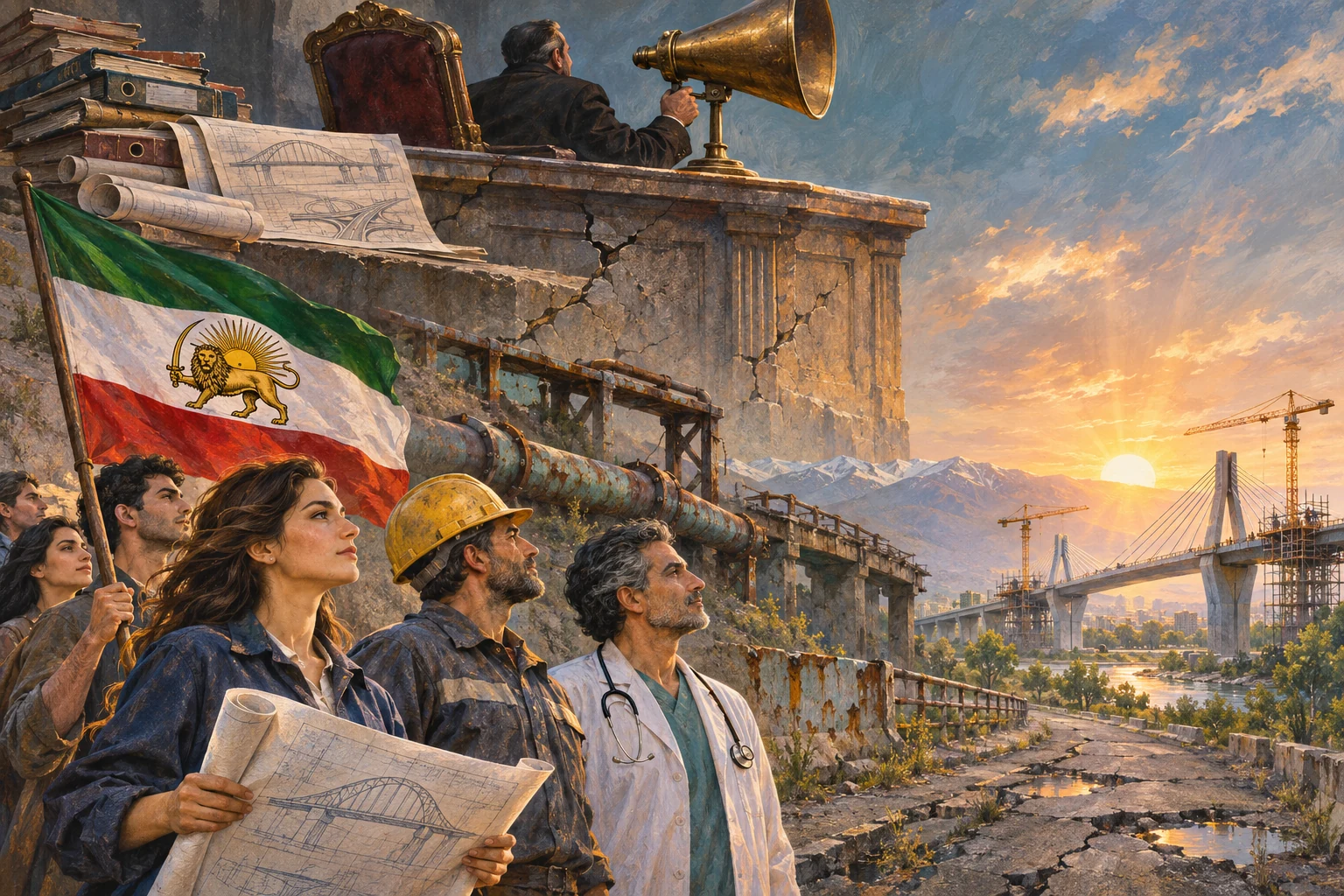
A government should be judged by the lives it improves, the dangers it prevents and the future it makes possible.
Iran’s tragedy is not a lack of resources, talent or ambition. It is a failure of government. The Islamic Republic has brought the country to a state of bankruptcy: an economy that exhausts its people, institutions that protect those in power, and a political system that has lost the ability to admit its mistakes.
A country can possess oil, gas, universities, doctors and engineers and still be badly governed. Wealth does not manage itself. Neither does a nation. Someone must make sensible decisions, appoint capable people, maintain roads, protect livelihoods and take responsibility when things go wrong. After forty-seven years, the rulers of Iran cannot keep behaving as though the condition of the country has nothing to do with them.
Ordinary Iranians pay the price every day. They pay when their wages buy less, when opportunities disappear, when their children look abroad for a future, and when asking a reasonable question becomes a political risk. The IMF’s October 2026 outlook projects a severe economic contraction and extraordinarily high inflation in Iran. Iran Human Rights recorded at least 691 executions in the first ten months of the year. Behind these figures are lives, families and futures. [1][2]
1. United in destruction, unprepared to govern
In 1978 and 1979, forces with very different ambitions came together against the monarchy. For the clerical opposition, the Shah’s modernisation, Western orientation and expansion of women’s freedom threatened the order they wanted to preserve. For the revolutionary left, his government represented Western influence, imperialism and opposition to communism. They could agree that the existing order must go. They had no shared, workable answer to what should replace it.
The reforms of the Pahlavi period had changed the place of women in public life, including voting rights and family law. Iran was moving towards a modern society. Its opponents gathered their strength around bringing that order down. Once it fell, the Islamists consolidated power and turned against former allies. Leftists were imprisoned and suppressed; political prisoners, including members of leftist groups, were executed in their thousands in the 1988 massacres. [3][4][5]
This is the lesson I draw from that revolution: the ability to overthrow a government says very little about the ability to run a country. Anger can destroy an institution in a day. Building a competent institution takes years. Iran was handed to people whose ideological certainty was far greater than their willingness to accept responsibility for the consequences.
We have lived with those consequences ever since. Eight years of devastating war followed Iraq’s invasion in 1980. Repression, economic hardship and repeated confrontation consumed energy that should have gone into the country’s development. Iran needed a government devoted to helping its people live better. Instead, the survival of the ideological state became the overriding concern. [4]
2. A government that always has an excuse
What happens when ideology becomes more important than competence? The wrong people are appointed for the right political connections. Warnings are ignored because they are inconvenient. Experts learn that telling the truth may cost them their position. Eventually, the system hears only what it wants to hear.
The Islamic Republic places religious authority at the centre of government. Its constitution invokes the hereafter, the occultation of the Twelfth Imam and the unity of the Islamic world. These are part of the framework through which political power presents itself. [6]
My objection is straightforward. The people responsible for running a country must care about life in that country. They must care whether a mother can afford food, whether a child receives a proper education and whether a worker comes home safely. A promise about the afterlife cannot repair a dangerous road. Invoking a sacred mission cannot replace a functioning economy.
When rulers present suffering as a test of loyalty and confrontation as proof of their righteousness, failure becomes remarkably convenient. Mismanagement creates hardship. Hardship is blamed on enemies. The existence of those enemies is then used to justify more control, more propaganda and the continuation of the same policies.
That is the vicious circle. The country suffers, but the ideology acquires another excuse. The officials who should explain their decisions deliver another speech. The citizen who asks for an answer is treated as the problem.
3. Sanctions have become an alibi
Sanctions and conflict hurt an economy. They restrict trade, complicate banking and make life harder for ordinary families. The IMF’s regional assessment describes the damage that conflict and disrupted trade can inflict on production and prices. [7]
But the Islamic Republic uses external pressure as a complete explanation for its own failures. We are told, again and again, that the country would have prospered if only the United States and its allies had left the government alone.
That explanation asks us to forget who appoints the officials, who decides where public money goes, who suppresses criticism and who chooses the country’s diplomatic priorities. Sanctions do not appoint an incompetent manager. They do not require an official to ignore a maintenance report. They do not compel a government to reward loyalty while driving expertise out of public life.
Foreign policy is also a responsibility of government. A sensible administration tries to reduce unnecessary hostility and open opportunities for its people. If confrontation becomes a permanent identity, the costs eventually arrive in people’s homes. Families pay more, businesses have fewer opportunities, and young people see a narrower future.
After forty-seven years, “our enemies did this” is an exhausted answer. Governing means taking responsibility for what lies within your power and using that power to improve the lives of your citizens.
4. Abdanan and the human price of failure
The deaths of thirteen workers in a bus crash have brought these questions painfully into focus. The bus was carrying workers from the Dehloran oil and gas project when it overturned on 14 November 2026. The tragedy was followed by protests in Abdanan, with demands for resignations and accountability. [8][9][10]
These men had gone to work. Their families expected them home. A journey that should have been routine ended in funerals. For those families, the argument about governance is no longer abstract.
As a major trauma surgeon, I see an injury in the context of everything that happened before it and everything that follows it. Was the vehicle maintained? Was the road safe? Were working hours and transport arrangements sensible? Were concerns raised and acted upon? Was the emergency response adequate?
These are the questions a serious investigation must answer. The authorities have announced an investigation. The families deserve published findings, clear responsibility and changes that prevent the same tragedy happening again. A promise to investigate has value only when it produces answers and action.
When people protest after a tragedy, the government should hear their demand for care and accountability. It should understand why trust has been exhausted. A state that responds to grief chiefly as a threat to its authority reveals how far it has drifted from the people it is supposed to serve.
5. The Iranian people must not be forgotten
I find it deeply troubling to see the Islamic Republic’s flag raised at demonstrations in support of Palestinians. The Palestinian people need safety, dignity and a peaceful future. Their suffering should never become a means of granting moral authority to the rulers of Iran.
The Islamic Republic presents itself abroad as a champion of justice while denying justice at home. Its support for armed organisations across the region is documented. I see a government that has repeatedly used confrontation to strengthen its influence and sustain its political narrative. Iranian families are left to carry the costs. [11]
Anyone who chooses to support this government should also look at the people living under it. Listen to the workers, the grieving families and the citizens who want a different future. Supporting the Islamic Republic helps sustain a system against which those people are struggling. That choice has consequences.
Peace between Israelis and Palestinians would give families on both sides a chance to build a life. The Iranian people need the same freedom from permanent confrontation. Our region needs governments that can make peace and manage a future worth living.
6. Why people chant “Javid Shah”
Reports from Abdanan included the chant “Javid Shah”: “Long live the King.” I understand why that slogan carries such force. It expresses a desire to recover a national direction that was lost in 1979. [9]
For me, the Pahlavi name stands for the ambition to build a modern Iran: education, professional administration, women’s participation, national development and a country connected to the world. It represents a government whose task is to build the nation and whose attention belongs to Iran’s future.
That is why I support a secular democratic constitutional monarchy and a responsible transition under Crown Prince Reza Pahlavi. The country needs capable people in positions of responsibility. It needs law, order, professional institutions and a clear commitment to the welfare of the Iranian nation.
The Lion and Sun flag and the patriotic anthem “Ey Iran” speak to that sense of belonging. They remind us that Iran existed before this regime and will exist after it. The nation is larger than the ideology that has tried to speak in its name.
The Islamic Republic repeatedly places its ideological mission and its claim to leadership of the ummah ahead of its obligations to Iranians. I want a government that starts with the country entrusted to its care: its people, its land, its resources and its future.
7. How do we recognise mismanagement?
We should judge a government by what happens to people under its rule. Are families becoming more secure? Can young people find worthwhile work? Are public services improving? Do appointments go to people who can do the job? Can a professional raise a concern without fear?
When ideology matters more than people’s livelihoods, something has gone badly wrong. When loyalty matters more than ability, failure becomes predictable. When education demands conformity instead of encouraging knowledge and independent thought, the country begins to waste its own future.
| Area | Warning sign | What accountability requires |
|---|---|---|
| Livelihoods | Declining purchasing power is met with slogans and denial. | Publish credible figures on inflation, real wages, poverty and employment; explain corrective policy. |
| Public safety | Warnings are ignored and failures recur without learning. | Independent investigations, maintenance records and evidence that recommendations are implemented. |
| Appointments | Ideological loyalty protects people who cannot do the job. | Transparent selection based on competence, experience and performance. |
| Education | Political conformity restricts inquiry and professional independence. | Academic freedom, sound scientific teaching and assessment based on achievement. |
| Public money | Favoured institutions escape scrutiny while essential services deteriorate. | Auditable budgets, open procurement and enforcement against conflicts of interest. |
| Foreign relations | Confrontation becomes an end in itself, regardless of its cost. | Judge diplomacy by security, peaceful cooperation and opportunities for citizens. |
| Civil rights | Criticism is punished and failures are concealed. | Independent courts, a free press and protection for those reporting wrongdoing. |
| Correction | The same officials repeat the same failures without consequences. | Clear responsibility, published remedies and lawful replacement of those who fail. |
These are ordinary standards of competent management. Every hospital, business and public service needs people who know what they are doing, reliable information and a willingness to correct mistakes. A country needs those things on a much greater scale.
Iran already has the talent. Its doctors, engineers, teachers, scientists and entrepreneurs demonstrate that every day, inside the country and abroad. The tragedy is that so much of this ability is obstructed, pushed aside or lost to emigration. A country should make room for its capable people.
8. Taking responsibility for Iran’s future
Mismanagement is the thread connecting so much of Iran’s suffering. It runs through the economy, public safety, education, foreign policy and the way people are selected for positions of power. It becomes entrenched when those responsible can always blame someone else.
Replacing this system must therefore mean more than replacing its slogans. We need people prepared to manage: people who understand institutions, respect expertise, listen to criticism and accept responsibility for results. We need a clear commitment to keeping services running, rebuilding the economy and restoring confidence in public life.
That is the responsibility of our movement as well. The Lion and Sun must stand for the work of national reconstruction. Support for Crown Prince Reza Pahlavi should bring capable people together around a practical future for Iran.
A nation is not a waiting room for the afterlife. Its people have one life to live, children to raise and a country to build. They deserve a government that takes those responsibilities seriously.
Iran deserves to be governed by people who care about the Iranian nation and know how to manage its affairs. After forty-seven years of excuses, that is the change I want to see.
Sources and related writing
- International Monetary Fund. World Economic Outlook: Resilience Under Strain, Urgent Choices, October 2026. Annex Table 1.1.4. Forecasts for Iran.
- Iran Human Rights. At Least 77 Executed in October; 691 Executions Recorded in 2026, 3 November 2026. Documented minimum, not a complete official total.
- Encyclopaedia Iranica. Feminist Movements iii. In the Pahlavi Period. Historical account of women’s organisation, reforms and their limitations.
- Encyclopaedia Iranica. Hostage Crisis. Sections on the aftermath, consolidation of clerical power, suppression of former allies and the Iran–Iraq War.
- Amnesty International. Iran committing crimes against humanity by concealing fate of thousands of slaughtered political dissidents, 4 December 2018. Findings from Blood-soaked Secrets.
- Iran Human Rights Documentation Center. The Constitution of the Islamic Republic of Iran. English translation; Articles 2–5 and 11.
- International Monetary Fund. Steering Through Uncertainty: Strengthening Resilience in Challenging Times, Regional Economic Outlook, October 2026. Regional conflict, trade disruption and inflation.
- Hana Human Rights Organization. Death Toll From Bus Crash Involving Dehloran NGL Project Workers Rises to 13, 16 November 2026.
- Iran International. Protesters take to streets in western Iran after 13 oil workers die, 17 November 2026. Reporting on footage and slogans.
- Asharq Al-Awsat. Hundreds Protest in Western Iran Over Deadly Bus Crash, 17 November 2026. Local reports and the prosecutor’s stated investigation.
- UK Government. Government Response to the Intelligence and Security Committee of Parliament Report “IRAN”, 4 September 2025. Includes assessments of regime survival and support for regional armed organisations; the underlying inquiry gathered evidence through August 2023.