Political essay
Cohesion Factor
Crown Prince Reza Pahlavi, equal citizenship and the shared work of bringing Iranians together for a secular democratic future.
English article
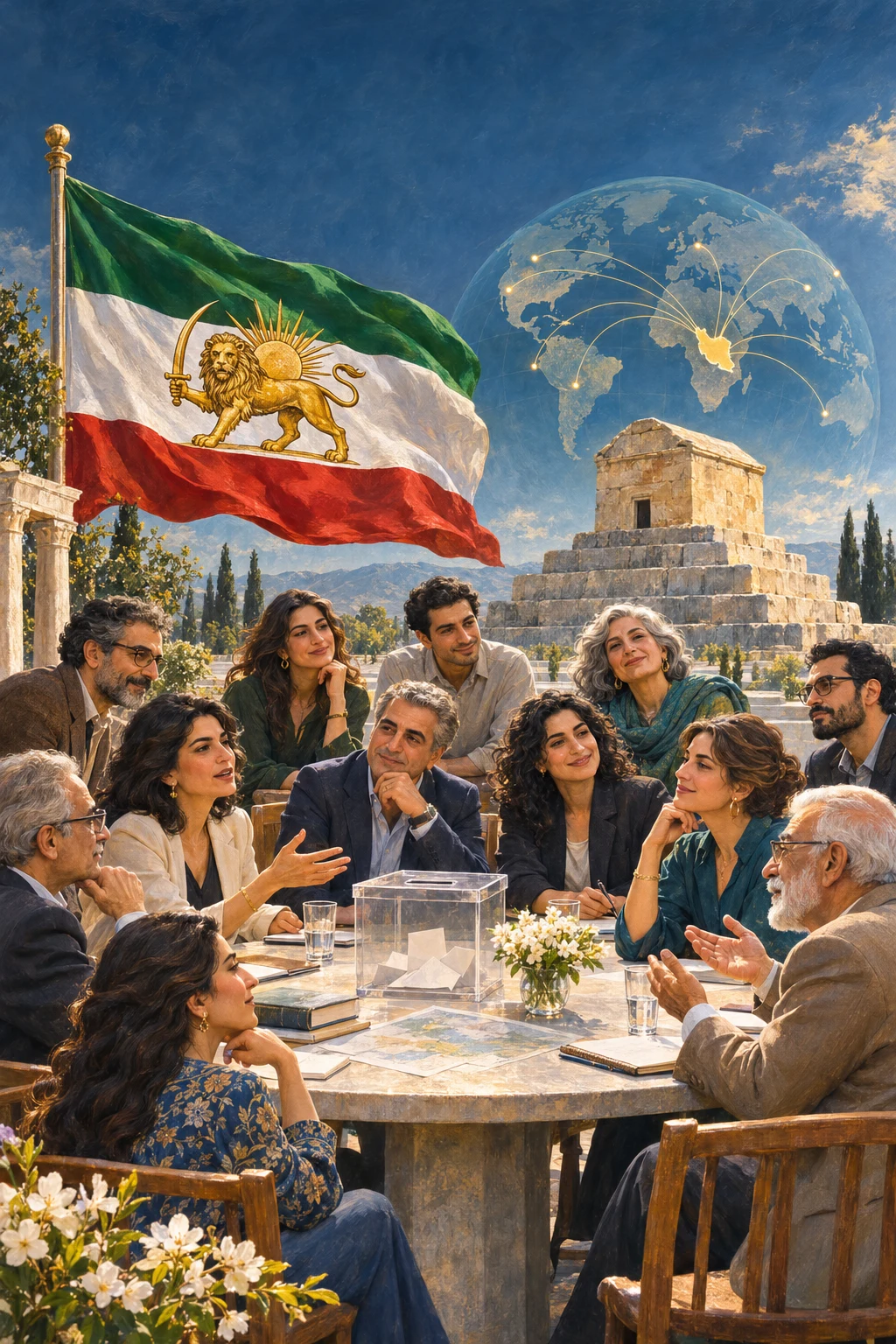
For forty-seven years, Iranians have carried an extraordinary amount of suffering, knowledge, courage and unrealised ability. Those inside Iran have lived with the consequences of an ideological state. Those abroad have built lives across continents while carrying memories, family ties and hopes that distance has never erased. Yet our strengths have too often remained separated. We recognise the pain, recognise the failures of the Islamic Republic and recognise the need for change, but struggle to act together with the consistency that a national undertaking requires.
In my view, one of our deepest political failures has been the absence of a dependable cohesion factor: a shared centre around which different Iranians can organise their efforts without surrendering their minds. Repression, control of resources and the machinery of the state help explain the Islamic Republic’s endurance. Our fragmentation has nevertheless weakened the force capable of challenging it and preparing a credible future. We cannot choose every external condition. We can take responsibility for how we treat one another and what we are prepared to build together.
The Islamic Republic has faced sanctions imposed through the United Nations, the European Union and the United States, alongside repeated international condemnation. [9][10] Yet external pressure has not, by itself, produced the free Iran we seek. To me, that is a reason to take our own organisation more seriously. A national movement needs the trust, shared purpose and practical preparation that can turn widespread dissatisfaction into a credible democratic alternative.
A scattered people need a shared destination
The revolution of 1979 and its aftermath scattered generations of Iranians across the world. Exile has taken different forms: escape from persecution, departure after disappointment, the search for education, work or a secure future for children. The diaspora contains people who left at different ages and under different circumstances. Their memories of Iran do not all belong to the same decade. Meanwhile, people living inside the country have continued to change under pressures that those abroad cannot fully experience from a distance.
This separation is psychological as well as geographical. One person speaks from the memory of a lost homeland; another speaks from the daily struggle to pay rent, obtain medicine or protect a child. Even when both want freedom, they may hear each other badly. Years of suspicion can turn a difference in language into an accusation about loyalty. We then spend our strength explaining why another Iranian cannot be trusted instead of discovering what we could accomplish together.
A common enemy can bring people into the same street. A common destination gives them a reason to remain together afterwards. Opposition to the Islamic Republic, the Islamic Revolutionary Guard Corps (IRGC) and the Basij militia must therefore be joined to a convincing account of the country we intend to build. People need to know that their rights, dignity and place in Iran will survive the success of the movement they support. Cohesion begins when that promise becomes believable.
The injury of ideological citizenship
The political order established under Ayatollah Khomeini placed a particular religious interpretation at the centre of state authority. Iran’s constitution subjects legislation to Islamic criteria, assigns leadership during the Twelfth Imam’s occultation to a qualified jurist, and establishes Twelver Ja‘fari Shiism as the official religion. It formally recognises Jewish, Christian and Zoroastrian minorities, while Bahá’ís remain outside that recognised category. These distinctions are part of the institutional structure, with consequences beyond private religious belief. [1]
International human-rights bodies have repeatedly condemned repression and discrimination in Iran. UN findings address the treatment of religious and ethnic communities, including restrictions affecting recognised minorities as well as Bahá’ís and Sunni Muslims. The experiences of different communities are not identical, but the underlying political failure is familiar: citizenship has not provided everyone with a dependable guarantee of equal protection. [2] A person should not have to defend a religious identity, conceal a belief or prove ideological conformity to belong fully to the country of their birth.
A secular democratic Iran must repair that relationship. A Shia Muslim, Sunni Muslim, Jew, Christian, Bahá’í, Zoroastrian or non-believer must stand before the same law with the same civic dignity. An Iranian’s ethnic background, language, sex or political opinion must not determine the quality of their citizenship. Religious people belong within this freedom. Secular government protects their conscience alongside everyone else’s. The common foundation is the person’s equal standing, and that foundation must be stronger than any government’s preference.
Iranian identity has become a language of reunion
I see an answer emerging from the Iranian people themselves. Their attachment to Cyrus the Great, Pasargadae, Ferdowsi, the Shahnameh and the customs passed through Iranian families expresses a belonging deeper than the Islamic Republic’s ideological demands. No committee needed to invent that inheritance. People found it in language, poetry, history, celebrations and the places through which they recognise themselves. In my reading, this return to Iranian identity has become one of the strongest available foundations for national cohesion.
The message I hear is simple: we are Iranian people, with a history and a future of our own. Our country cannot be reduced to an instrument of a ruling ideology or absorbed into its political interpretation of the ummat. A citizen may feel religious solidarity beyond Iran’s borders and still insist that the Iranian state owes its first public duty to its citizens. No theological ambition should make an Iranian child’s freedom or welfare expendable.
This Iranian identity must have room for the whole country. Its strength grows when a Kurd, an Azerbaijani, an Arab, a Baluch, a Persian or a Turkmen can bring their language, memories and local attachments into the same national home. Historical pride should give us confidence to include one another. It should never become another examination in belonging. The practical meaning of loving Iran is accepting responsibility for the rights and future of the people who share it.
Crown Prince Reza Pahlavi as a national centre
This is where I see the importance of Crown Prince Reza Pahlavi. He connects a recognisable national inheritance with the possibility of a different future. In a fragmented political landscape, such a connection can help people recognise a common undertaking. I support his role as a cohesion factor because I want our scattered abilities to meet, acquire direction and become useful to Iran.
That role must remain broad enough to welcome people across democratic political traditions. It should not be captured by a party of the right, the far right, the left or any exclusive circle. The centre I mean is a national meeting place. People can arrive with different economic ideas and different constitutional preferences while accepting the same democratic rules. The Crown Prince’s value to that undertaking grows when people who disagree can still recognise that there is room for them around it.
His published principles support this understanding. In his address to the Dutch parliamentary foreign-affairs committee on 6 July 2026, Crown Prince Reza Pahlavi described a coalition crossing left and right, monarchists and republicans, religions and regions. He set out territorial integrity, equal rights and individual liberties, separation of religion and state, and the Iranian people’s freedom to choose their future government. These are commitments around which a broad democratic partnership can work. [5] Our responsibility is to understand their meaning and make our own conduct consistent with them.
Traditional and future-oriented Pahlavism
I distinguish between traditional Pahlavism and what I have called futuristic, or future-oriented, Pahlavism. These describe habits of political thought rather than fixed categories of people. Traditional Pahlavism can become preoccupied with defending the crown and every decision associated with the past. Its energy is directed towards proving that nothing was wrong. Future-oriented Pahlavism asks what we should carry forward, what we must improve and what kind of country today’s Iranians need.
I value the modernising ambition associated with the Pahlavi period. Education, professional competence, women’s participation, national confidence and engagement with the wider world remain central to the future I want. A serious attachment to that inheritance also requires honesty. Amnesty International’s contemporary 1976 account raised concerns about political detention, torture and inadequate trial protections. [3] Acknowledging such failures does not prevent us from recognising achievements. It allows us to state clearly which safeguards must be stronger in the future.
Historical judgement also needs context. Iran lived beside the Soviet Union during the Cold War, with Soviet influence, the Tudeh Party, revolutionary guerrilla movements and Islamist opposition shaping the political environment. Contemporary American assessments discussed Soviet support for Tudeh and the risks of infiltration. [4] Those pressures were real. So were differences within the opposition. Context helps us understand the choices of the period; constitutional principles help us decide what must govern our own choices now.
In Nation Building, I called this future-oriented ambition Pahlavi Plus: a modernising national inheritance strengthened by enforceable rights, democratic consent and institutions able to correct their mistakes. We do not honour Iran by insisting that it can never learn. We honour it by preparing a future worthy of what its people have learned.
Loyalty must make people stronger
Emotional attachment has a place in a national movement. People who have experienced humiliation, exile and loss need hope, symbols and a language of dignity. The problem begins when emotion becomes the only permitted form of participation. A supporter who asks a serious question should not be treated as disloyal. A capable person should not have to imitate the loudest voice in the room before being allowed to contribute.
Some supporters speak as though Crown Prince Reza Pahlavi must personally solve every difficulty, issue every instruction and supply every answer. This expectation burdens leadership while weakening the people around it. Iran cannot be rebuilt by a population waiting for orders. A modern nation needs citizens who can think, prepare, cooperate and accept responsibility. No leader can replace the knowledge distributed among millions of lives.
My argument in Pahlavism — Liberation or Obedience? was that national unity should release the capacity of free individuals. A doctor can prepare a healthcare proposal. An engineer can examine a water problem. A lawyer can help explain constitutional choices. A teacher can make difficult ideas accessible. They can coordinate their work without abandoning judgement. Support for the Crown Prince becomes more valuable when it produces such capability.
We should therefore judge loyalty partly by its consequences. Has it brought another Iranian into useful cooperation? Has it helped resolve a disagreement or complete a task? Has it strengthened confidence in a democratic future? Loyalty that drives capable people away diminishes the national centre it claims to defend.
Strong citizens, a strong nation and a constitutional crown
My preference is a constitutional parliamentary monarchy. I see value in a crown that represents historical continuity and national belonging while elected representatives and accountable ministers govern. Its dignity should rest on the confidence of free citizens. A strong king, in this understanding, is a respected constitutional figure within a strong nation whose institutions protect the people.
Japan offers a useful example of the distinction between symbolic continuity and governing power. Its constitution describes the Emperor as a symbol of the state and the unity of the people, deriving his position from popular will, and excludes powers of government from his role. [7] Iran would need its own constitutional settlement, shaped by Iranian circumstances. The lesson is that a deeply rooted national institution can coexist with democratic government when their responsibilities are clearly defined.
My reference to Israel concerns another aspect of nation building: the relationship between cultural continuity, a dispersed people and practical contribution to a common home. Israel has a parliamentary system with a president, not a monarchy. [8] Its society also contains serious differences. The useful question for Iranians is how attachment to a shared history can encourage education, scientific work, enterprise and cooperation across distances. We should learn from particular achievements without imagining that another nation offers a complete model to copy.
The direction I propose begins with strong citizens. Their knowledge and confidence strengthen the nation; a capable, accountable government serves that nation; a constitutional crown can embody its continuity. Each part gains legitimacy by respecting the others. Public institutions must remain answerable to law.
A coalition wide enough for Iran
The future of Iran needs the democratic left and right, liberals and conservatives, monarchists and republicans, organised parties and people who belong to none. It needs those concerned with women’s rights, workers’ security, enterprise, the environment and animal welfare. These interests will sometimes compete. That is precisely why we need parliamentary politics: a shared place in which competing proposals can be examined, negotiated and decided.
A republican who cooperates around a democratic transition need not promise to vote for monarchy. A constitutional monarchist need not conceal a preference for the crown. Both must protect the other’s right to campaign, organise and seek public support. Cooperation becomes credible when nobody fears that helping the common cause will later be used as evidence that they surrendered their own convictions.
The same generosity must extend across religion, ethnicity, class and geography. Territorial integrity gains strength when every region experiences the country as its own. Fair public services, local participation and respect for cultural life give national unity substance. A language of belonging should reach someone far from Tehran as naturally as it reaches a person in the capital.
The standards of this coalition should be clear: equal citizenship, secular government, Iran’s territorial integrity, human rights and peaceful democratic choice. Within that agreement, vigorous disagreement is healthy. The national centre has succeeded when people can remain different and still trust one another enough to build.
The ballot box must decide
A movement becomes democratic through the obligations it accepts before it holds power. We must be prepared to let citizens decide questions whose answers matter deeply to us. I want to make the case for constitutional monarchy openly and confidently. I also accept that the people must have a genuine choice. The right to choose has meaning only when the result has not been decided in advance by the strongest organisation or the most enthusiastic supporters.
The Iran Prosperity Project’s Emergency Phase Booklet, dated February 2026, offers a proposed transition framework. Its foreword describes a referendum on parliamentary monarchy or republic, an elected constituent assembly to draft a constitution, a referendum on that constitution and parliamentary elections. [6] It is a blueprint for discussion and preparation, not an enacted constitution belonging to one person. The constitution that ultimately binds Iran must acquire its authority through a legitimate national process.
Our task is to prepare for that process seriously. People need freedom to organise, reliable information, fair access to public debate and confidence that votes will be counted honestly. Rights must protect those who lose as well as those who win. Temporary authority needs defined responsibilities, public scrutiny and a credible route towards elected institutions.
Accepting the ballot box is a discipline that continues after the first vote. Governments change. Policies fail and require revision. Citizens withdraw support. A constitutional order must allow those changes without treating disagreement as an attack on the nation. That is how political cohesion becomes durable.
A common language between home and diaspora
The diaspora has much to offer Iran: professional experience, languages, research, investment, international relationships and familiarity with different institutions. People inside Iran possess knowledge that cannot be supplied from abroad. They understand daily conditions, local trust, practical barriers and the consequences of public decisions. The relationship between these strengths should be a partnership in which each side can learn.
That partnership begins with listening. Someone abroad should not mistake visibility for authority over people who carry greater immediate risks. Someone inside Iran should be able to draw on diaspora resources without being required to surrender independence. Cooperation must respect consent and protect private information. It should make room for people who can help quietly as well as those whose contribution is public.
In Common Language, I explored the work of understanding people beyond our own habits and experience. Political cohesion requires that effort every day. We should ask what another person means before deciding what kind of enemy they must be. We should be able to correct a factual mistake, admit that we misunderstood and revise an idea without humiliation.
A useful national vocabulary speaks of citizenship, responsibility, freedom, competence and shared work. It gives a young Iranian a reason to join the conversation. Insults and tests of personal devotion close that conversation. Every time we replace an accusation with a serious question, we make cooperation a little more possible.
Make cohesion visible in what we do
We should use every opportunity to make our cohesion factors practical. Cultural gatherings can introduce people who have never worked together. Professional networks can develop proposals around a defined need. Public discussions can bring democratic opponents into the same room. Support for survivors and families can demonstrate that national solidarity reaches people whose suffering is easily forgotten. The common centre becomes stronger when these activities help people trust one another.
Organisation matters. A group should agree on its purpose, divide responsibilities, keep clear records and explain what it has achieved. It should welcome competence wherever it finds it. A person who accepts a task should complete it or explain the difficulty honestly. These ordinary habits create the trust that slogans alone cannot provide. They also allow national leadership to draw on prepared work rather than repeated declarations of enthusiasm.
As a major trauma surgeon, I value coordinated responsibility: people need to know their role, share important information and speak when something requires attention. National life is far more diverse than a clinical team, but the value of competent cooperation is familiar. We should bring our education and experience into the national effort with the same seriousness we expect in our professional work.
Our progress should be visible in stronger relationships, useful projects, broader participation and better prepared institutions. The movement’s success cannot be measured only by how loudly supporters repeat a name. It must also be measured by how much confidence and capability they bring into the country’s future.
The responsibility to stay together
Iranian identity gives us a deep foundation of belonging. Equal citizenship gives that belonging a modern political meaning. Crown Prince Reza Pahlavi can provide a recognisable national centre around which these commitments are organised. Constitutional rules can protect their purpose through disagreement and change. These elements reinforce one another when we treat cohesion as a shared responsibility.
I ask fellow supporters of the Crown Prince to widen the circle. Bring capable people into the work. Listen to the democratic republican, the religious citizen, the young woman, the worker and the person whose experience differs from your own. Defend the principles you support through the way you behave. Read political proposals carefully, discuss them seriously and help make the path to a free vote credible.
We have spent too long allowing our differences to consume the strength we need for Iran. We can respect history, learn from its failures and move forward together. We can build a strong people, a strong nation, an accountable government and, if our citizens choose it, a respected constitutional crown.
We need to stand together and stay together. Our unity should give every Iranian more freedom to think, more confidence to contribute and a secure place in our shared future. That is the cohesion factor I believe Iran needs.
Sources
Sources checked 22 November 2026. Numbered notes support factual details; the political argument and proposed commitments are the author’s own.
- Constitution of the Islamic Republic of Iran, particularly Articles 4, 5, 12 and 13 UNHCR Refworld
- Situation of human rights in the Islamic Republic of Iran, A/RES/79/183 United Nations General Assembly
- Iran: Amnesty International Briefing, November 1976 Amnesty International
- National Intelligence Estimate, January 1953, Foreign Relations of the United States, Iran, document 152 United States Department of State, Office of the Historian
- Speech at the Foreign Affairs Committee of the Dutch House of Representatives, 6 July 2026 Official website of Crown Prince Reza Pahlavi
- Iran Prosperity Project: Emergency Phase Booklet, February 2026, foreword Iran Prosperity Project
- The Constitution of Japan, Articles 1 and 4 House of Councillors, National Diet of Japan
- Political Structure and Elections Israel Ministry of Foreign Affairs
- EU sanctions against Iran, including UN nuclear-related measures Council of the European Union
- Iran Sanctions US Department of the Treasury, Office of Foreign Assets Control