English translation · Historical and political essay
Wisdom in the Captivity of Ignorance — English Edition
The complete English translation of Peyman Bakhshayesh’s illustrated essay on Iranian wisdom, the freedom to act, and Iran’s history from the Achaemenids to the present. Includes 35 references.
English article
A review of Iran’s history from the Achaemenids to the present
English translation of the Persian edition dated 20 November 2026. Translation published on 22 November 2026. The original article’s time references and source citations have been retained.
I believe that Iranian wisdom has been held captive by ignorance for two thousand years. From the qanat builder who brought water to a village to the teacher who today does not dare answer a pupil’s question, the issue is the same: who has the authority to put what they know into practice?
Wisdom you can see in Shushtar
I was born in Abadan. When I think about Iran’s history, Shushtar is one of the first places that comes to mind. Anyone who channelled the Karun’s water towards a mill needed to understand the gradient of the waterway. If too much water was diverted in one direction, the farmer downstream paid the price. Today, we do not know many of those people’s names, but we can still stand beside the Karun and see the results of their judgement. This is what I call wisdom: knowing what you are doing and considering the consequences of your decisions for others. [1]
I believe that Iranian wisdom has been held captive by ignorance for two thousand years. I see this captivity in the distance between having knowledge and having the authority to act. In every period, there were people who offered the country a way forward. Sometimes they managed to build an observatory, open a school or bring water to a town. But how far did the future of that school or settlement depend on a ruler’s opinion, an official’s prejudice or the fear of asking questions? To understand these two thousand years, I want to begin further back, with the Achaemenids, who, to my mind, offer the clearest example in Iranian history of courage joined with wisdom.
The Achaemenids and the trust behind a seal
To me, a small clay tablet from the Persepolis Fortification Archive has as much to say as the columns themselves. Under Darius, a traveller setting out on official business could obtain provisions at the next station by presenting a sealed document. Whoever supplied the provisions recorded the quantity. The traveller did not have to prove afresh in every settlement who he was and why he was on the road. Usually, what we see of Achaemenid grandeur is what has survived. Behind those columns, however, there was also the ability to enable people with different languages and skills to trust one another’s work. [2]
People from different lands contributed to the art and architecture of that period. In my view, Achaemenid courage lay precisely in drawing on other people’s knowledge and putting it to work within a design they had chosen for themselves. We see the same connection between knowledge and organisation in the long tradition of the qanat. A qanat builder could carry water for kilometres underground along a very slight gradient. But if the villagers could not agree on their turns to use the water and the cost of clearing the channel, even the most skilled builder could not secure the village’s future. For me, the philosophy of civilisation begins here: people find a way to address a problem beyond the capacity of any one person, creating something on which the next generation can also rely. [3]
After Alexander, what were we able to rebuild?
With Alexander’s campaign in the fourth century BCE, the Achaemenid Empire collapsed. The Seleucids ruled a large part of its territory, while the Arsacids gradually recovered power from the east. At Nisa, one of the early Arsacid centres in present-day Turkmenistan, we see traces of Greek art alongside local traditions. What interests me is the choice recorded in these remains. People recovering their political authority could still learn from the art of those who had once ruled over them. Independence also requires this kind of self-confidence. [4][5]
From the third century CE, the Sasanians established a new state. An important part of Shushtar’s historic network of weirs, waterways and mills took shape during this period. Each mill depended on water arriving from elsewhere. I understand that dependence well, particularly when I hear people say that selling oil will make Iran prosper. The Karun was flowing before the mills existed. What brought bread to people was the knowledge they applied and the agreements they made with one another to maintain the waterways. [1]
After the conquest of Iran, what survived in Persian?
In the seventh century CE, Arab armies came to Iran. With the death of Yazdegerd III in 651, the Sasanian dynasty came to an end. The religious and linguistic transformation of society took centuries. Part of the Iranians’ resistance was invisible to any chronicler of military campaigns. A family celebrating Nowruz, a father choosing an Iranian name for his child, or someone telling a child a story in their own language preserved a thread between that child and those who had lived before. Generations later, in Samanid Bukhara, Rudaki wrote poetry in Persian. Ferdowsi entrusted this land’s history, legends and sorrow to a language in which we can still speak about fathers and sons, justice and injustice. [6][7][8]
When we speak of the “Islamic Golden Age”, I would like to pause for a moment at the bedside of one of Razi’s patients. Razi distinguished the signs of smallpox from those of measles and wrote down the differences so that the next physician could recognise them too. Ibn Sina wrote in Arabic for readers across different lands and composed the Daneshnameh-ye Ala’i in Persian. Biruni and Khwarazmi each added to what could be measured and understood. The name given to an age does not, by itself, tell us who did the painstaking work of observing and assessing. For me, that patient, and the physician who passed his observations to a colleague, provide a more precise starting point for identifying Iran’s contribution to the history of science. [9][8]
How did Khayyam and Tusi learn to trust an answer?
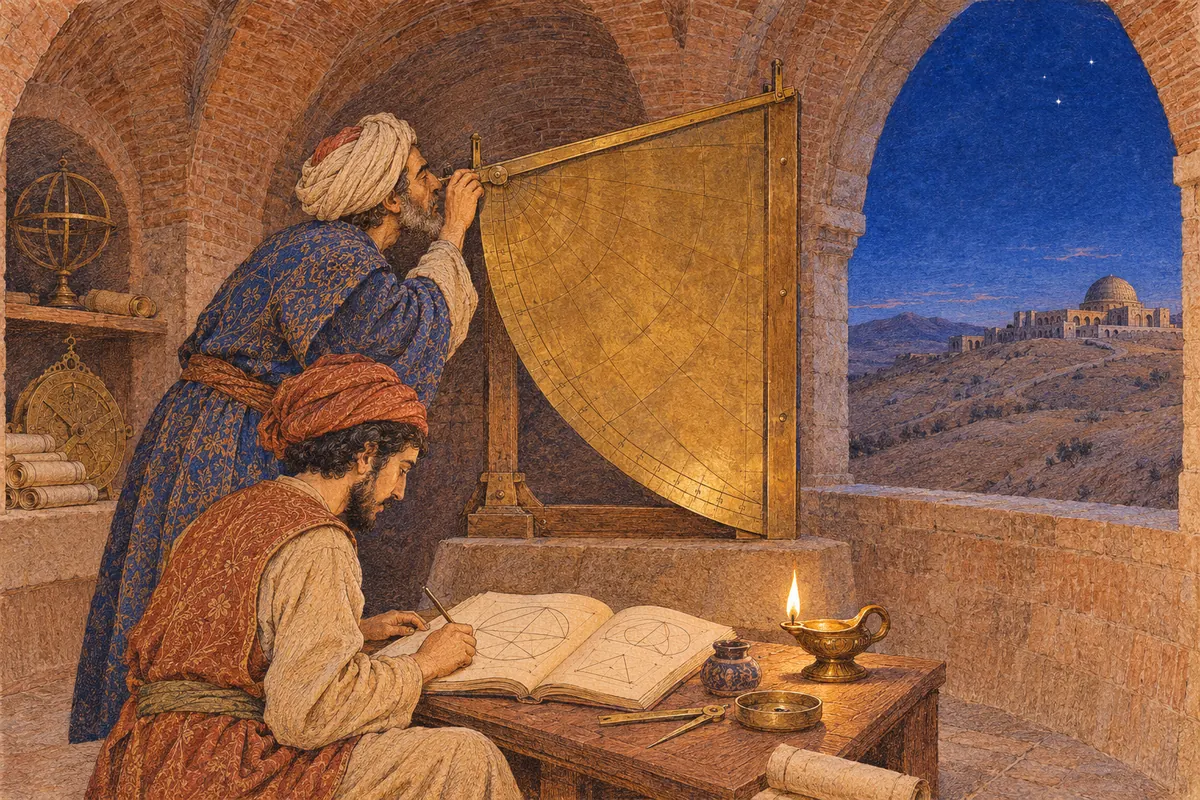
During the Seljuk period, Khayyam and his colleagues worked on reforming the calendar. They faced an apparently simple question: exactly which day marks the beginning of spring? The answer required observation, calculation and the opportunity to repeat both. After the devastation of the Mongol invasion, during the Ilkhanid period, Nasir al-Din Tusi began building the Maragha observatory in 1259. Mu’ayyad al-Din al-Urdi, an instrument maker and scholar from Damascus, worked with him on the project. Tusi’s genius alone was not enough to establish an observatory. Someone had to make precise instruments, someone had to cover the costs, and a group had to remain together long enough to compare tonight’s observations with those made a year later. [10][11]
In the Timurid period, too, calligraphers, painters and illuminators worked together on a single manuscript in the bookmaking workshops of Herat, in present-day Afghanistan. On one page, you can see the work of several hands without one having displaced another. This part of history is precious to the Iran of tomorrow. Today’s political borders do not encompass the whole geographical area in which the Persian language and Iranian thought developed. A civilisation that learned from its neighbours in Bukhara and Herat can still work with the world today while retaining its own distinctive signature. [12]
Safavid Isfahan and the two faces of power
In Shah Abbas’s Isfahan, you can enter Naqsh-e Jahan Square from the Qeysarieh Bazaar and see both the mosque and the palace in the same square. I think of a weaver whose cloth needed buyers, and an architect who relied on a tilemaker’s skill to build a dome. The same state that created space for art and trade also made the official religion a foundation of its authority. Someone could help build that square and yet lack the freedom to express their beliefs. This coexistence is precisely what gives the word “captivity” its meaning for me. [13][14]
After the fall of the Safavids, Nader Shah Afshar’s military power brought a vast area under his command. From that century, I think more often of Karim Khan Zand’s legacy in Shiraz, the city where I studied medicine. More than two centuries have passed since the Vakil Bazaar was built, and people still buy and sell there. This, too, is a measure by which to judge a ruler: once his name is no longer on everyone’s lips, can a mason, a shopkeeper or an apprentice still make a living through what he built? [15]
Dar al-Fonun opened; Amir Kabir had already been dismissed
In Qajar history, Amir Kabir’s story may offer the clearest image of these two thousand years. He brought teachers to Dar al-Fonun so that young Iranians could study medicine and engineering in Tehran. When the school opened in December 1851, Amir Kabir had already been removed as chief minister. The school survived and educated its pupils. Yet how had a country that needed this man’s judgement placed the power to determine his fate so completely at the court’s disposal? [16]
Half a century later, the constitutionalists put their finger on the same wound. If control of the country remained in the hands of individuals, what guarantee was there that the school would not be closed tomorrow or its budget spent elsewhere? In Mehr 1285, October 1906, the first National Consultative Assembly opened. There was a long road between having a parliament and enjoying freedom, but Iranians had created a place for their questions. From then on, it became possible to ask publicly who collected taxes, where the money was spent and to whom those responsible were answerable. The parliamentary democracy I want for Iran continues that demand. [17]
The Pahlavi era: linking the university to the world of work
Under Reza Shah, only four years separated the establishment of the University of Tehran in 1313, or 1934, from the completion of the Trans-Iranian Railway in 1317, or 1938. A railway stretching 1,394 kilometres connected the Caspian Sea to the Persian Gulf. The Iranian state worked with dozens of contractors from different countries, and construction was financed through domestic taxation. During the same years, Iran gained a university capable of training doctors, lawyers and engineers to serve the country. For me, the importance of the Pahlavi era lies in these developments happening together. If you lay railway tracks but do not train engineers, maintenance remains in someone else’s hands. If you train engineers but give them no field in which to work, they pack their bags. [18][19]
Under Mohammad Reza Shah, women gained the right to vote in 1342, or 1963, and the Literacy Corps took young teachers into the villages. In my view, where a woman gained a voice in an election or a child far from the centres of power learned to read, modernisation acquired a meaning that touched an individual life. Today, when I defend the Pahlavi legacy, I also state my political destination clearly. I want a constitutional monarchy and parliamentary democracy. I want ministers to answer to elected representatives and university professors to be able to criticise those ministers’ decisions in a newspaper. Our generation can take the achievements of modernisation and add guarantees of freedom. [20][21][22]
From Abadan to Leeds: what I carried with me from the 1979 revolution
I witnessed the revolution as a child. In the Abadan of my childhood, the oil industry both supported families and connected the city’s life with people from different parts of the world. Then came the Iran-Iraq War. For someone who experienced war in childhood, the word “destruction” is not confined to a map of borders. It means that a child no longer knows what will happen to their school, their home or their tomorrow. Later, I studied medicine in Shiraz, left Iran in 1998 and now work as a trauma surgeon in Leeds. I have written about this personal journey in The Face of a Revolution. Millions of Iranians each have their own story. [23][24]
My judgement of the 1979 revolution comes from this life. Sections of the left and religious forces united around overthrowing the monarchy. The government that emerged prescribed people’s beliefs and clothing, and what their children would learn at school, in the name of velayat-e faqih, the rule of the Islamic jurist. In my view, this is where ignorance acquires political power in the Islamic Republic. A pupil asks a good question, the teacher knows the answer, and before speaking thinks about the consequences. The cost of that silence appears in no budget. In Liberation of the Resources and The Future of Education in Iran, I have also written about how a country can possess both oil and universities while its young people are compelled to use what they have learned somewhere else. [25][26][27]
January and the families’ right to know
For me, the killings in the month of Dey drew a line beyond which there could be no return to life as it had been. The UN fact-finding mission identified 18 and 19 Dey 1404, corresponding to 8 and 9 January 2026, as the deadliest days of those protests. Behind every number is a family entitled to know who gave the order, who fired and how their loved one died. Iranians have paid a heavy price in their pursuit of the modern world. As someone whose work is to treat the injured, I measure the cost of history by what remains on a person’s body and in their life. Our political duty is to protect people’s lives and reduce that cost as far as we can. [28]
The American and Israeli attack on Iran on 28 February 2026, and the death of Ali Khamenei, turned the question of succession from a hypothetical issue into an event. On 8 March, the Assembly of Experts announced Mojtaba Khamenei as his father’s successor. In my view, this transfer at the top of the ruling apparatus demonstrated the distance between an organisation’s survival and a nation’s consent. I believe the Islamic Republic will go. But I do not know the date of its end, nor can anyone guarantee what external pressure or the presence of millions of people on the streets will achieve on their own. My questions for the day of transition are very specific. Who will deliver medicines to the hospitals? Who will protect a neighbour who holds a different opinion? What institution will ensure that the next ruler, too, can lose an election and leave office? [29][30]
My message to Europe, America and Israel
For years, I have criticised European governments’ policy of appeasement. When an Iranian dissident is not safe from pursuit even in a European capital, repression can no longer be regarded as Iran’s internal affair. In July 2025, fourteen governments issued a joint statement describing attempts by the Islamic Republic’s intelligence services to kill, abduct and harass dissidents, journalists and Jewish citizens in Europe and North America. On 19 February 2026, the Council of the European Union formally placed the Islamic Revolutionary Guard Corps on the EU terrorist list. Today, 20 November, in Brussels, EU and UK leaders called on Tehran to end hybrid attacks on European soil, while also supporting a diplomatic solution in the same statement. This is precisely where my criticism lies. Judge the value of diplomacy by the safety of the person living under threat. Appeasement of the apparatus pursuing that person must end. [31][32][33]
Friendship with the people of Israel has a personal and practical meaning for me. In Israel, too, there are parents who want their children to go to school safely. In Iran, too, there are parents exhausted by war and by a government that seeks it. The future I want has room for both families. Iran can work with Israel on water recycling and trauma medicine, with America on research and technology, and with European countries on industry, vocational education and trade. This is the choice I want for Iran. No foreign government has a mandate to cast the Iranian people’s vote. Our country of ninety-three million people can choose for itself to be an educated, independent and dependable ally in the Middle East. [34]
Iranian wisdom at home and in the diaspora
A Stanford study examining scientific publications from 1970 to 2019 identified around 110,000 researchers of Iranian origin affiliated with a university or research institution outside Iran. The same study estimated the number of Iranian-born emigrants in 2019, including those with temporary residence, at around 3.1 million. These figures have specific dates and definitions. What neither counts is the simple telephone call a researcher can make to a former colleague. For me, this ability to find the right person in another city and another language is one of Iran’s most valuable assets. [35]
Suppose a group in Khuzestan wants to reduce water losses in an urban network. The local engineer knows which neighbourhood loses water pressure and which pipe has broken repeatedly. Their Iranian colleague in Europe may know a method of detecting leaks. A manufacturer inside the country can say which component can be produced locally. The municipality needs to be able to allocate a budget to one neighbourhood, publish the results using measurements taken before and after the repair and, if the method works, extend it to the next neighbourhood. In such a project, nobody abroad dictates a ready-made solution to local residents. Local people define the problem, the money is accounted for, and the result can be seen at the tap in their homes.
In medicine, too, this is easy for me to imagine. An Iranian surgeon working abroad can, at the invitation of colleagues in an Iranian hospital, take part in a meeting reviewing a treatment failure. The discussion takes place in Persian, a paper can be read in Swedish or English, and the new question can be pursued by the same team in Iran. If a young nurse can say without fear where something went wrong, the way to improvement opens. How can a country learn from its mistakes nationally if it cannot tolerate this small freedom in a surgical department? This is what I mean by freeing resources and putting to use what millions of Iranians scattered across the world have learned.
How will we recognise the freedom of wisdom?
I believe in Crown Prince Reza Pahlavi’s role in bringing together Iranians who want a transition. In my view, the most durable foundation for this solidarity is a pact on which even my political opponent can rely. They must be able to form a party, stand for election and govern if they win the votes. An Iranian woman must have authority over her education, her work and the conduct of her own life. Iranians who speak different languages at home must enjoy equal rights under the same law. Such a pact can give investors the confidence to invest and scientists the assurance that a finding inconsistent with a minister’s beliefs will not cost them their jobs. [22]
Sometimes I see Iran’s future in the distance between two cities. A girl in Abadan finds a better way to treat an injury. Years later, a surgeon in Leeds teaches that same method to a trainee. What matters to me is that the girl should be able to stay in Abadan, test her discovery, challenge her teacher’s opinion and publish the result under her own name. And if she finds a way that reveals I have been taking the wrong approach in the operating theatre for years, I want to be able to learn from her. After two thousand years, this is what the freedom of Iranian wisdom means to me: that this girl should have the authority, in her own country, to do what she knows how to do.
References and earlier writings
- UNESCO: Shushtar Historical Hydraulic System.
- University of Chicago, Richard Hallock: Persepolis Fortification Tablets.
- UNESCO: The Persian Qanat and water distribution.
- Encyclopaedia Iranica: The Seleucid Empire.
- UNESCO: Parthian Fortresses of Nisa.
- Encyclopaedia Iranica: The Arab conquest of Iran.
- Encyclopaedia Iranica: Nowruz in the Islamic period.
- Encyclopaedia Iranica: Iran in the Islamic period, the Samanids and Persian culture.
- University of Alabama at Birmingham, Reynolds-Finley Historical Library: Razi and the description of smallpox and measles.
- Encyclopaedia Iranica: Omar Khayyam as an astronomer.
- Encyclopaedia Iranica: Nasir al-Din Tusi as a mathematician and astronomer.
- Smithsonian National Museum of Asian Art: The arts of the book in fifteenth-century Iran and Central Asia.
- UNESCO: Meidan Emam (Naqsh-e Jahan Square), Isfahan.
- Metropolitan Museum of Art: The Art of the Safavids before 1600.
- Encyclopaedia Iranica: The Vakil Bazaar, Shiraz.
- Encyclopaedia Iranica: Dar al-Fonun, its establishment and early years.
- Encyclopaedia Iranica: The intellectual background to the Constitutional Revolution.
- Encyclopaedia Iranica: Higher education in Iran and the founding of the University of Tehran.
- UNESCO: Trans-Iranian Railway.
- Encyclopaedia Iranica: Elections under the Qajar and Pahlavi monarchies.
- Encyclopaedia Iranica: Literacy Corps.
- Peyman Bakhshayesh: Nation Building. Author’s website, 2026.
- Peyman Bakhshayesh: The Face of a Revolution. Author’s website, 2026.
- Encyclopaedia Iranica: The Iran-Iraq War.
- Encyclopaedia Iranica: Ruhollah Khomeini’s political life and the 1979 revolution.
- Peyman Bakhshayesh: Liberation of the Resources. Author’s archival version and online publication, 2026.
- Peyman Bakhshayesh: The Future of Education in Iran. Author’s website, 2026.
- UN Human Rights Council: Report of the Iran fact-finding mission, document A/HRC/63/61, paragraph 27, September 2026.
- Reuters: Report on the death of Ali Khamenei and the announcement of Mojtaba Khamenei’s succession, 8 March 2026.
- Peyman Bakhshayesh: We Begin Building Iran’s Great Civilisation Today. Manuscript of 28 July and published edition, 2026.
- Joint statement by fourteen governments on threats from the Islamic Republic of Iran’s intelligence services, 31 July 2025.
- Council of the European Union: Designation of the Islamic Revolutionary Guard Corps on the EU terrorist list, 19 February 2026.
- Joint statement of the EU-UK summit in Brussels, paragraph 13, 20 November 2026.
- United Nations Population Fund: State of World Population 2026, population indicators table, Iran entry.
- Stanford Iran 2040 Project: Migration and Brain Drain from Iran, 2020.
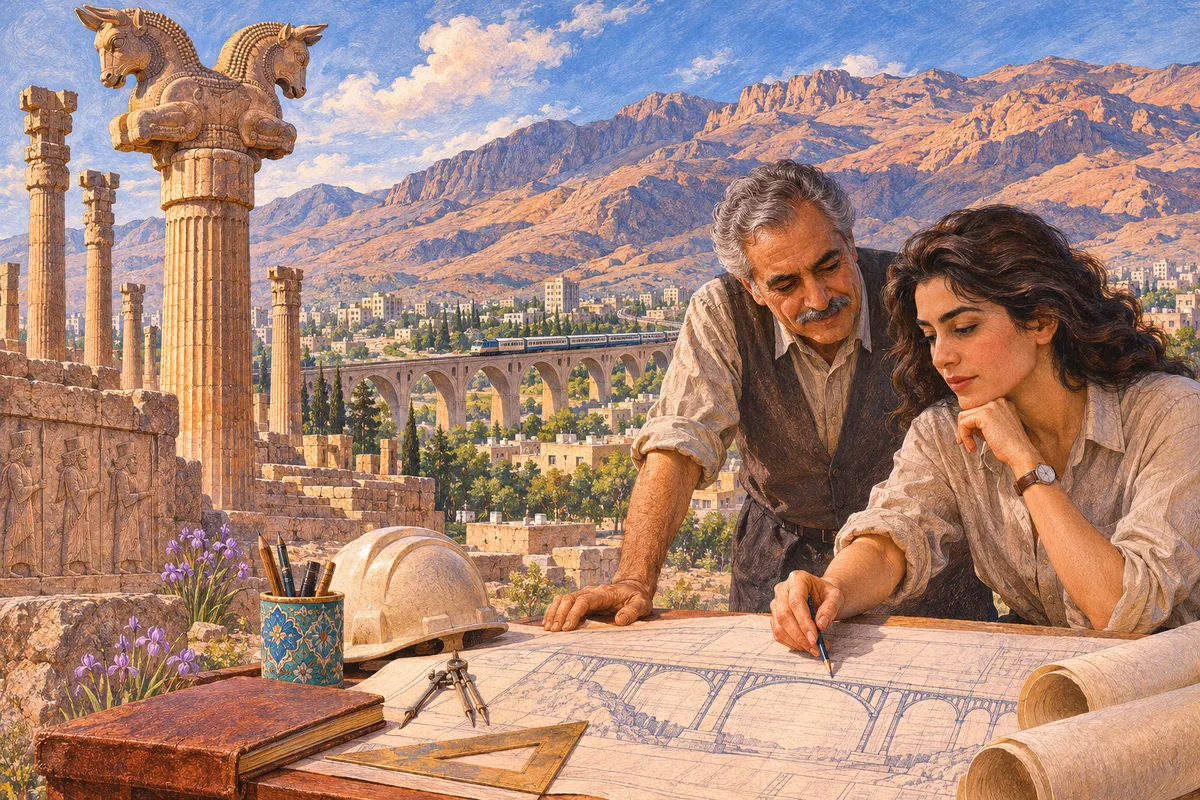
The two illustrations in this article were created using artificial intelligence. The cover brings together Persepolis and engineers of the present day. The Maragha image is an artistic interpretation of the work of astronomers of that period.