
Illustrated English book · Twenty chapters · 36 pages
The Iranian Soul
Memory, Wounds and Renewal
Twenty reflections on identity, freedom and a shared future
· First English synthesis
The author and the argument
Introduction: The Life Behind These Pages
I am Mr Peyman Bakhshayesh, MD, PhD, MBA, a major trauma surgeon whose understanding of Iran began in Abadan. My father was a naval officer; my mother's family belonged to the world of the oil industry. Affection for national continuity and concern for working people's lives were therefore not abstract opposites in my upbringing. They existed within the same family. Revolution, war and displacement made the relationship between the individual and the state a personal question long before it became a philosophical one.
I studied medicine in Shiraz and left Iran in 1998. My journey through Germany, Sweden and the United Kingdom brought medical training, research and encounters with different ways of organising public life. Reading politics, philosophy and economics in Berlin widened my questions. Specialist practice, doctoral research at Karolinska and my subsequent work in Leeds reinforced an enduring interest in how people and institutions respond when ordinary life is disrupted. These are recollections from my own earlier writings, not a claim that one biography explains a nation.
My political understanding has changed. I once belonged to the worker-communist movement; I now support parliamentary constitutional monarchy and Crown Prince Reza Pahlavi as a focus for national cooperation. I do not erase that intellectual journey. It makes me more conscious of the need to allow others to reconsider their beliefs. A person who changes his mind is not necessarily betraying a principle. He may be discovering what that principle requires in the world as it is.
Trauma surgery has taught me to look beyond the first successful intervention. Survival, rehabilitation and a return to meaningful life are different tasks. That experience shapes the questions I ask about Iran: how do we protect people, coordinate competence, restore trust and create conditions in which life can flourish? The analogy has limits. A society is not my patient; citizens are not passive recipients of a surgeon's authority. My qualifications create a duty to reason carefully, not an entitlement to govern.
By the Iranian soul I mean a living conversation between memory, belonging, grief, pleasure, fear and hope. I do not mean an inherited personality possessed by every Iranian. Region, language, class, generation, belief, gender and personal history all shape experience. A person may love Iran while rejecting my political preference. That person belongs to the country as fully as I do. A holistic perspective must hold these differences together without explaining them away.
This compact book reworks the twenty submitted files into twenty thematic chapters. Some files duplicate or overlap other texts; several are books in their own right. The result is a new English synthesis, not a full translation or a reproduction of twenty separate originals. It moves from memory to everyday life, from conflict to understanding, and from national feeling to practical responsibility. My central conviction is that liberation becomes real when people can think, disagree, work, love and enjoy life without asking power for permission.
Part I · Chapters 1–5
Memory and Inner Life
The experiences through which a country becomes a personal inheritance: belonging, constitutional aspiration, loss, private life and the right to joy.
Chapter 1
A Country Larger than Its Government
A government can control borders, institutions and public language. It cannot exhaust the meaning of a country. Iran also lives in family memories, friendships, music, work, landscapes and the words people use when they speak intimately to one another. The country survives through these relationships, even when public authority fails its citizens. My objection to the Islamic Republic begins with this distinction: loyalty to Iran does not require obedience to a state that claims to speak for it.
Historical pride can sustain people through humiliation. Yet it becomes fragile when it demands proof that we have always been superior, innocent or united. Civilisations are made through exchange as well as invention, and their histories contain conflict as well as achievement. We do not need to diminish other peoples to value our own inheritance. Nor should the Persian strand of that inheritance make any Iranian language or community seem less entitled to a place in the national story.
Nowruz offers an image of continuity through renewal. UNESCO describes its traditions of family visiting, intergenerational solidarity and reconciliation across several countries and communities.[R8] I see in such practices a useful political lesson: belonging is renewed through what people do together. A shared celebration need not produce one religion, one political opinion or one way of living. A durable national identity can accommodate change because its members remain responsible for one another.
The problem to address is the conversion of belonging into a test of obedience. This happens when the state defines the authentic Iranian, but it can also happen when opponents of the state reserve patriotism for their own circle. My constitutional monarchism should be an argument offered to fellow citizens, never a condition of their citizenship. A free Iran must make room for people who inherit different memories and imagine different futures. Our common country becomes stronger when nobody must beg a faction for permission to belong.
Back to contents ↑Chapter 2
The Unfinished Constitutional Promise
Iran's modern struggle for freedom did not begin with our own generation. The Constitutional Revolution of 1905-11 sought to place law, representation and limits on arbitrary power at the centre of national life. Its participants disagreed over religion, sovereignty and reform, yet the achievement of a parliament made a lasting promise: government should answer to something greater than the will of its rulers.[R1] I see that promise as unfinished. Each generation inherits the responsibility to give it practical meaning, rather than merely repeat its vocabulary.
The Pahlavi period occupies a constructive place in my understanding of that journey. Its governments expanded infrastructure, education, industry and administrative capacity, helping Iran acquire the instruments of a modern state.[R2] Those achievements deserve recognition. Equally, modern institutions did not consistently bring effective constitutional restraint. Political authority remained concentrated around the monarch, and the bureaucracy was more answerable upwards than to the population.[R3] Admiration should make us capable of learning from this tension. Roads, universities and professional expertise are enduring assets; a society also needs freedom to question how power uses them.
The revolution of 1979 did not resolve that problem. The monarchy was replaced by an Islamic republic whose constitution entrenched the guardianship of the jurist and an overriding religious authority.[R4] Electoral institutions alone could not guarantee popular sovereignty within that arrangement. To me, the warning is profound: replacing a ruler does not secure freedom if the new order preserves an authority that citizens cannot effectively challenge. Constitutional language must be matched by enforceable rights, independent institutions and a peaceful means of correcting government.
My preference remains a parliamentary constitutional monarchy. I support Crown Prince Reza Pahlavi because I believe historical continuity can help a divided society approach a democratic future. That is my political judgement, not a substitute for the people's decision. The constructive Pahlavi inheritance should be carried forward with stronger safeguards, not historical immunity. A future crown would need defined and limited powers; elected government would need accountability; and citizens who prefer a republic would need the same protection as those who share my view.
Back to contents ↑Chapter 3
Revolution, War and Exile
I was born in Abadan, and my childhood unfolded across the revolution and the Iran-Iraq war. These personal beginnings cannot represent every Iranian experience. Abadan gives the word homeland weight for me: Iran is a place of people, homes and human attachments before it becomes a political argument. When I consider our national future, I therefore begin with a question central to my work as a major trauma surgeon: what will this decision mean for the people who must live with its consequences?
The war lasted from 1980 to 1988; the UN-supervised ceasefire took effect on 20 August 1988.[R5] Its consequences extended into families and communities. Yet no single response to such experience can be prescribed. Some people seek security above all else; others become impatient with every restraint; many move between hope, caution and exhaustion. These are possible human responses, not a diagnosis of a nation. Remembering suffering responsibly requires room for different recollections, including those that complicate our own political story.
I left Iran in 1998. Living abroad has made comparison part of my understanding of home. Distance can sharpen appreciation of what a country has lost, while also limiting what an observer can know about conditions inside it. The diaspora therefore has a double responsibility: to contribute knowledge and opportunities abroad, and to listen carefully to people whose decisions carry immediate consequences within Iran. Neither nostalgia nor professional achievement gives any of us ownership of another person's courage, grief or choices.
A useful national memory must become a commitment to protection. We should preserve testimony, support people living with injury and bereavement, and refuse to turn loss into a competition between factions. My surgical perspective reminds me that survival is the beginning of recovery, not its completion. Applied as a political metaphor, this means that a country needs more than an end to immediate danger: it needs continuity of care, dependable institutions and a credible future. We honour the past when we make life more secure for those who follow.
Back to contents ↑Chapter 4
The Private Self and the Public Mask
When authorities regulate belief, appearance and expression, people may learn to separate what they say publicly from what they think privately. The protective silence, the careful joke and the conversation reserved for trusted company can become ways of preserving a personal world. These responses should not be mistaken for an Iranian character defect. They are possible adaptations to circumstances in which candour carries consequences; individuals experience and navigate those circumstances differently.
The coercion is not merely a matter of atmosphere. The UN fact-finding mission on Iran found serious violations in the repression of the 2022 Woman, Life, Freedom protests, some amounting to crimes against humanity, including gender persecution.[R6] In January 2026, the UN High Commissioner reported thousands killed in a crackdown that intensified on 8 January, while stressing the difficulties of precise verification during a communications blackout.[R7] Such findings demand accountability. They also warn against treating public quiet as reliable evidence of consent.
My concern extends to the habits that coercion can leave behind. If a person expects authority to punish unwelcome information, even a friendly organisation may struggle to hear bad news. If access matters more than a transparent rule, people may seek a patron before trusting a procedure. These are interpretive possibilities, not a clinical diagnosis or an excuse for wrongdoing. Responsibility for oppression remains with those who impose it; survivors should not be blamed for the precautions they need.
A different public culture begins when truth becomes safer to tell. Schools, workplaces, professional associations and political groups should allow questions, protect privacy and explain their decisions. A secular state should protect believers and non-believers alike, including women's freedom to choose their appearance. Neither compelled religious conformity nor a new test of secular conformity can create an honest society. The desired change is an everyday confidence that a citizen may speak sincerely and still retain dignity, livelihood and legal protection.
Back to contents ↑Chapter 5
Pleasure and the Burden of Guilt
A country can build roads, universities and factories while leaving an inner courtroom inside its citizens. In that courtroom, laughter requires a defence, love risks dishonour, and pleasure waits for punishment. When I write about joy contaminated by guilt, I mean this conflict between the life a person desires and the life they have been taught to permit themselves.
My reading of Iranian cultural life finds this tension in the distance between modern aspirations and inherited judgments about the body, appearance, music and intimacy. Films can illuminate that tension, although they cannot tell us how every Iranian feels. Nor does one generation experience it in the same way as another. Some find consolation and generosity in faith; others encounter religion through coercion. Their experiences must not be collapsed into a single story.
The distinction I defend is between responsibility for harm and shame at being alive. If I deceive or injure someone, remorse can call me to repair what I have done. If I enjoy music, dance or a relationship grounded in consent and respect, another person's disapproval does not by itself establish wrongdoing. An ethical conscience should help us recognise others' rights, rather than teach us to fear harmless happiness.
I believe compulsory religious authority has led some Iranians to question the very judgments it sought to enforce. That is an interpretation, not proof of a universal transformation. It would be wrong to describe decades of repression as a necessary education. People paid costs they did not need to pay, and their resistance deserves the credit for whatever freedom they have reclaimed.
The habit of self-punishment can survive migration. It can even return in political language: while others suffer, you have no right to enjoy your life. Solidarity demands care and contribution; it does not demand the destruction of every ordinary pleasure. A humane Iran must make room for celebration and mourning together. Its citizens should be able to live responsibly without continually proving that they deserve to live.
Back to contents ↑Part II · Chapters 6–10
Pressure and Understanding
How fear, exhaustion and hostility narrow our choices, and how listening, fair disagreement and responsible language can reopen them.
Chapter 6
Pressure, Exhaustion and Agency
For a child, political pressure is not an abstract theory. It appears in a parent's worry, an interrupted education, an uncertain home and a future that adults cannot explain. My memories of Abadan, revolution and war taught me that public decisions enter the most private rooms of life. Later, as a surgeon, I learned to pay attention to the resources that help a person recover, as well as the injury itself.
That comparison has limits. A society is not a patient under one doctor's authority. Citizens possess different judgments, interests and rights. Yet the question of capacity remains useful: what burdens people, what sustains them, and what routes allow them to change their circumstances? These are three different questions. Economic insecurity is a burden. Trust and practical support are resources. Independent associations, public discussion and accountable institutions are channels for action.
We should therefore resist easy judgments about silence. A person may be frightened, exhausted, bereaved or responsible for dependants. Withdrawal does not necessarily mean consent. Nor does anger automatically become organised power. People need credible partners, reliable information and some reason to believe that their effort can matter. No amount of suffering supplies those conditions by itself.
The same care is necessary when discussing the effects of repression. Fear under a real threat can be understandable. It should not become a diagnosis applied to an entire nation. Political participation may create belonging, but it can also expose people to loss and distress. No one should have to hide exhaustion or refuse help to establish patriotic credentials.
My answer is to restore agency through proportionate, voluntary commitments. A useful contribution might be professional work, support for a family, accurate documentation or a dependable act of solidarity. Those abroad must respect the different risks faced inside Iran. The purpose is to lighten burdens and strengthen people's capacity to choose. A movement worthy of freedom should protect the human beings whose freedom it seeks.
Back to contents ↑Chapter 7
When Disagreement Becomes Enmity
We are responsible for the friendships we cultivate, but also for the unnecessary enemies we create. This does not mean that every conflict can be settled or that every actor deserves our trust. It means that hostility has consequences. Each avoidable rupture can remove a skill, a relationship or a future possibility from the work of rebuilding Iran.
I distinguish disagreement from political competition, and both from a breach of trust or the organised denial of rights. A disagreement invites reasons. Competition needs fair rules. Broken trust requires evidence, boundaries and the possibility of repair. Repression requires protection of those harmed and accountability for those responsible. Treating all four as the same situation leaves us either reckless about danger or incapable of cooperation.
My opposition is directed at coercive power and the subordination of citizenship to religious authority. It is not a declaration against Muslim citizens. The believer and the nonbeliever belong equally in the country I seek. Similarly, disagreement with my preference for constitutional monarchy does not make a republican an enemy of Iran. Rights cannot depend on agreement with my political judgment.
Anger at injustice can clarify what matters. It can also become an identity that requires a fresh adversary every day. Understanding that possibility does not excuse harmful conduct or diagnose the person who displays it. It asks us to examine what our own language achieves. Does it expose a specific wrong, invite correction and protect a right? Or does it make the continued humiliation of another person the objective?
A national movement should preserve routes back from error without erasing responsibility. People can reconsider an ideology, leave an organisation or learn from a failed strategy. Where crimes are alleged, evidence and fair proceedings remain essential. Reconciliation cannot mean compulsory forgetting. But the future cannot be built as a permanent tribunal over every citizen's family, former beliefs or previous associations. We need institutions strong enough to judge conduct and a political culture generous enough to recognise change.
Back to contents ↑Chapter 8
Political Sniping and the Attention Economy
I do not approach political sniping as an innocent observer. In my own political development, I sometimes used language that made the understanding I wanted harder to achieve. Admitting that matters. A book about a healthier public culture would fail its first test if its author presented everyone else's mistakes clearly while concealing his own.
By political sniping, I mean a habit that keeps another person permanently on trial. Strong criticism is different. It identifies a claim, presents evidence and asks for a correction or a better decision. Sniping converts every explanation into further proof of guilt. A change of mind becomes betrayal; an old association becomes an unanswerable charge; a useful proposal disappears beneath an argument about who is entitled to offer it.
Digital platforms can intensify this temptation. An insult produces a visible response more quickly than patient planning. Attention can begin to feel like accomplishment. Yet the reward offered by a platform is not necessarily a reward for Iran. A widely shared attack may leave our collective capacity smaller, while an uncelebrated conversation may make a lasting project possible.
The problem is not simply bad manners. It concerns incentives and power. Those who imagine the future as a limited stock of offices and privileges may see new participants as rivals for a share. Those seeking flawless political ancestry may demand that people deny the very experiences from which they learned. Neither habit prepares a democratic country. Competence, present conduct and accountable commitments are better standards than inherited loyalty.
I propose a discipline that begins before publication: identify the actual claim; read its context; distinguish disagreement from misconduct; offer evidence proportionate to the accusation; and leave a clear route for correction. Protect private lives and refuse campaigns of humiliation. Unity must never conceal wrongdoing, but criticism should make truthful cooperation more possible. When a dispute produces only repetition, return to useful work. Our time, credibility and relationships are finite national resources; we should spend them with care.
Back to contents ↑Chapter 9
Understanding before Judgement
I grew up with political differences inside the same family. My father remained loyal to the monarchy, while parts of my maternal family were drawn towards the Left. These were not abstract positions sitting in separate books. They belonged to people who worked, worried, loved their children and shared a country. Their differences taught me that a political label never contains a whole person.
To understand another Iranian, I must ask what experience lies behind the argument. A republican may fear the return of concentrated power. A constitutional monarchist may fear the destruction of national continuity. A religious citizen may fear humiliation; a nonreligious citizen may fear coercion. These concerns can be heard without accepting every conclusion drawn from them.
Understanding is therefore an intellectual discipline. Before answering an opponent, I should be able to explain the strongest version of that person’s position in language they recognise. Otherwise, I may defeat an argument that nobody actually made. I must also distinguish what I know, what I infer and what I have not yet understood.
This does not mean treating every claim as equally sound. Evidence can contradict a belief. A proposal can threaten another person’s rights. Understanding helps us identify the real disagreement and challenge it precisely. It gives criticism a better foundation than ridicule, inherited suspicion or an accusation about motives.
For me, national cohesion begins here. We need shared rules strong enough to protect people who remain unconvinced by one another. Equal citizenship cannot depend on affection. Nor can a common future require identical memories of the past. The person who refuses my preferred constitutional arrangement must still possess the same right to speak, organise and vote.
I support Crown Prince Reza Pahlavi and parliamentary constitutional monarchy. That conviction gives me an argument to present, not authority to close the discussion. If I ask others to reconsider their assumptions, I must accept the same responsibility. A nation becomes more capable when disagreement produces knowledge instead of another permanent enemy.
Back to contents ↑Chapter 10
The Art of Political Discourse
Political language shapes the relationships from which future institutions will be built. A movement can speak continually about freedom while making its own members afraid to ask questions. It can win applause through an insult and lose someone who might have become a colleague. I therefore regard the quality of our discussions as part of our preparation for government.
In my writing, I distinguish four useful methods. Dialogue helps us understand the question and the concerns behind it. Rhetoric explains a position clearly and invites people to act. Debate compares competing claims by stated standards. Polemic draws a firm boundary around a specific falsehood or harmful practice. These are teaching distinctions, not an exhaustive scientific classification.
The difficulty is often choosing the wrong method. A planning meeting needs clarification and a decision; it rarely benefits from a public contest of loyalty. A constitutional disagreement may require structured debate. A threat requires a clear response and protection for the person threatened. No single speaking style is suitable for every task.
Before a discussion, I want us to define the issue in one sentence. “Iran’s future” is too broad for a useful decision. “How should transitional authority be limited?” creates a question that can be examined. We should then separate evidence from interpretation, hear objections and identify what would change our judgement. Confidence is no substitute for an answer.
We must also recognise unequal power within our own circles. Access to a platform, personal prestige and proximity to leadership can silence quieter members without any formal prohibition. Fair speaking opportunities and an honest record of decisions help protect independent judgement. Criticism of a proposal should not become an accusation of betrayal.
Firmness remains necessary. Unsupported allegations, insults and disclosure of private information should be addressed through clear, proportionate rules. Describe the conduct, allow correction and protect participation. The purpose is a working political community. At the end of a productive discussion, we should know what was understood, what remains disputed, who will act and when the result will be reviewed.
Back to contents ↑Part III · Chapters 11–15
Freedom and Common Purpose
The principles that allow different political traditions to work together: conscience, equal citizenship and the people's free constitutional choice.
Chapter 11
Purpose: What Is Freedom For?
A nation can be certain about what it rejects and uncertain about the life it wants to build. In my view, ending the Islamic Republic is a necessary political objective. Yet removing a system does not, by itself, establish freedom. If a new authority again takes possession of the citizen’s right to choose, the central purpose has been lost.
I distinguish a wish, a goal and a means. A wish pictures a better future. A goal turns that picture into a commitment we can examine. A means is the organisation, policy or institution chosen to advance it. Confusing these categories allows us to defend a familiar tool long after it has ceased to serve the people.
The destination is a free life: the ability to think, question, learn, work, love and participate without arbitrary coercion. That destination must become visible in a classroom, a court, a workplace and a home. A constitution matters because it protects these possibilities. A leader matters because leadership helps people establish and sustain them.
My preference is parliamentary constitutional monarchy. I believe it can connect historical continuity with democratic government. But this preference must remain subject to the people’s free choice. If Iranians freely choose a secular republic, respect for that decision would test the sincerity of my commitment to liberty. The destination cannot depend on my winning every argument.
My clinical work reinforces another distinction: a technically impressive intervention is not successful merely because it is difficult or dramatic. Its consequences matter. Society is not a patient, and professional expertise confers no political ownership; nevertheless, responsibility for outcomes is a lesson worth carrying into public life.
We should therefore examine our purposes repeatedly. Are our methods consistent with dignity? Have we assigned responsibility and resources? Can people question the decision? Are its benefits open to those outside our circle? Can we admit error and change direction? Meetings, slogans and enthusiasm may support a cause, but they cannot replace these tests. Freedom becomes credible when it is the measure by which its advocates agree to be judged.
Back to contents ↑Chapter 12
Liberation of Conscience
Leaving a country does not necessarily end the power it has exercised over the mind. We may carry fear of disapproval, habits of silence and a need for permission across a border. My own experience of migration made freedom a continuing question: how does a person become able to think, choose and revise a judgment without surrendering responsibility for others?
Liberation has an outer and an inner dimension. The outer dimension requires protection from censorship, discrimination, intimidation and arbitrary power. The inner dimension involves learning to question, to tolerate uncertainty and to recognise one's capacity to act. Neither replaces the other. Personal courage cannot compensate for the absence of legal protection, and a change in law does not immediately remove habits learned under threat.
No belief, historical narrative or beloved political figure should stand beyond examination. A person may regard something as sacred; that does not give them authority to silence everyone else. The secular state I support protects freedom of belief and unbelief together. It does not decide which conscience is worthy of citizenship. I must apply this principle to my own convictions as readily as to those I reject.
Freedom also requires the ability to change one's mind without fabricating a new past. My journey through different political commitments belongs to me. I need not erase it to defend my present support for Crown Prince Reza Pahlavi and constitutional monarchy. I do need to explain my reasons, acknowledge mistakes and accept the same right of reconsideration in others.
This is not an argument for freedom from every rule. Surgery has taught me the value of discipline, training and standards that protect life. The distinction concerns whether a rule serves a defensible purpose, applies fairly and can be questioned. A mature conscience can honour a commitment, admit uncertainty and ask for help. The Iranian future I seek should cultivate that maturity: citizens secure enough to speak honestly, independent enough to disagree, and connected enough to build something together.
Back to contents ↑Chapter 13
National Cohesion without Uniformity
A nation becomes capable of acting together when its members can trust that disagreement will not cost them their place within it. This is what I mean by national cohesion. Iran's strength cannot rest on requiring every citizen to share one interpretation of history, one political preference or one way of living. Its common future must be broad enough to contain its real people.
Persian language and culture carry a profound part of our historical memory. They can connect us without diminishing the languages, traditions and local attachments of Iran's communities. A secure national belonging allows these identities to flourish. Whenever we make a compatriot choose between love of a community and membership of the country, we create an unnecessary wound in the body we claim to defend.
The habits of coercive politics can survive among its opponents. We may condemn exclusion by the state while excluding a colleague for an unfamiliar background or an unwelcome opinion. We may praise unity while allowing a private circle to decide who belongs. Cohesion requires us to examine these contradictions in our own behaviour. Its first evidence is often modest: an invitation honoured, a disagreement handled fairly, a responsibility fulfilled.
I support Crown Prince Reza Pahlavi because I believe he can provide a recognisable centre for such cooperation. My preference is parliamentary constitutional monarchy, with elected government and powers constrained by law. That preference must earn consent. A national centre should help citizens reach a free constitutional choice, and its supporters should make room for those who will campaign for a different outcome.
Our shared commitments can be clear without becoming exhaustive: a united country, equal citizenship, freedom of conscience, secular government and accountable public authority. Within that framework, disagreement is part of the future we seek. The practical question is whether we can work together on something useful while preserving our differences. A nation learns cohesion when its members repeatedly discover that cooperation is possible and that the promises holding it together can be trusted.
Back to contents ↑Chapter 14
Monarchists and Republicans: A Shared Democratic Arena
Republicans should not be bullied for their beliefs. I say this as a constitutional monarchist, because the dignity of a fellow Iranian cannot depend on agreement with me. If our promised democracy offers security only to those who choose our preferred constitution, it has already failed its most basic test. The future must belong equally to people who argue against us.
Different memories of 1979 still shape our arguments. Some remember the interruption of modernisation and national continuity; others remember hopes for liberation captured by clerical power. These memories deserve examination, but no citizen should be imprisoned within a judgement made decades ago. We need room to learn without humiliation. Acknowledging an error should open a conversation about responsibility rather than end a person's right to contribute.
In my judgement, republican opposition has often struggled to turn diverse convictions into a durable common direction. Monarchists have an advantage in the recognition surrounding Crown Prince Reza Pahlavi. That advantage creates an obligation to welcome cooperation. It provides no justification for contempt. Organisational weakness can be criticised seriously while the courage, knowledge and citizenship of the people concerned remain fully respected.
I favour a parliamentary constitutional monarchy because I believe historical continuity can support a stable national framework while elected representatives govern. Republicans must be equally free to advocate their alternative. Cooperation during a transition need not settle this disagreement in advance. Its purpose can be to establish the lawful and open arena in which both positions are heard, tested and decided through the people's free choice.
Our conduct now gives substance to that promise. When a republican offers expertise, we should discuss the work. When a monarchist faces an honest challenge, we should answer the argument. Neither side benefits from endless pursuits across social media, where outrage consumes the time needed for useful action. We will eventually need parliamentary opponents who trust the rules sufficiently to accept defeat and continue participating. We can begin building that trust before we reach the parliament.
Back to contents ↑Chapter 15
Ideology, Work and Reconstruction
An ideology earns its place in public life by helping us understand conditions and improve them. When it demands that society conform to a predetermined story, it can become an obstacle to the people it claims to serve. I want philosophy to remain capable of learning. Iran needs the intellectual confidence to revise an argument when experience exposes its limits.
This is why I believe a Marxist can cooperate with Crown Prince Reza Pahlavi in a democratic transition without abandoning concern for workers or inequality. Supporting a transitional role, choosing a constitutional system and endorsing an economic programme are separate decisions. My own preference remains parliamentary constitutional monarchy, subject to the people's consent. A colleague may favour a republic and still help establish the freedoms through which both of us can pursue our convictions.
Reconstruction also requires attention to material realities. A country must develop its capacity to produce useful goods, knowledge, services and employment. Investment, innovation, education and reliable infrastructure need institutions that protect contracts and constrain arbitrary power. Claims about the health of an industry should be tested against evidence. Neither national pride nor ideological suspicion can tell us which enterprise is competitive, which can improve or which provides an essential public service.
Workers belong at the centre of this discussion. Independent representation, collective bargaining, safe workplaces and social protection are integral to prosperity. Economic change can impose costs on families with little room to absorb them. Retraining, income protection and credible employment opportunities should therefore accompany restructuring. A reform that counts gains while overlooking the people carrying its burdens has measured its achievement incompletely.
Nor should any organisation claim exclusive political authority in the name of labour. Workers hold different beliefs and must remain free to choose their representatives and parties. The same principle constrains entrepreneurs, religious authorities and national leaders. Reconstruction becomes a shared endeavour when productive initiative, social responsibility and democratic accountability develop together. We need institutions through which conflicts can be negotiated without turning every dispute into an existential struggle for the state.
Back to contents ↑Part IV · Chapters 16–20
The Work of Renewal
Leadership judged by service, reconciliation joined to justice, and human potential converted into institutions and everyday opportunity.
Chapter 16
Leadership and Measurable Loyalty
If we removed the leader's name from our declarations, what would remain of our record? I ask this of myself as readily as of anyone else. Loyalty should leave something dependable behind: care delivered, knowledge shared, money accounted for, a promise honoured or a division repaired. The value of a movement appears in what its members enable others to do.
I support Crown Prince Reza Pahlavi as a national focal point and favour parliamentary constitutional monarchy through the people's free choice. These commitments require more from me than admiration. They require conduct that makes cooperation wider, criticism safer and the proposed democratic future more credible. A supporter who treats access to a leader as personal ownership of the movement diminishes the national reach that gives that leadership its purpose.
Measurement must distinguish activity from benefit. A meeting matters when something useful follows it. A publication matters when it informs. A donation matters when it reaches its intended purpose. Counting photographs, appearances or declarations can conceal the absence of results. Honest reporting should also include what failed and why. A leader surrounded only by reassuring accounts is denied the evidence needed to correct a course.
Yet accountability must never become a ranking of human worth. People have different resources, health, responsibilities and exposure to danger. Quiet work may be indispensable, and an hour freely given may represent a substantial sacrifice. Confidentiality also matters. We can report the broad results of assistance without exposing recipients, and review sensitive details through responsible arrangements. No one owes publicity, money or bodily danger as proof of belonging.
The discipline I propose is straightforward: accept a defined responsibility, identify who will carry it, set a realistic deadline and report the outcome. Ask for help before an avoidable failure becomes a crisis. Leadership should support this practice and welcome unwelcome information. As a trauma surgeon, I return to the person whose suffering gives our work its urgency. Political commitment acquires moral weight when it lightens that person's burden.
Back to contents ↑Chapter 17
Reconciliation with Justice
Reconciliation asks whether people with different histories can share a lawful future. It does not ask victims to forget what happened to them. Nor does it allow a political agreement to erase responsibility for abuse. A durable national settlement must make room both for cooperation and for truth, evidence and justice.
My own political journey makes this personal. I once belonged to the Worker-communist Party and later moved towards national politics and parliamentary constitutional monarchy. I do not conceal that change or pretend it followed one simple cause. Experience, argument and reconsideration altered my conclusions. If I claim the freedom to learn, I must allow others the same possibility.
Past affiliation alone cannot establish guilt. A person is not a criminal because of a religious family, a left-wing conviction or years spent advocating a republic. Responsibility concerns specific conduct and must be examined through evidence, independent proceedings and the right to a defence. Collective punishment would repeat the machinery of exclusion we seek to overcome.
The rights of survivors and bereaved families remain central. They should be heard, evidence should be preserved and individual responsibility pursued fairly. No leader or coalition owns their grief. No public demand for unity should require them to surrender the truth or accept an imposed account of their suffering.
Cooperation nevertheless requires a common political foundation. I favour equal citizenship, individual liberty, separation of religion and state, Iran’s territorial integrity and the people’s free choice of constitutional government. Within these commitments, monarchists, republicans and others can retain their convictions while preparing institutions that protect their future competition.
The practical test begins before any transition. Can we resolve a disagreement without humiliation? Can we publish responsibilities and accounts? Can someone leave our group without being declared an enemy? Can we protect essential services and the rights of people who did not support us? Reconciliation is strengthened by these repeated acts. Iran must become a shared home in which disagreement is lawful and accountability belongs to institutions, rather than a prize divided among the victorious.
Back to contents ↑Chapter 18
Liberating Iran's Human Resources
When I speak of Iran's resources, I begin with people: the scientist's knowledge, the worker's skill, the artist's imagination, the entrepreneur's initiative and the experience carried by older generations. Resources also include confidence, physical energy, beauty and the capacity for joy. A country cannot flourish while allowing only the narrow portion of human life approved by an official ideology to develop.
People are not property waiting to be mobilised by a new master. Their abilities become a national strength when they can contribute freely and retain their conscience. Liberation therefore requires a different relationship between citizen and state: protection for independent thought, equal citizenship, lawful enterprise and freedom of belief. Replacing officeholders is insufficient if arbitrary authority continues to obstruct the lives beneath it.
We must apply the same test within our own political activity. When a newcomer is humiliated, an expert ignored for lacking personal connections or an honest critic expelled, the movement wastes the capacity it claims to defend. My support for Crown Prince Reza Pahlavi rests partly on his potential to gather that capacity around a shared future. Gatekeeping that narrows participation defeats the reason for my support.
I propose practical routes through which goodwill can become work. Health professionals can contribute to care and training; engineers to infrastructure planning; lawyers to safeguards; workers, entrepreneurs and economists to employment and recovery. Educators, artists and translators can make complex choices understandable. Each project needs a credible purpose, capable participants, an accountable budget and an honest account of what remains uncertain. Participation should not require ritual declarations or exposure to avoidable risk.
Iranians abroad bring knowledge and connections; people inside Iran bring experience that distance cannot replace. Their relationship should be a partnership with room for disagreement and learning. The same openness should guide cooperation beyond our national community. Scientific exchange, trade and friendship can strengthen independence when institutions protect the public interest. The goal is an Iran in which people can use their abilities without seeking permission to be themselves, and where the future draws strength from everyone willing to help build it.
Back to contents ↑Chapter 19
The Missing Piece: Organised Care
A flag, a song or a declaration of loyalty can give people a sense of belonging. But when the gathering ends, a family may still need support and an injured person may still need treatment. The missing piece in our national effort is the connection between what we feel and what we can reliably do for one another.
As a major trauma surgeon, I cannot regard an injured person as an item in a political calculation. Each has a body, relationships, hopes and a future that injury can alter. Care must follow need. It must never depend on the recipient's political allegiance or willingness to become a public symbol. Consent, confidentiality and dignity are part of the service itself.
Organised care requires more than the creation of another committee or charity name. It requires a defined purpose, suitable expertise, clear responsibilities, transparent use of resources and follow-through. Cooperation between existing organisations can be more useful than duplication. A successful project should be able to explain whom it served, what it delivered, what remains unfinished and what it learned, while protecting sensitive personal information.
The same discipline applies to international advocacy. A meeting is a beginning. We should record the issue raised, the request made, the response received and the person responsible for following it up. A photograph is not evidence that a problem has been solved. Medical, scientific and civic partnerships become meaningful when they produce accessible knowledge, dependable services or practical support.
Contribution should remain proportionate to a person's circumstances. Time, professional skill, careful translation and steady administration can matter alongside financial support. No citizen's worth can be measured by the size of a donation. Nor should those abroad prescribe risks for people living under repression. My support for the Lion and Sun movement carries this expectation: national feeling must become a capacity to protect life and sustain trust. Start with a realistic commitment, give it an owner, complete it, and report the result honestly. Small promises kept can become the foundation of large institutions.
Back to contents ↑Chapter 20
Victory and the Next Turning Point
A turning point acquires its meaning through what follows it. Recognition, a powerful speech or a moment of national emotion may open a possibility. None can guarantee that the possibility will become a durable freedom. I want us to understand victory as a quality of life and government, rather than a date we announce or an image we celebrate.
My political preference is a parliamentary constitutional monarchy, and I support Crown Prince Reza Pahlavi as a focus for national cooperation. That preference carries obligations. The people must be free to determine their constitutional future. Republicans must retain the right to campaign. Critics must be protected. No historical name or popular leader can substitute for the institutions that make these commitments enforceable.
The practical tests are demanding. Can a woman decide how to live without compulsory ideological supervision? Can a worker organise, a researcher question, an entrepreneur begin, and a journalist investigate? Can a citizen obtain fair treatment without patronage? Can a government lose an election and leave office? These are measures by which national confidence becomes something more substantial than a slogan.
Reconstruction must also sustain ordinary life. Hospitals, schools, water, electricity and essential administration cannot wait for every constitutional dispute to be settled. Accountability for repression must distinguish individual responsibility from collective guilt. We need evidence, fair proceedings and care for survivors. A democratic future should allow those who accept equal rights to contribute, while refusing to make political conversion a substitute for justice.
What I call Pahlavi Plus joins an appreciation of modernisation and national continuity to stronger constitutional limits, pluralism and the ability to correct mistakes. Its value will lie in practice. The deepest victory would be an Iran whose people no longer have to organise their lives around fear: a country capable of remembering its wounds without living by revenge, welcoming the world without surrendering independence, and protecting disagreement without losing its common home. That future is a responsibility we can begin to practise now.
Back to contents ↑From reflection to responsibility
Conclusion: Freedom Must Become Ordinary Life
The threads of this book return to a single question: what will allow Iranians to live together with dignity? Historical memory gives us resources, but no exemption from learning. Suffering deserves recognition, but it must not become a demand that every future generation inherit our conflicts. Pride can build confidence; it becomes constructive when it makes us more willing to contribute and more capable of acknowledging error.
The Islamic Republic is central to the political problem described here: religious authority, coercion and repression restrict the space in which people can choose their lives. Yet the end of that system would not automatically supply trustworthy courts, honest administration or the habits of listening. A change of power opens a possibility. Institutions, civic conduct and continuing scrutiny determine whether that possibility becomes freedom.
I support Crown Prince Reza Pahlavi and a parliamentary constitutional monarchy because I believe continuity can serve a modern democratic future. In my use of Pahlavi Plus, the constructive inheritance of modernisation must be joined to stronger rights, pluralism and constitutional restraint. This is my interpretation and proposal, not an official programme attributed to the Crown Prince. My preference must stand within a free constitutional choice whose result belongs to the Iranian people.
The practical agenda below joins the inner and outer dimensions of renewal. People need protection from arbitrary power and a realistic opportunity to use their freedom. They need care after injury, time to mourn, a chance to work and room for ordinary pleasure. No political affiliation should determine access to those necessities. A nation does not recover by selecting which citizens deserve a future.
The Iranian soul, as I have used the expression, is neither broken beyond repair nor destined for greatness without effort. It is the capacity of different people to keep making meaning together. We honour it when loyalty becomes service, courage includes listening, and disagreement no longer destroys belonging. The clearest proof of renewal will be an ordinary day: a woman choosing her own life, a child learning without fear, a worker treated fairly, a critic protected by law, and neighbours able to imagine tomorrow together.
A practical agenda for renewal
| Priority | What to do | How to judge progress |
|---|---|---|
| Equal citizenship | Protect speech, belief, women's autonomy and minority rights. | Rights remain enforceable when the claimant is unpopular. |
| Truth and justice | Preserve testimony; establish individual responsibility through fair proceedings. | Victims receive recognition and redress; defendants receive due process. |
| Care and recovery | Support injury care, rehabilitation, bereavement and accessible services. | Help follows need, with consent, privacy and accountable funding. |
| Trust and competence | Use clear responsibilities, open accounts and fair recruitment. | Failures can be reported, investigated and corrected. |
| Livelihood and opportunity | Enable enterprise, education, worker protections and fair competition. | People can build a life without dependence on ideological patronage. |
| Reliable public services | Prepare continuity of hospitals, water, power, schools and local administration. | Political change protects civilian life and institutional knowledge. |
| Peaceful constitutional choice | Agree limits on transitional authority and a credible democratic process. | Citizens can choose the settlement and replace governments peacefully. |
| An open national life | Connect diaspora expertise and international friendship to shared public benefit. | Cooperation creates opportunities while respecting local knowledge and consent. |
References
Personal recollections, interpretations and political proposals are the author’s. The following sources support the historical and factual passages identified in the text.
- [R1] Abbas Amanat. Constitutional Revolution i. Intellectual Background. Encyclopaedia Iranica. 1992; updated 2018.
Constitutionalism, representation and the limits of arbitrary rule.
- [R2] M. Hashem Pesaran. Economy ix. In the Pahlavi Period. Encyclopaedia Iranica. 1997; updated 2014.
Economic development, structural change and uneven modernisation.
- [R3] Alireza Sheikholeslami. Administration in Iran vii. Pahlavi Period. Encyclopaedia Iranica. 1983; updated 2018.
Administrative modernisation and concentrated political authority.
- [R4] Saïd Amir Arjomand. Constitution of the Islamic Republic. Encyclopaedia Iranica. 1992; updated 2016.
The 1979 constitution and guardianship of the jurist.
- [R5] United Nations. United Nations Iran-Iraq Military Observer Group: Background.
The war and the ceasefire of 20 August 1988.
- [R6] United Nations Office at Geneva. HRC Press Conference: Fact-Finding Mission Report on Iran. 18 March 2024.
The mission’s findings on the 2022 protests, including gender persecution. Investigative findings are not criminal-court verdicts.
- [R7] UN High Commissioner for Human Rights Volker Türk. Briefing to the Human Rights Council special session on Iran. 23 January 2026.
Reported killings in January 2026 and limits on precise verification.
- [R8] UNESCO. International Day of Nowruz.
Renewal, family visits and reconciliation across cultures.
The essays behind the book
This English synthesis draws on twenty supplied files. The two copies of Purpose are identical, while the separate Art of Mutual Understanding chapters overlap the complete edition. The chapters here are a new thematic arrangement, not twenty unabridged translations.
| Original work | Language | Chapters developed here |
|---|---|---|
| National Cohesion | English | 1, 13–16 |
| Purpose (Hadaf), two identical supplied files | Persian | 11; conclusion |
| The Art of Mutual Understanding, complete edition | Persian | 1, 9, 13, 17 |
| The Art of Mutual Understanding, Chapters 1–2 | Persian | 9–10; overlaps complete edition |
| The Art of Mutual Understanding, Chapters 3–4 | Persian | 9, 13; overlaps complete edition |
| Social and Political Pressure | Persian | 4, 6 |
| Measurable Loyalty | English | 16, 18–19 |
| Political Sniping in the Digital Public Sphere | Persian | 7–8, 12 |
| Should Republicans Be Bullied? | English | 13–14 |
| Liberation of the Resources | English | 1, 13, 15–16, 18 |
| Enmity | Persian | 7–8, 17, 19 |
| The Art of Political Discourse | Persian | 9–10, 17 |
| Victory (Pirouzi) | Persian | 6, 8, 19–20 |
| Readiness for Reconciliation (Ashti-Paziri) | Persian | 9, 17; also an appendix in complete edition |
| Pleasure Tainted by Guilt | Persian | 4–5 |
| Can a Marxist Support Crown Prince Reza Pahlavi? | English | 15, 18 |
| Liberation (Rahaei) | Persian | 4–6, 12, 20 |
| The Missing Puzzle Piece | Persian | 19–20 |
| A Turning Point | Persian | 20 |
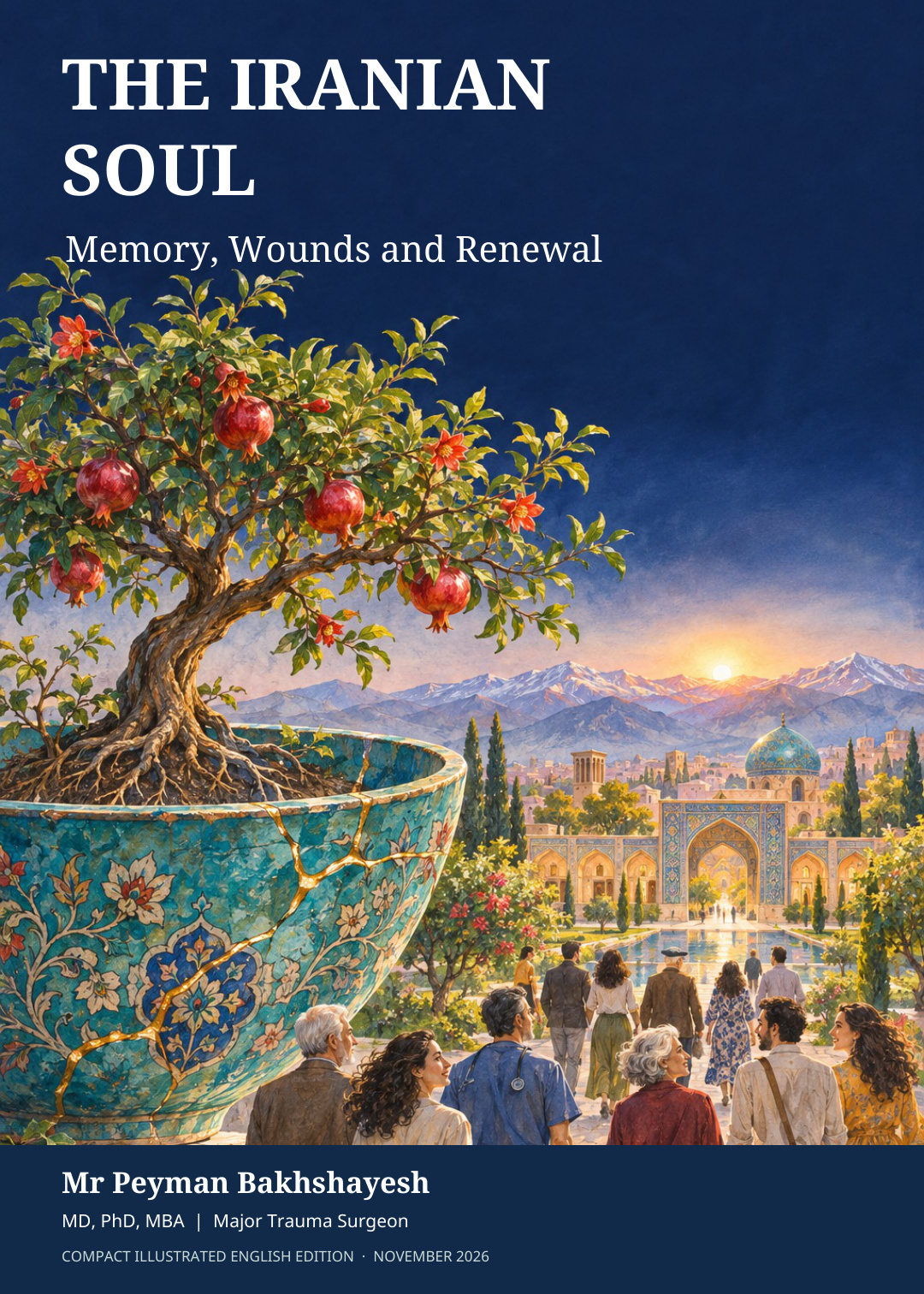
Cover and interior images are symbolic illustrations created with AI. They do not document actual people or events. This book expresses the author’s personal civic views.