
مقالهٔ سیاسی
When Criticism Becomes a Crime Against God
The school rooftop in 1979, the prisons of 1988 and the price of asking who bears responsibility in Iran today.
مقالهٔ انگلیسی
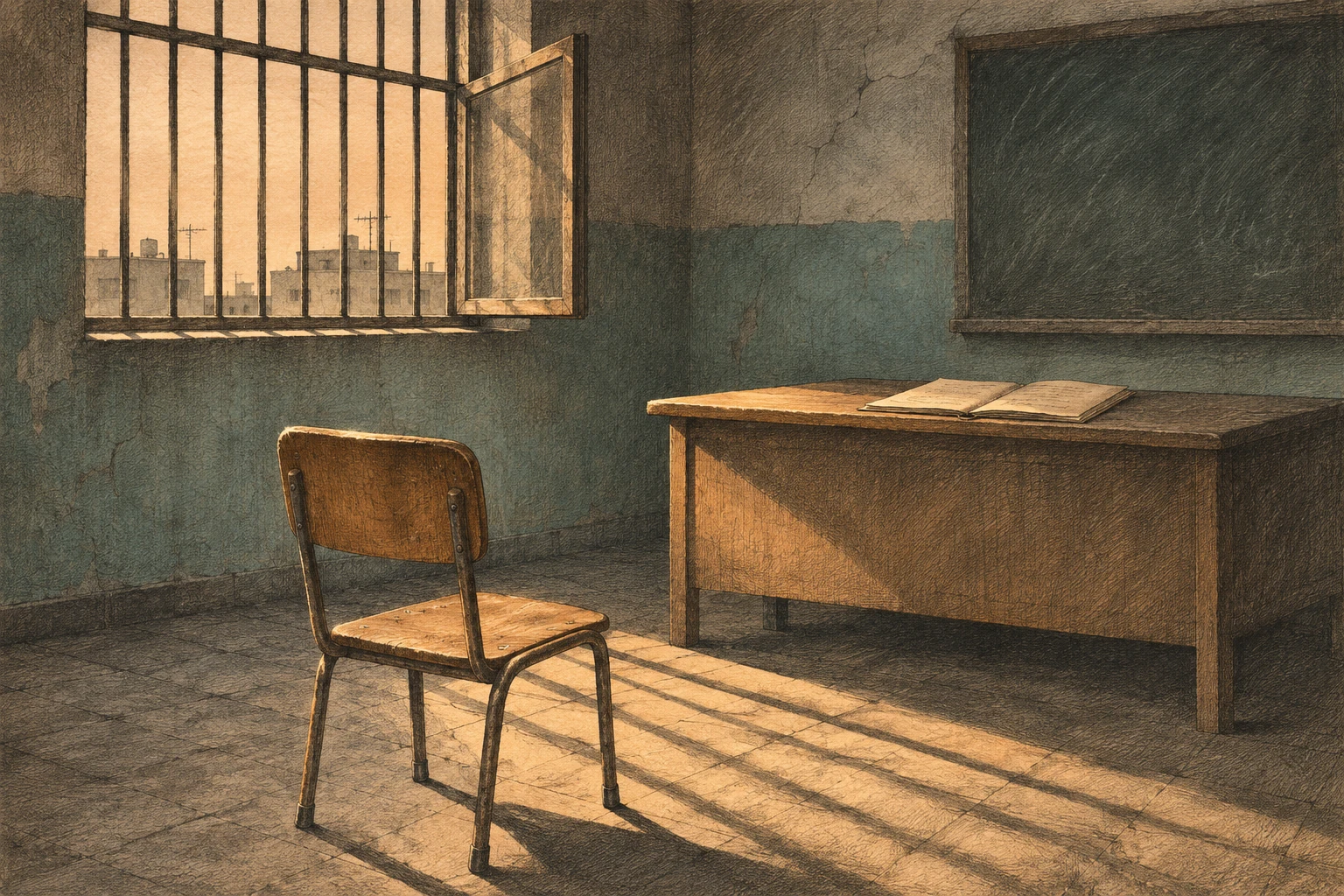
A question put to a prisoner
In the summer of 1988, a political prisoner in Iran could be asked whether his father prayed. Imagine having to decide, in the few seconds before you answered, what that question meant. It concerned something your father had done in his own home, perhaps thirty years earlier. Yet your answer could help the men across the table decide whether you would return to your cell or be hanged. What possible bearing did your father’s prayers have on any offence you had committed? [7][8]
I think of that question whenever I hear an Iranian official speak in the name of God. The official has a budget, appoints people to jobs and makes decisions whose consequences the rest of us must live with. He owes the country an account of those decisions. How did we arrive at a system in which he could instead demand an account of our faith?
What Khomeini promised
I was a child in Abadan in 1979. Looking back, what strikes me is how little the people who wanted the Shah gone had agreed about the day after his departure. As I wrote in Mismanagement, leftists and Islamists could march together against the monarchy without sharing an understanding of how Iran should be governed. The question they left unanswered was who would have the authority to tell the victors no. [1]
Oil prices and production had strained the Shah’s relations with Western governments. His human rights record was under scrutiny. Fear of Soviet influence also shaped Western thinking. In November 1978, William Sullivan, the American ambassador in Tehran, was already considering whether the armed forces and Khomeini’s followers might reach an accommodation. Some observers could imagine an anti-communist cleric offering spiritual leadership, a kind of Iranian Gandhi. An image is a poor substitute for asking what powers a man intends to exercise. [2][5]
There was an answer on the record. In an interview given in Najaf in September 1978 and published by Le Monde in October, Khomeini was asked whether religious leaders would themselves govern. He said they had no intention of doing so. By the end of 1979, the constitution had placed a religious jurist at the head of the state. I regard that assurance as a political deception. Some Iranians call it taqiyya. Whatever word we choose, the public had been given a promise clear enough to judge against the office Khomeini subsequently occupied. [4]
Four days later, on a school rooftop
The monarchy fell on 11 February 1979. On the night of 15 February, four senior officers of the old order were shot on the roof of Tehran’s Refah School. General Mehdi Rahimi was among them. The revolutionary tribunal had heard allegations of the utmost gravity. That made an independent court, access to counsel and a chance to challenge the evidence especially important. The men were dead before any appeal could be heard. [6]
The distinction matters even to someone who believes a particular officer was guilty. Once the revolutionaries could dispense with a defence for the Shah’s generals, what protection would a civil servant have? Or a student? By 1981, the repression had reached political organisations that had themselves fought the monarchy. In 1988, thousands of political prisoners were secretly executed. Some had already spent years serving sentences imposed by the Islamic Republic’s own courts. Their families were left trying to discover when they had died and where they had been buried. [7][8]
The questions varied. Prisoners associated with the Mojahedin-e Khalq were pressed to renounce their organisation. Leftist prisoners were interrogated about belief, prayer and their upbringing. These proceedings expose a distinction that English accounts sometimes lose. Moharebeh means waging war against God. A mofsed-e fel-arz is a person branded a spreader of corruption on earth. Kafir means unbeliever, and mortad means apostate. These words carry different religious and legal meanings. What joined them in the experience of prisoners was the power of state officials to attach a label to a human being and decide whether that person would live. [7][9]
Who answers when the water runs out?
Consider a family whose taps run dry. They are entitled to know which authority allocated the water, what the engineers advised and who ignored the advice. A worker whose wages no longer cover the food bill is entitled to ask where public money went. Neither question requires a declaration of religious belief. After forty-seven years, I still see the same evasion. The government’s conduct comes under scrutiny and the conversation turns to the loyalty of the person asking.
In December 2020 the authorities executed Ruhollah Zam, the founder of AmadNews, after convicting him of spreading corruption on earth. His outlet had carried allegations about officials and information relating to protests. UN human rights experts condemned his execution and drew attention to his right to express dissent and share information. Think of the editor deciding the following morning whether to publish a well-founded allegation. The state had given that editor a reason to stay silent that no written censorship order could match. [10]
The same question of accountability arises beyond our borders. Tehran claimed a duty to export its revolution and made hostility to Israel a cause in Iran’s name. It helped build Hezbollah in Lebanon and supported Hamas, the Houthis in Yemen and particular militias within Iraq’s Popular Mobilisation Forces. Those groups have histories and interests of their own. An Iranian citizen is entitled to ask what those commitments cost, who authorised them and what peace or prosperity they brought to people in Iran or in the countries concerned. No cleric received a mandate from all Muslims to decide these things on their behalf. [11]
There is an extraordinary presumption here. In Twelver Shi‘a tradition, the Mahdi is expected to return and bring justice to a world filled with oppression. A believer may draw hope from that promise. How can a ruler invoke it while denying a prisoner a lawyer or a mother the location of her son’s grave? The Islamic Republic chose one interpretation of Islam, wrote it into the institutions of the state and claimed the authority to speak for people whose own understanding of faith could be quite different.
The rule I would want for Iran
In my paper on reconciliation, I argued that the families of victims are owed the truth and that responsibility belongs to individuals. That principle will cost us something if we mean it. A former revolutionary judge standing trial in a future Iran must have a lawyer, time to prepare a defence, access to the evidence and a right of appeal. I would insist on those rights even for a judge who had refused every one of them to the people who appeared before him. [3]
That is part of what secular government means to me. The citizen who prays, the citizen who has given up prayer and the citizen who has never believed all have the same standing before the law. Each can ask why the water ran out. Each is entitled to hear the minister answer. And no Iranian should ever again enter a courtroom fearing that the decisive evidence against him will be whether his father prayed.
Sources and further reading
- Peyman Bakhshayesh · Mismanagement
- Peyman Bakhshayesh · Iranians’ Lived Experience Regarding Political Islam Facing Western Democracies
- Peyman Bakhshayesh · Love, Revenge and National Reconciliation in Revolutionary Transitions
- Le Monde · Interview with Ruhollah Khomeini, recorded in Najaf, 21 September 1978; published 17 October 1978
- National Security Archive · Ambassador William Sullivan’s cable, “Thinking the Unthinkable”, 9 November 1978
- Abdorrahman Boroumand Center · Omid memorial record for Mehdi Rahimi
- UN Special Rapporteur Javaid Rehman · Findings on atrocities in 1981–82 and 1988, July 2024 (especially pp. 33–35)
- Amnesty International · Blood-Soaked Secrets: Mass Secret Killings of Political Dissidents in 1988
- Iran Human Rights Documentation Center · Islamic Penal Code, articles 279 and 286, English translation
- UN human rights experts · Statement on the execution of Ruhollah Zam, 14 December 2020
- Congressional Research Service · Iran-Supported Groups in the Middle East and U.S. Policy