مقالهٔ سیاسی
The Face of a Revolution
There are millions of us. Iranians at home and in exile bring knowledge, languages, hard-won experience and love to the work of building a free Iran and a better world.
مقالهٔ انگلیسی
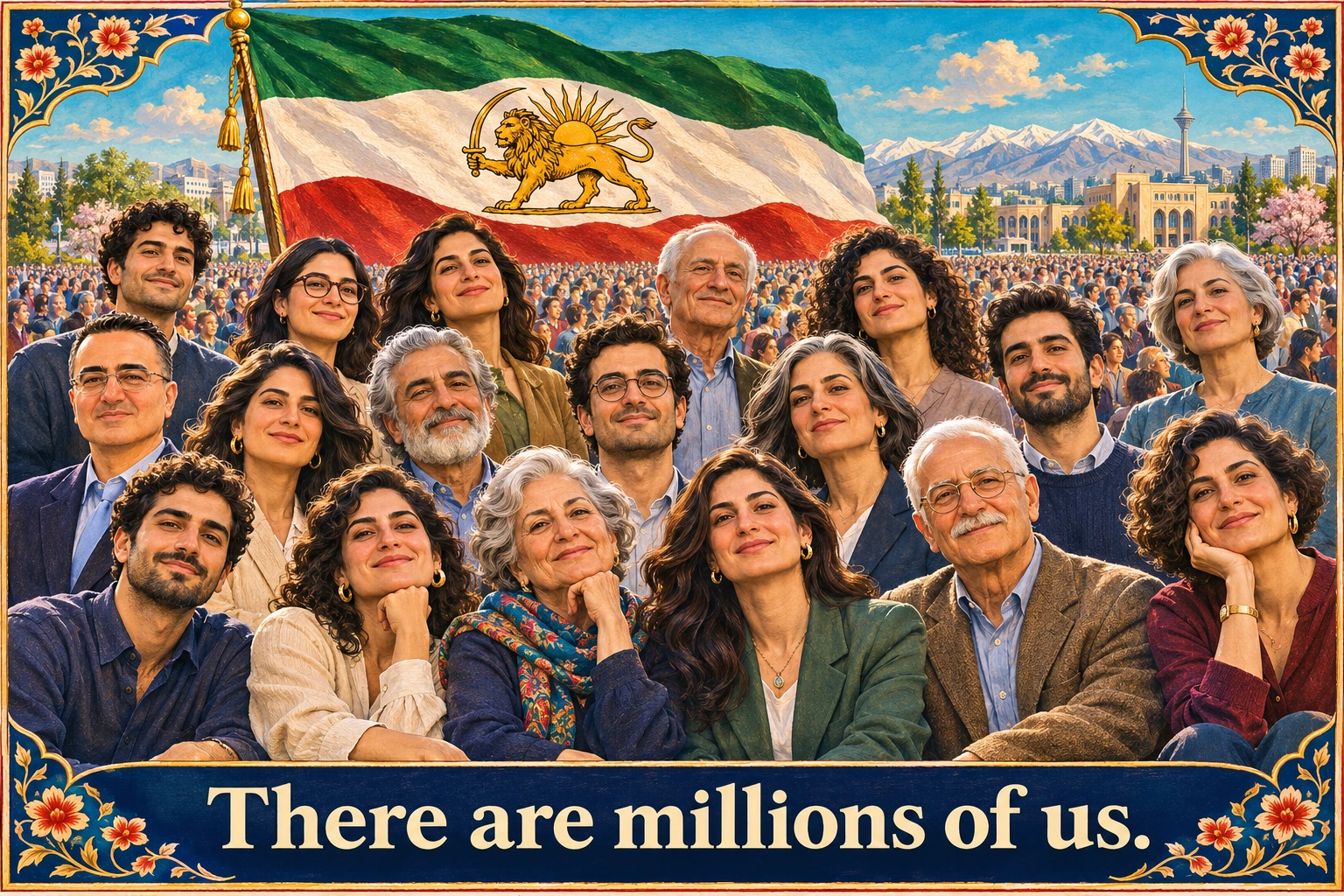
There are millions of us.
There are millions of us. Look at our faces together and you will begin to understand the Iran that wants to be free. Women and men, different generations, different professions, different journeys. Thoughtful people with knowledge to share, work to do and love to give. People who have survived, learned, started again and still believe that life can be better. This is the face of our revolution.
I am one of these people. My story belongs beside millions of other stories. The picture I want the world to see is all of us standing together: Iranians at home and abroad, bringing our experience towards a common future. We want the freedom to use our minds, to build prosperity, to make friends and to leave this planet better than we found it.
What we carry in our flesh and blood
Among us are people who remember the revolution of 1979 and who lived through the Iran–Iraq war. We remember what happened when an ideology entered the classroom, the workplace and the privacy of the family. We learned how a political system could decide what a woman should wear, what a student could question and which parts of a person's identity were acceptable. Our knowledge of the Islamic Republic was acquired through our own flesh and blood.
The political executions of the early 1980s and the prison massacres of 1988 belong to the history through which our generation grew up. Families have carried the loss of those killed for decades. In 1992, residents in Mashhad protested as their homes faced demolition. Later generations remember the student protests of 1999, the Green Movement of 2009, the protests of 2017–18 and 2019, and the demand for water in Khuzestan in 2021. These struggles reached into ordinary life: a home, a child, a vote, a livelihood, a glass of water. [1–4]
In 2022, women and girls gave the world another view of Iranian courage through Woman, Life, Freedom. The UN fact-finding mission subsequently documented grave violations in the suppression of those protests, including acts amounting to crimes against humanity. Behind that language are human beings who wanted to live freely. Their courage belongs to the living memory of our people. [5]
Our experiences differ. Some lived through the war as children; others were born long afterwards. Some endured imprisonment or the loss of someone close. Some remained in Iran and kept their families, professions and hopes alive under pressure. Others left. We recognise one another through the refusal to let fear decide the whole meaning of our lives.
The work of beginning again
Exile can mean learning how to introduce yourself all over again. A person who had a profession, a reputation and a place in society may arrive somewhere else with an unfamiliar accent and qualifications that need to be assessed again. Many of us have moved from country to country, learned another language, sat another examination, worked while studying and rebuilt a home. We have raised children between cultures while carrying concern for the family we left behind.
I was a boy in Abadan when the revolution and war changed my world. I studied medicine in Shiraz, left Iran in 1998 and continued learning and working in other countries. Today I am a trauma surgeon in Leeds. I offer that experience as one example among many. Across the world, Iranians have made their own difficult journeys through education, work and repeated beginnings. Much of what we acquired could become a gift to the country we still love.
People who have learned to know the world
There are millions of us, and among us are multilingual people with several qualifications, years of research and experience in more than one society. Many can move between Persian and English, Swedish, German, French or other languages. Each additional language has brought more than vocabulary. It has opened another way of understanding people: their humour, their worries, their expectations and the things they find difficult to explain.
We have studied with people from different continents. We have worked beside them, cared for them, become their neighbours and welcomed them into our families. The world has become familiar through actual human relationships. A country that appeared distant on a map may now be the home of a colleague who helped us, a friend we trust or a teacher whose kindness we remember.
A university degree can represent years of discipline. So can learning a trade, caring for a relative, keeping a small business alive or teaching children through difficult times. Our collective face should contain that whole range of achievement. Knowledge grows in laboratories and workshops, in classrooms and hospitals, and through the practical intelligence of people who solve problems every day.
We also know the exhaustion behind a successful life. A qualification hanging on a wall does not show the uncertainty, the rejected applications or the evenings spent studying after work. We have failed, recovered and tried again. That experience can make us patient with another person's struggle. It can teach us to recognise ability before the world has rewarded it.
The resources Iran already possesses
When I write about the liberation of Iran's resources, I begin with people. Think of the knowledge scattered across our country and across the world. An engineer understands water systems. A teacher knows how to awaken a child's curiosity. A researcher can connect two laboratories. A business owner knows how to organise production, create jobs and find customers. A nurse knows what safe care requires during a difficult night. Together, these abilities can change what a country is capable of doing.
Iranians inside the country know its daily realities. They know which services fail, which promises have been broken and what families actually need. Iranians abroad can contribute experience, training, investment and relationships built elsewhere. We need to bring those forms of knowledge together. A professional returning from overseas should arrive ready to listen as well as to teach.
Contribution can begin wherever a person lives. It may be a course taught online, a translated textbook, a research partnership, a carefully funded project or an introduction that helps an Iranian enterprise find its first customer. Some will return; others will remain where their children have grown up. Both can help. A free Iran should make useful cooperation possible and allow people to choose their part in it.
We know suffering, and we still choose love
I am angry at what the Islamic Republic has done to our people. Its killings, repression and organised intimidation deserve to be named plainly. A state that wounds its citizens and then frightens their families into silence has turned power against life itself. Its threats have also followed people beyond Iran's borders; British authorities have documented Iran-linked threats against dissidents, journalists and others abroad. This is part of the record against which our struggle must be understood. [5, 6]
The regime has spent decades cultivating hostility and broadcasting propaganda in the name of a country whose people have so much else to offer. I want the world to meet the Iranians whose work heals, teaches, discovers, creates and brings people together. We have a right to be known through our lives and our choices. We are fighting the cruelty of this political system because we want human beings to have a better life.
Love is a serious reason to resist. We love our children and want them to grow up without fear. We love our parents and want their later years to have dignity. We love the places we came from, the languages we speak and the friends we have made. We want a woman to walk home safely, a young person to speak honestly and a family to plan next year without wondering what arbitrary power will take away.
My work continually brings me back to the value of an ordinary human life. Helping someone walk again can restore a parent's ability to care for a child or a worker's ability to earn a living. Other people do equally necessary work in different ways. A repaired water supply, a well-run school and a reliable wage can change the future of a family. This is the scale at which prosperity becomes real.
Friendship is part of the future
I want friendship with the people of Israel, with our neighbours, with Europe, America and people everywhere. Those of us who have lived among different nations know how much can begin with a conversation. A scientist needs a colleague. A patient needs someone with the right knowledge. A student needs access to a good teacher. Political hostility has denied too many people the benefits of those simple connections.
In my writing on Iranian and Israeli friendship, I have asked what cooperation could achieve in medical education, rehabilitation, water technology and scientific exchange. The same practical question belongs in our relationships across the world. Could this partnership prevent an injury, improve a harvest, help a child learn or create useful employment? Let those outcomes help shape the reputation of a free Iran.
We were born on this planet. Our responsibility to it does not end at the border of our birthplace. Clean water, human health, knowledge and the safety of children concern us wherever people live. I want Iran to contribute confidently to that shared life, with citizens free to choose their friends and a government capable of cooperation and mutual respect.
Standing together, with our own minds
I stand with the Lion and Sun movement and support Crown Prince Reza Pahlavi as a centre of national unity. My preference is a secular constitutional monarchy, with public power constrained by law and government accountable to the people. Modernism, secularism and national responsibility matter to me because they can give ordinary Iranians the freedom and confidence to build.
Millions of capable people will bring millions of experiences and opinions. A national movement needs room for them. We should be able to stand beside one another, offer our knowledge and speak honestly. The republican, the constitutional monarchist, the believer and the person without religious belief all belong to Iran. Their citizenship and dignity must be secure. The country's constitutional future must rest on the free choice of its people.
Unity becomes visible through the way we work. We can introduce a younger colleague to someone who can help, translate useful information, support an injured person, organise a discussion or finish a project we promised to complete. We can keep honest accounts and give credit to the people who did the work. That is how strangers begin to trust one another enough to build something together.
A face turned towards the future
The educated, thoughtful Iranian face I want in this picture can belong to a woman or a man, to someone young or someone whose life has already crossed several eras. It carries memory, but it also carries curiosity. It has known cruelty and retained tenderness. It can look at another human being and see someone to understand, someone to work with, someone whose happiness matters.
Picture what that means for a child growing up in a free Iran. She can ask a difficult question at school, read the evidence and follow an interest wherever it leads. Her family's income should not close the door to her education. When she qualifies, her ability should count. If she wants to start a business, publish research or work with a colleague overseas, she should have a fair chance to do it. Her life should have room to grow.
This is the future towards which our experience can point: schools that encourage thought, hospitals that care well, enterprises that create wealth, institutions that earn trust and friendships that cross borders. Good thoughts, good words, good deeds become meaningful when we put them into the way we live and work.
Look at us together. We have survived revolution, war, repression, exile and the work of beginning again, in different ways and at different times. We have learned languages, acquired knowledge, built friendships and found reasons to keep loving life. We want our people to prosper. We want to bring something good to humanity.
There are millions of us. I am one of them. Together, we have a future to build.
Sources
- 1. Amnesty International. Political executions in Iran (1988).
- 2. Amnesty International. Blood-soaked secrets: Iran's 1988 prison massacres (2018).
- 3. Arab Gulf States Institute. Iran's November Protests in Perspective (2019). Historical overview of the 1992, 1999, 2009 and later protests.
- 4. Human Rights Watch. Iran: Deadly Response to Water Protests (22 July 2021).
- 5. UN Human Rights Council. Report of the Independent International Fact-Finding Mission on Iran, A/HRC/58/63 (2025).
- 6. House of Commons Library. Iranian state threat activities in the UK. Research briefing CBP-10413.
Earlier writing by the author
- Liberation of the Resources · 10 November 2026
- Pahlavism — Liberation or Obedience? · 19 November 2026
- The Future of Education in Iran · 18 November 2026
- We Build the Great Iranian Civilisation—Starting Today · 28 July 2026 · Author's manuscript
- Iranians' Lived Experience Regarding Political Islam Facing Western Democracies · July 2026 · Author's manuscript
- Love, Revenge and National Reconciliation · Author's manuscript
- Iran and Israel: Beyond a Common Enemy · 25 September 2026 · Author's manuscript