مقالهٔ سیاسی
Liberation of the Resources
A forceful appeal by Mr Peyman Bakhshayesh for national unity, inclusive cooperation and the liberation of every Iranian’s knowledge, capital, talent, beauty and energy.
مقالهٔ انگلیسی
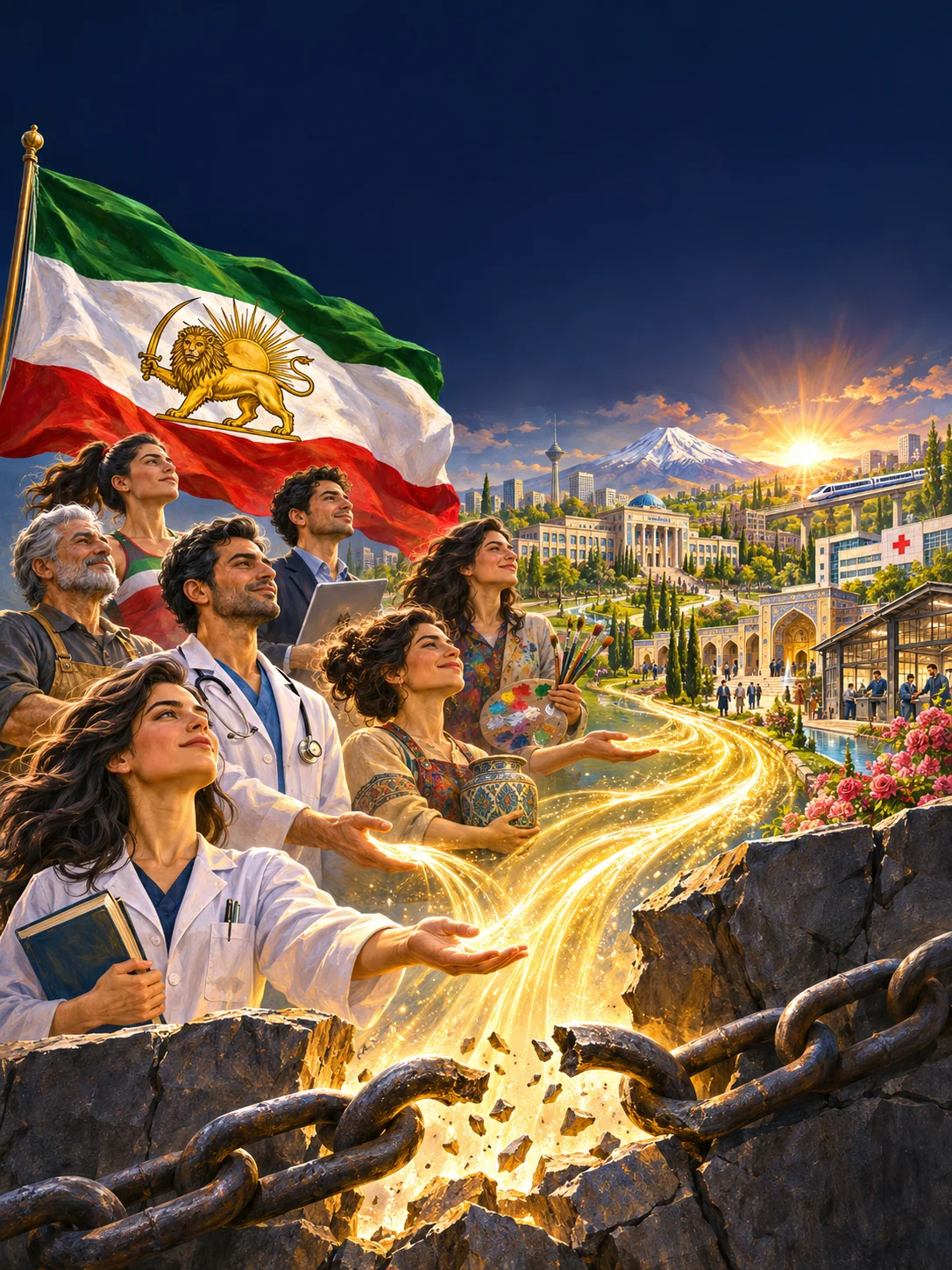
Iran belongs to all Iranians. Its future needs all of us.
1. A nation whose potential has been obstructed
Iran is not short of intelligence. Iran is not short of ambition, courage, money, beauty, knowledge or human energy. What we have lacked is the freedom, trust and national organisation that allow these resources to flow together. We have people capable of building a prosperous country. We have allowed too many barriers to stand between those people and their country.
I call the removal of those barriers the liberation of the resources. By resources, I mean far more than oil, gas, land or minerals. I mean the abilities of Iranians: the scientist's knowledge, the worker's strength, the entrepreneur's capital, the artist's imagination, the woman's freedom, the young person's desire, the older generation's experience, and the patriot's determination to build. People are not property to be mobilised by another master. Their resources become national strength when they are free to contribute by choice.
The Islamic Republic has obstructed that freedom. But we must also confront a painful truth within our own opposition: whenever we humiliate a willing contributor, silence an independent mind or close the door on an Iranian because of a factional disagreement, we obstruct the very resources we claim we want to liberate.
A movement that wants to free Iran must learn to open doors. If it becomes a competition to guard them, it has already forgotten its purpose.
2. Our inheritance is a responsibility
The Constitutional Revolution, whose constitutional milestone came in 1906, expressed a demand that remains alive: government must be constrained by law, and Iranians must have a voice in the institutions that govern them.[1] Our struggle for a dignified place in the modern world did not begin yesterday. Generation after generation has sought a country in which learning, enterprise and public responsibility can flourish.
Look at the intellectual inheritance of the Persian and wider Iranian cultural world. Avicenna and Razi helped transform medicine and philosophy. Al-Khwarizmi's work helped establish algebra. Khayyam contributed to mathematics and astronomy.[2][3][4] Their achievements belong to a civilisation of exchange, across languages and peoples. Yet any account of the period commonly called the Islamic Golden Age that erases the Persian contribution is intellectually impoverished. Our pride requires accuracy; it does not require us to erase anybody else.
Nor did our identity simply disappear under successive empires and ideologies. Persian remained a great language of shared cultural life. Ferdowsi's Shahnameh helped preserve and renew its literary inheritance. Nowruz carried renewal, continuity and belonging across generations and borders.[5][6] These are living resources, not museum decorations. A people who can preserve a civilisation must also learn to organise a future.
National pride becomes sterile when it stops at reciting the names of dead geniuses. The proper tribute to Avicenna is to give today's medical student freedom to study and practise. The proper tribute to Khayyam is to give today's mathematician a future. We must stop using the greatness of our ancestors as an excuse for tolerating the waste of their descendants.
3. The cost of blocked lives
Since 1979, the Islamic Republic has imposed its political interpretation of religion on the lives of Iranians. Repression is not an abstraction. The UN fact-finding mission has documented grave violations in the suppression of the protests that began in 2022, including acts it found amounted to crimes against humanity.[7] Behind the legal language stand interrupted lives, wounded families and abilities that could have served the country.
Every student pushed out of education, every woman punished for controlling her own appearance, every professional driven away by fear, and every enterprise damaged by arbitrary power represents a loss beyond that individual. A nation loses the discoveries that were never made, the jobs that were never created, the children who grew up without security, and the trust that might have held a community together.
This is why liberation cannot mean merely replacing the people occupying government buildings. It must mean changing the relationship between the state and the citizen. A free Iran must protect independent thought, freedom of conscience, lawful enterprise and equal citizenship. Otherwise, we will have changed the portraits while preserving the obstruction.
Iranians are often formidable as individuals. Our task is to become dependable as collaborators. Intelligence without cooperation can become an endless quarrel. Ambition without common rules can become a struggle for personal position. National cohesion is the discipline that turns separate capacities into shared achievement.
4. Iran comes before ideological obedience
I reject any political doctrine that asks Iranians to neglect their own country in obedience to an imagined higher command. The Islamic Republic's use of the language of the ummah cannot excuse sacrificing Iranian welfare to ideological ambitions. A Muslim Iranian has every right to faith, just as another Iranian has every right to a different faith or no faith. No interpretation of religion may cancel our equal membership of the nation.
The same test applies to internationalism. Whenever a communist movement treated the interests of Moscow as more important than those of Iranian citizens, the language of universal liberation became an instrument of dependency. An Iranian leftist who puts liberty, workers' dignity and Iran's prosperity first belongs in our national conversation. The question is whether an ideology serves our people or demands that our people serve it.
Our national identity must be generous enough to contain our real country. Persian can unite us as a common language while the languages and cultures of Iran's communities are respected and allowed to flourish. National unity does not require cultural uniformity. A nation grows stronger when belonging is secure.
We need our flag, our memory and our confidence. We also need the maturity to understand that loving Iran gives us responsibilities towards other Iranians. Patriotism that cannot tolerate the citizen next door is a miserable foundation for national reconstruction.
5. A centre of unity must widen the circle
I support Crown Prince Reza Pahlavi because I see in him a centre around which a broad national coalition can form. Constitutional monarchists possess a recognisable unifying figure. In my judgement, the republican opposition has not yet produced a comparably shared centre of leadership. That is an organisational criticism, not a licence to humiliate republicans. Their knowledge, courage and love of Iran remain part of our national wealth.
My understanding of Pahlavism centres on modernisation, secular government, national confidence and reconstruction. Its future must also include constitutional limits, accountability and the rights of people who disagree with us. The strongest defence of constitutional monarchy is to demonstrate that its supporters can cooperate with free citizens. The final constitutional choice belongs to Iranians through a free and credible democratic process.
Supporting Crown Prince Reza Pahlavi should therefore be a practical proposal for unity. It must never become an entrance examination for Iranian citizenship. A republican can help rebuild a hospital. A leftist can help design fair labour institutions. A believer can defend secular government. An atheist can serve alongside a believer. None should be asked to surrender conscience before offering competence.
Those who speak in the Crown Prince's name should ask themselves whether their behaviour makes his potential coalition larger, more capable and more trusted. If it makes that coalition smaller, frightened and dependent on a private circle, it is defeating the purpose for which I support him. The Lion and Sun should make Iranians feel at home. It must never become the badge of a closed club.
6. The gatekeepers must lose their power
There is something grotesque about demanding liberation while bullying the people whose participation makes liberation possible. An Iranian offers expertise and is interrogated about old affiliations. A newcomer offers time and is told that joining late makes them inferior. A donor offers support and is driven away by personal feuds. An independent voice raises a useful criticism and is accused of disloyalty. What kind of national movement wastes its own strength in this way?
If you drive away capable Iranians, you reduce Iran's capacity. If you turn a voluntary contribution into a factional humiliation, you damage trust. The flag in your hand does not cancel the consequences of your behaviour. A loud declaration of loyalty cannot transform obstruction into service.
We must also reject the mentality that treats a future transition as a queue for offices. Anyone calculating that a smaller circle today will mean a larger share of power tomorrow is approaching Iran as a prize to be divided. Iran is a country to be rebuilt. No promise or expectation of American or Israeli intervention relieves us of the duty to organise ourselves. No foreign actor can manufacture the trust that we destroy among ourselves.
The answer is to remove the power of informal gatekeepers through open participation, transparent appointments, accountable finances and fair procedures for disputes. Challenge destructive conduct firmly. Refuse intimidation. Protect dissent and deal with wrongdoing through evidence and law. We need to end the machinery of exclusion, not create another machinery of revenge.
7. Loyalty must produce something
I do not measure loyalty by the volume of a chant, the number of photographs beside a prominent person, or the date on which somebody first declared support. Long service deserves respect. It does not confer ownership of the movement. A person who arrived yesterday and does useful work today may strengthen Iran more than somebody who has spent years policing everybody else's loyalty.
Let us ask concrete questions. What work have you completed? Whose knowledge have you brought into the effort? What useful project have you helped finance? How many divisions have you repaired? How many people now feel able to contribute because of your behaviour? These are measures of service. Noise is not an outcome.
Money matters because serious work requires resources. But donation totals cannot be a price list for patriotism or a ticket to political office. Contributions must be judged in the context of ability and circumstance. The wealthy person who funds a project, the nurse who gives a few precious hours, the worker who translates a document, and the carer who quietly supports a family may all be offering something substantial. No citizen becomes worth less because they have less to give.
Practical loyalty means delivering, telling the truth about results, accounting for money and making cooperation easier. Theatrical loyalty demands an audience. Useful loyalty leaves something behind that others can build upon.
8. A national forum that turns goodwill into work
We need a national forum that is open enough to attract the full range of Iranian ability and organised enough to put it to use. Here I am proposing a method of cooperation, not claiming that any organisation has already adopted it. Its common ground should be clear: a united Iran, equal citizenship, secular government, political freedom and public authority constrained by law.
Such a forum should offer practical routes into work. Doctors and nurses can contribute to health planning and training. Engineers can help prepare for water, energy and infrastructure needs. Lawyers can work on constitutional safeguards. Economists, entrepreneurs and workers can examine recovery and employment. Artists, educators, translators and communicators can make the future understandable. Each project needs a defined task, responsible people, realistic deadlines and results that can be examined.
Capital should follow credible projects, with clear budgets and honest reporting. Expertise should receive a hearing without requiring personal access to a factional organiser. Participants should be able to disagree without being publicly degraded. People inside Iran must be able to contribute without being pressured into exposing themselves. No public loyalty register is needed to prove somebody's worth.
Our resources also include beauty, sport, physical energy, emotional intelligence, hospitality and the capacity for joy. Beauty is the freedom to create, dress, perform and live without compulsory shame. Strength is the ability to work, care, rescue, build and endure. Nationalism is useful when it gives these abilities a common civic purpose. Iran needs the whole human being, not merely the narrow part approved by an ideology.
9. A country ready for friendship
The liberation of our resources also requires an Iran able to cooperate with the world. Scientific exchange, investment, travel, trade and cultural confidence depend on trust. We need relations with our neighbours and the wider international community that are governed by national interests and mutual respect, rather than permanent ideological confrontation.
I want friendship with the peoples of the region, including the Israeli people, and constructive relations with the United States, Europe and other countries willing to respect a free Iran. Independence does not require isolation. Friendship does not require submission. A confident nation can negotiate, cooperate and disagree without making hostility its national identity.
Nor should Iranians abroad be treated as spectators or as automatic claimants to leadership. Their knowledge and connections can help. Iranians inside the country bring experience that no distance can replace. The task is partnership: to connect capacities across borders while keeping the future accountable to the Iranian people.
10. Open the doors
The future of Iran cannot be built by a handful of self-appointed owners. It needs people who have never joined our meetings, people who do not share every part of our history, and people who may never vote for the constitutional system that I personally favour. If we cannot make room for them now, our promises of national unity are empty.
I am a supporter of Crown Prince Reza Pahlavi because I want a platform that gathers the maximum possible Iranian capacity around the country's freedom and prosperity. Every supporter should be able to face this test: has my conduct helped to create that platform? Have I made cooperation easier? Have I helped another Iranian find a place in the national effort?
Bring your money if you can contribute it responsibly. Bring your knowledge. Bring your skill, beauty, strength, imagination, discipline, connections and energy. Bring your love of Iran. Bring your honest questions as well. A confident movement can work with people who think.
To those who would monopolise that movement, my message is direct: Iran is not your private property. Its future is not your reward for standing closest to a leader. No circle, however loud, has the right to confiscate the nation's possibilities.
Open the doors. Let the resources flow. Let Iranians build together. Iran belongs to all Iranians, and its liberation must release the potential of them all.
Sources
Political essay by Mr Peyman Bakhshayesh, Major Trauma Surgeon, MD, PhD, MBA. 10 November 2026. Political judgements and proposals are the author’s. Numbered sources support the historical and factual passages.
- Encyclopaedia Iranica: Constitutional Revolution iii. The Constitution
- Encyclopaedia Iranica: Avicenna
- US National Library of Medicine: Islamic Medical Manuscripts, Bio-Bibliographies - R (Razi)
- University of St Andrews, MacTutor: Al-Khwarizmi; Omar Khayyam · Omar Khayyam
- UNESCO: Bayasanghori Shahnameh
- UNESCO: International Day of Nowruz
- UN Independent International Fact-Finding Mission on Iran: Update, 13 September 2024
Related writing
- National Cohesion
- Measurable Loyalty
- Pahlavism, Technocracy, and National Reconciliation in Iran's Transition — earlier essay by the author.