
مقالهٔ سیاسی
Measurable Loyalty — English
In defence of loyalty measured through service, accountability and results. The complete English translation of Dr Peyman Bakhshayesh’s essay.
مقالهٔ انگلیسی
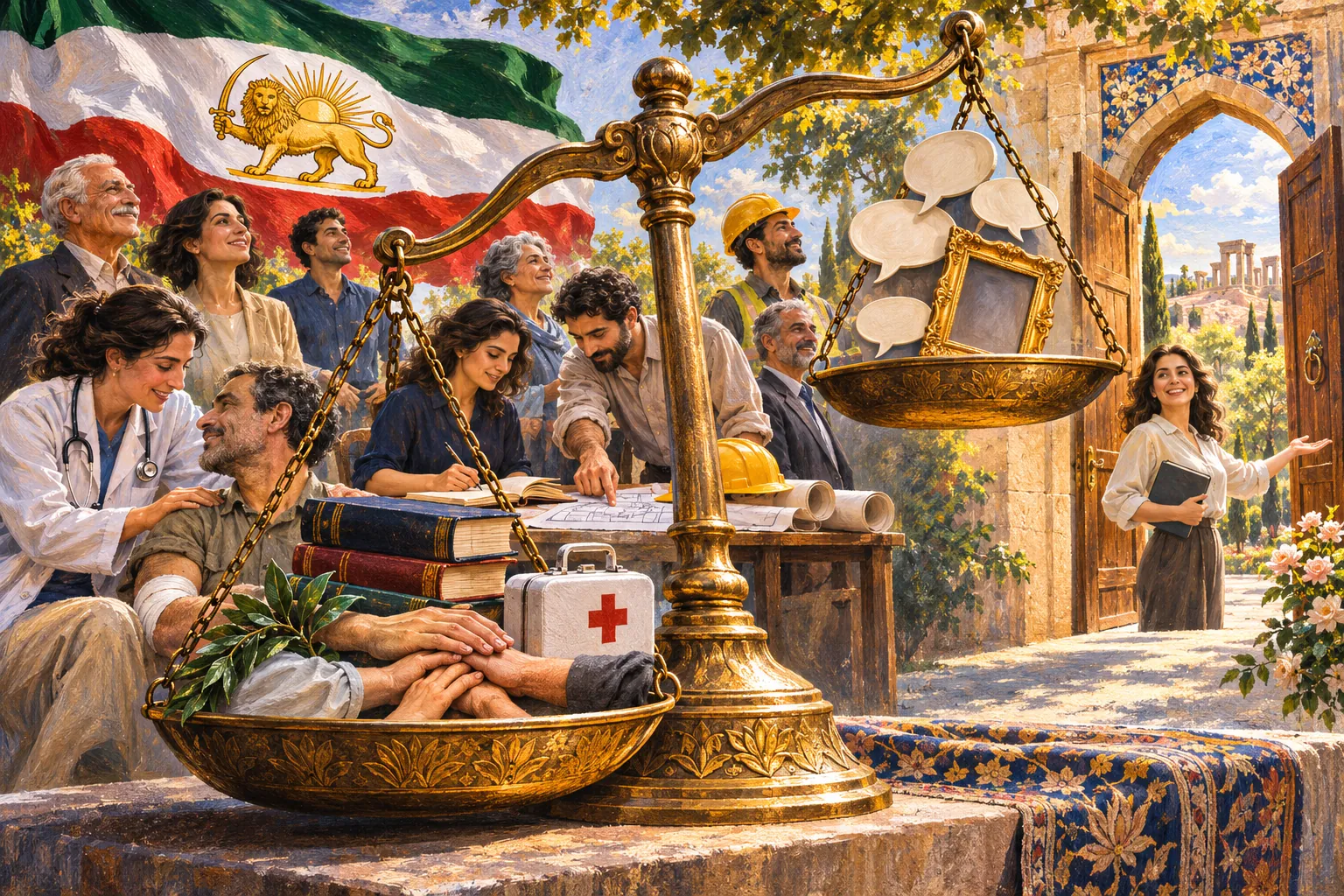
If we removed the Crown Prince’s name from your slogans, what would remain of your record? We should put this question, without hesitation, to everyone who speaks of loyalty, including myself. What have we built? What problem have we solved? What suffering have we relieved? What trust have we earned? And which responsibility have we carried through to the end?
Loyalty holds an honoured place in Iran’s historical culture. Yet a great value, detached from responsibility, can become a cover for a small claim. Iran, trapped under the Islamic Republic, needs a record of achievement. It needs people whose contribution can be shown to have made something better. This is what I call “measurable loyalty”: loyalty that leaves a clear trace in service, commitment, honesty and results.
The legacy of building Iran, and our responsibility for its future
When I look at the period between Qajar Iran and the Iran that emerged after the 1979 revolution, I see the Pahlavis as prominent representatives of a determination to build the country: to modernise, expand knowledge and expertise, strengthen the position of women, develop cities and infrastructure, and connect Iran with the world. My support for that legacy grows from this understanding.
This judgement does not mean treating the past as flawless. History must be examined through evidence, an understanding of context, and comparison with the possibilities and standards of its time. Both achievements and restrictions on political freedom and citizens’ rights belong in that examination. Historical scholarship must not erase service, just as patriotism must not forbid criticism. Our responsibility today is equally clear: to use the experience of the past to build the future. No nation creates tomorrow simply by praising yesterday.
In my view, the experience of religious rule has made the need to separate religion from the state tangible to a substantial part of society. My political preference is a parliamentary constitutional monarchy, and I support Crown Prince Reza Pahlavi’s leadership during the transition. That preference carries a practical obligation: we must show how this path leads to freedom, security, prosperity and the people’s right to choose. We cannot announce the majority’s will on the people’s behalf in advance. We must create the conditions in which they can express it freely.
Put your record of service on the table
Someone who builds a network of treatment and support for the injured has done something that can be examined. Someone who raises funds and accounts for how they are spent has accepted a responsibility. An author who produces credible books and articles, a translator who carries Iranian voices to the world, a person who turns contact with journalists and politicians into follow-up and results, and a specialist who prepares a workable plan for the country’s future have all added to our collective capacity.
Even here, however, precision matters. The number of books, meetings, photographs or pounds raised does not by itself establish effectiveness. A book must be worth reading and offer useful insight. A meeting must lead to follow-up. Money must reach its stated destination. A project must solve a problem. Measurable loyalty distinguishes activity from impact.
Set against this is a form of professed loyalty that evades every question. Its claimant says: my loyalty is “qualitative”; it cannot be measured. But trust, integrity, reliability and the ability to cooperate also reveal themselves through behaviour. Quality is no refuge from accountability. Someone who can offer no evidence of service has no right to issue certificates of loyalty to others merely by speaking more loudly.
Proximity to a personality is no proof of service to a nation. Put your record on the table.
Turn “Javid Shah” into a commitment
“Javid Shah” (“Long live the Shah”) and “Payandeh Iran” (“May Iran endure”) can express national feeling, hope and historical continuity. My question is what happens when the chanting ends. Has a new colleague joined the work? Has a family received help? Has a misunderstanding been resolved? Has a project advanced? Or does everything stop when the camera switches off?
If someone believes that repeating the title “Shah” or “King” removes the need for the people’s vote, they have not resolved the issue. They have erased the people’s rights from it. Support for Crown Prince Reza Pahlavi and the aspiration to constitutional monarchy acquire meaning through respect for Iranians’ free choice. In his speech in Toronto on 19 September 2026, he himself emphasised the people’s right to determine their future system through a free and fair vote, and the inclusion of republicans and monarchists, people of the right and of the left, within a framework of shared principles.[4]
Anyone who denies that right of choice in the name of loyalty must answer a simple question: to which commitment are they being loyal? We cannot speak of constitutional government while removing, from the outset, the condition of the nation’s consent.
A national movement does not belong to an inner circle
In the vision I defend, the Lion and Sun movement under the leadership of Crown Prince Reza Pahlavi must be capable of bringing together as many Iranians as possible. Such a movement cannot become an exclusive club for longstanding supporters, the loudest voices and those with privileged access. A history of support deserves respect. It does not confer ownership of Iran’s future.
Monarchists, republicans, liberals, social democrats, and people of the left, right and centre should be able to cooperate if they uphold territorial integrity, the separation of religion and state, equal rights and a free vote. They can preserve their differences for open political competition. I have explored this connection between responsibility and the ability to bring people together in my earlier writings on the Lion and Sun movement, political responsibility and reconciliation.[1], [2], [3]
Anyone who regards every newcomer as a threat to their own standing should reconsider their motives. Do they want Iran to be free, or do they want to remain the person closest to the leader within a small circle? Every time you narrow that circle, you diminish the national reach of the leadership. Whatever attractive name this behaviour adopts, the movement pays its price.
Reach those who have not yet joined
A political activist’s task is not confined to talking to like-minded people. We must move beyond our familiar circle, open the door to conversation and ask respectfully: what prevents you from joining us? Such conversations must be voluntary, without pressure, harassment or demands for information that someone does not wish to share.
The answer may be fear for family members in Iran. It may be concern about property, travel or personal safety. Someone may have been frightened by exclusionary slogans, threats against opponents, or contempt directed at leftists and republicans. They may distrust promises or have questions about the transition plan. Each answer gives us information with which to improve our work. None gives us permission to insult the person offering it.
If an Iranian says that calls for death directed at political groups have driven them away, our duty is not to rebuke them. We should communicate the issue clearly and with evidence to the Crown Prince’s office and advisers, respecting people’s consent and confidentiality and without compiling dossiers on opponents. Reports that pass praise upwards while concealing warnings damage the basis for decision-making. Mature loyalty can deliver unwelcome news.
No one is entitled to divide the spoils
No one can declare in advance the outcome or cost of the confrontation with the Islamic Republic. Hope of victory is essential. Believing that the work is already done is dangerous. Wishful thinking cannot overcome repression, and the enthusiasm of a gathering cannot, by itself, predict the future.
Cooperation with the United States, Israel and other countries, within the framework of Iran’s national interests, can form part of the foreign policy we support. Yet no foreign power can substitute for social trust, civic organisation, a transition plan and Iranians’ own responsibility. To expect others to bear all the costs while we arrive to divide offices and privileges is, in my judgement, the moral bankruptcy of political activism.
If someone cannot yet answer for a small project, on what record are they queuing for greater responsibility? A free Iran is not the spoils of any personality’s supporters. It is the home of its citizens.
People stand up for life
At the centre of this discussion stands the person who pays the price of repression with their body, family and future. Someone who stands for liberation wants, above all, freedom and life: for themselves, their children, their family and their country. Their suffering cannot be converted into a deed of ownership for a faction or a claim to privilege for those close to power.
As a trauma surgeon, I cannot reduce a human being to a number among the dead and injured in a political contest. No one owes their blood as proof of loyalty. The courage of the people increases our responsibility to protect their lives, support those who have been harmed and reduce the costs of the struggle. An appeal for sacrifice should give meaning to time, knowledge, work, resources and commitment. No activist abroad has the right, from a place of safety, to prescribe death as someone else’s duty.
In humanitarian assistance, too, need must be the criterion. Treatment and support for an injured person are not rewards for sharing our views. If we withhold help because of someone’s beliefs, we have betrayed the principle of equality before even reaching freedom.
How should loyalty be measured?
I advocate assessing performance, not ranking human worth. People do not have equal financial means, time, health or exposure to danger. An hour of responsible work may cost one person far more than a large donation costs another. Quiet and confidential work can also be valuable. We must therefore consider the commitment accepted, the person’s circumstances and the actual result together.
| Area of responsibility | A question that can be examined | Appropriate evidence |
|---|---|---|
| Humanitarian assistance | What need was met, and what follow-up took place? | Aggregate service reports and confirmation by the responsible person, protecting recipients’ identities |
| Financial resources | How much was received, where was it spent, and what remains? | Clear accounts, receipts and expenditure reports for responsible review |
| Content and education | What was produced, and what understanding or skill did it develop? | Published material, credible sources and meaningful audience feedback |
| Media and political engagement | What follow-up or specific action resulted from the discussion? | Meeting summaries, commitments that can be disclosed and the results of follow-up |
| Coalition-building and trust | What lasting cooperation emerged, and which barriers were reduced? | Joint projects, voluntary feedback and sustained participation |
| Project delivery | What was promised, what was delivered, and what was not? | A defined objective, responsible person, timetable, output and an honest explanation of delay or failure |
None of these criteria authorises the disclosure of sensitive information. Public reports can be general and anonymous, while responsible, trusted individuals examine the details. Honest failure from which lessons are learned is also different from a fabricated claim of success. Loyalty reveals itself in the willingness to acknowledge error.
Patriotism acquires meaning in everyday work
When I refer to examples such as Japan and Israel, I do not mean attributing a virtue to every individual in those societies or treating their policies as flawless. What I want for Iran is a culture of professional commitment, public responsibility and cooperation: a doctor faithful to the patient, an engineer to the soundness of a structure, a teacher to learning, a manager to the public trust, and a political officeholder to citizens’ rights.
Love of Iran should be visible in the quality of the work we deliver: in refusing to make empty promises, to turn collective credibility into personal privilege, or to invent imaginary opponents to conceal incompetence. A writer should produce passionate, reasoned work that creates responsibility. An organiser should make cooperation possible. A financial supporter should demand transparency. Those close to the leader should keep the channels through which reality reaches him open.
My proposal is simple. Each person and each group should accept a clear commitment proportionate to their capacity, identify who is responsible and set a deadline. At the end of that period, they should state what was done, what was not done and why. This small discipline builds a larger culture of accountability.
If you are loyal, build something on which people can rely. Trust, knowledge, an institution, access to treatment, a way to cooperate, or a plan for governing Iran better. Crown Prince Reza Pahlavi needs a capable and responsible society to advance a national transition. A closed circle of admirers, however loud, cannot take the place of such a society.
Real loyalty widens the circle of cooperation and lightens the burden of people’s suffering. When we ask ourselves and others, “What have you done for Iran?”, we should be able to give a clear answer: one that steps beyond the stage and makes a difference in people’s lives.
May Iran endure. Javid Shah: with a commitment to freedom, the people’s right to choose, and a record of service we can defend before the nation.
Related writings and the source of the official position
1. Peyman Bakhshayesh, Responsibility in the Lion and Sun Revolution: Between Top-Down Organisation and Bottom-Up Association. Persian text in the author’s personal archive, consulted for this article.
2. Peyman Bakhshayesh, “Political Responsibility in Iran’s Revolution”, 17 October 2026. Persian article.
3. Peyman Bakhshayesh, “Reconciliation”, 18 October 2026. Persian article.
4. Official website of Crown Prince Reza Pahlavi, speech at the Cyrus the Great event in Toronto, 19 September 2026. See the passages on the four principles, the right to choose the future political system and the inclusiveness of the movement. Source checked on 9 November 2026.