مقالهٔ سیاسی
Disturbing the Equilibrium
Mr Peyman Bakhshayesh examines the fragile balance around the Islamic Republic, the Iranian people’s place within it, and the responsibility to prepare humanitarian support before another crisis.
مقالهٔ انگلیسی
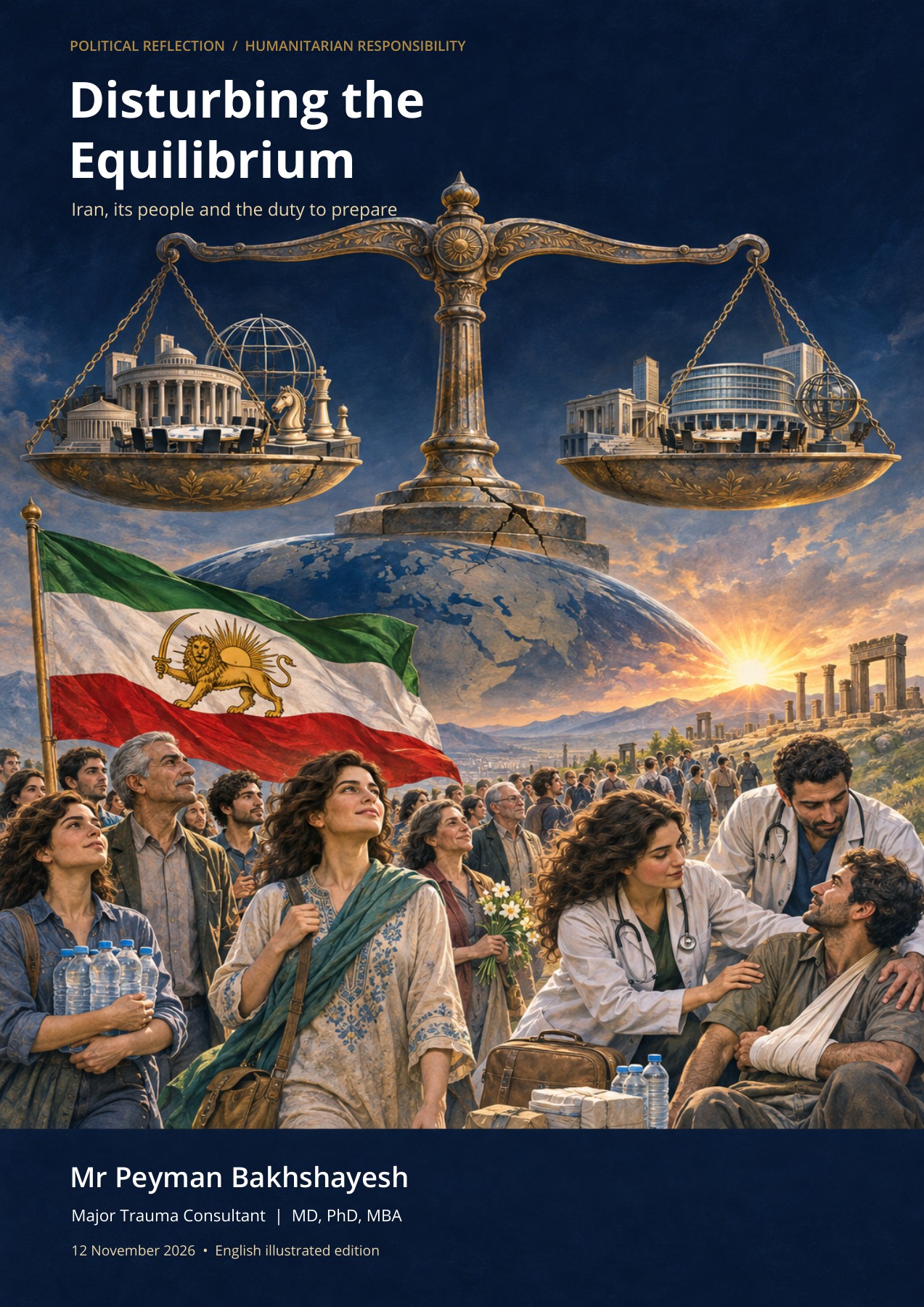
The world’s powers may find a balance they can live with. But where, inside that balance, are the Iranian people?
Author's note: This is my political analysis and humanitarian argument. Current events are referenced below; interpretations of motives, future risks and political choices are my own.
1. An equilibrium is not necessarily peace
An equilibrium is a steady state: the different forces inside a formula balance one another. But balance does not tell us whether the formula is fair. A system can remain in balance while the people living inside it suffer. What looks like stability from a negotiating table may look like imprisonment from an Iranian home.
This is how I understand the position surrounding the Islamic Republic of Iran. Each external power has its own concerns: security, energy, trade, influence, elections, migration, or the avoidance of another expensive war. Their priorities differ, but they can still arrive at an arrangement in which each accepts enough of the existing situation to carry on.
We must be precise about the present. The confrontation of June 2025 was followed by the US-Israeli campaign beginning on 28 February 2026. The conflict has not simply disappeared. Recent reporting describes continued confrontation at a lower intensity, attacks on shipping, a blockade and unresolved negotiations. What I call an equilibrium is therefore an unstable balance within an unfinished conflict, not a declaration that peace has arrived. [1][2][14]
My argument is about the direction in which powerful actors may wish to settle. They may find a way to contain the Islamic Republic, negotiate with it, punish it in selected areas and tolerate its continued existence. But there is a missing part of this formula: the Iranian people. I have raised this question before in The Illusion of Stability and The Missing Puzzle Piece. A balance that excludes the people cannot be assumed to last. [10][12]
2. Faith, ideology and Europe's political hesitation
There is a fundamental difference between Islam as a faith and political Islam as a project of power. Muslims are individuals with different beliefs, political opinions and ways of life. Their right to live safely, practise their religion and participate equally in Western society should not be confused with the ambitions of movements or states claiming religious authority.
My criticism is directed at the political establishment when it fails to keep that distinction clear. In my view, fear of appearing Islamophobic can sometimes discourage a necessary examination of authoritarian ideology. Protecting Muslim citizens from prejudice and challenging political intimidation are compatible duties. One must not become an excuse for neglecting the other.
Nor should different organisations be carelessly treated as one. The Muslim Brotherhood, the IRGC and the institutions of the Islamic Republic have different histories and structures. Any claim about their activities requires evidence. There is, however, documented concern about Iranian state operations abroad: in June 2026, 24 governments jointly condemned lethal plotting and intimidation associated with Iranian security services. [4]
It would be wrong to say that Europe has done nothing. The European Union designated the IRGC a terrorist organisation in February 2026 and imposed further sanctions. Britain has expanded sanctions while continuing to seek a negotiated solution to the nuclear dispute. [3][16] My question is whether these measures are sufficient, and whether the wider political approach still places managing relations with the regime above supporting a durable, Iranian-led democratic alternative.
In Using the UK's and Europe's Backyard, I described my concern that the freedoms of an open society can be exploited by those who do not respect them. [11] The answer is evidence, consistent law enforcement and political clarity, alongside equal citizenship. Confusing ordinary Muslims with the regime would repeat the very mistake I am criticising.
3. Different powers, different calculations
Europe has centuries of cultural, financial and political exchange with the Middle East. Its governments know how to negotiate, preserve relationships and continue trading through disagreement. I believe this experience can also create a dangerous confidence: the assumption that every contradiction can eventually be managed within the existing order.
In the United States, the argument is shaped by domestic politics as well as foreign policy. Opposition to President Trump is not, by itself, support for Tehran; objections to war can arise from constitutional, strategic and humanitarian concerns. Yet I worry that partisan rivalry sometimes becomes so dominant that the Iranian people's position disappears behind the argument about Trump.
The recent midterm election has also changed the political calculation. Democrats are projected to control the incoming Senate, although the new Congress takes office in January 2027. [7] That may alter the pressures on the administration. It does not automatically produce a coherent policy for Iran, and it does not mean that people inside Iran can put their lives on hold until Washington resolves its disagreements.
China and Russia approach Iran through their own strategic interests. In my view, they are milking the cow: drawing advantage from a relationship whose costs are borne heavily by ordinary Iranians. Neither should be mistaken for a guarantor of the Iranian people’s freedom.
My concern is simple. Every powerful country can find a reason to postpone the Iranian question. The people who cannot postpone it are the people living under the system.
4. Israel's security and Iran's future
For Israel, the question has a different intensity. Israelis must consider threats to their own lives and national security. A government facing missiles, drones and armed organisations supported by Tehran cannot view the Islamic Republic only as a difficult diplomatic partner.
The military damage inflicted on Iran and armed allies such as Hezbollah and Hamas does not justify assuming that their capacity or intention to cause harm has permanently disappeared. A weakened state can try to rebuild. A quieter period can be used for recovery. I regard renewed confrontation as a serious risk, but no analyst can honestly promise when, where or in what form it will occur.
We should also resist the comforting idea that overseas threats have gone quiet. On 10 November, the US Department of Justice announced an indictment alleging Iranian-backed involvement in nearly twenty attacks and attempted attacks in Europe and the United States. These remain allegations to be tested in court, but they reinforce the need for vigilance. [17]
Israeli politics is changing too. Following the October election, Benjamin Netanyahu's bloc lacks a parliamentary majority, and Gadi Eisenkot is attempting to form a coalition. The outcome remains uncertain. [8] A different government could change the tone or methods of policy, but we should not confuse that possibility with a guaranteed settlement or an automatic change in Israel's fundamental security concerns.
This is another reason for Iranians to retain their own political agency. Israel's government must answer to Israelis; America's government must answer to Americans. Cooperation with either may be valuable, but neither can substitute for an Iranian national project.
The survival of the Islamic Republic, Israel's security, regional stability and the freedom of Iranians are connected questions. They are not identical questions. If negotiations address only the first three, the fourth does not cease to exist.
5. The missing part of the formula: the Iranian people
Iran is a country of roughly 93 million people. [15] They do not all think alike, and nobody can honestly claim to speak for every one of them. Nevertheless, the scale of popular anger cannot be reduced to a diplomatic inconvenience. There is a nation inside this equation, with its own memory, dignity, suffering and expectations.
The killings of January 2026 changed the political and emotional landscape. On 23 January, the United Nations Human Rights Council deplored the violent crackdown that had resulted in thousands of deaths and called attention to the communications blackout imposed from 8 January. [5] The exact death toll remains contested; that uncertainty does not diminish the documented scale of the tragedy.
Nor does a reduction in street killing mean that repression has ended. In September, the UN fact-finding mission reported protest-related executions and continuing danger to detainees. [6] A prisoner awaiting execution, a family searching for a missing relative, or a wounded person afraid to seek care does not experience this situation as an equilibrium.
In my judgment, January destroyed whatever confidence many Iranians still had that the existing system could accommodate their aspirations through meaningful reform. For many, reconciliation with the Islamic Republic has become almost non-negotiable. This is why an arrangement acceptable to foreign governments may remain unacceptable to a large part of Iranian society.
The Islamic Republic may be able to negotiate with other states. It cannot assume that those negotiations will reconcile it with its own people. External acceptance does not create internal legitimacy.
6. Leadership, trust and the terrible question of sacrifice
Will Iranians return to the streets? Would they respond again to a call from Crown Prince Reza Pahlavi? His calls for coordinated expressions of protest on 8 and 9 January were publicly reported. [9] What follows from that experience cannot be answered simply by counting supporters or repeating slogans.
I believe many people hoped that the United States, Israel and Crown Prince Reza Pahlavi were moving towards a common position that would offer them protection. Hope, however, is not a verified security guarantee. After the killings and the blackout, any future appeal must confront the question of trust: what has changed, and what protection can actually be provided?
The Islamic Republic has demonstrated that it can respond to popular opposition with lethal force. We must not make a prediction that the next confrontation will necessarily be worse, but we must prepare for the possibility of severe repression. Courage deserves respect; it must never become an excuse for careless promises.
Are we prepared to contemplate the loss of two or three million of our own people? I use those words as a terrible question, not a casualty forecast and certainly not an acceptable price. No responsible political project should treat human beings as an expendable resource. The duty is to prevent catastrophe and protect life.
Leadership must be judged by organisation, honesty and responsibility as well as popularity. It must explain the limits of external support, strengthen national cohesion and take civilian protection seriously. People deserve more than another expectation that someone else will arrive in time.
7. Preparedness is a practical responsibility
Given Iran's economic pressures, repression and blocked political hopes, I do not believe that passive waiting is an adequate answer. That does not make internal war inevitable or desirable. It means that renewed mass protest, intensified repression, displacement and wider conflict must be considered as humanitarian contingencies before they overwhelm us.
As a major trauma consultant, I know that the moment a casualty arrives is too late to begin discussing whether a system should exist. Preparedness means connecting competent people, defining responsibilities and ensuring that supplies and pathways are real. Sympathy alone cannot provide an operation, a dressing, safe water or a place for a frightened family to sleep.
We need relationships with established humanitarian organisations, hospitals, professional bodies and international partners. Those relationships should support civilian access to medicines, essential healthcare, food, drinking water and shelter. Preparation must include people with diabetes, cancer, disability and other continuing needs, whose care can collapse when attention turns entirely to visible injuries.
We should plan for rehabilitation and prosthetic needs, psychological support, displaced families, refugees and the relatives of imprisoned people. Support for detained people and their families also requires trusted legal and human-rights organisations. Confidentiality matters: a list of vulnerable people can become a source of danger if it is handled carelessly.
Aid must be allocated according to need. It must not depend on political allegiance, religion, publicity or willingness to support a particular leader. A humanitarian network gains trust by protecting people consistently, including those whose political views differ from our own.
8. Prepare for change by protecting the people
The coming months and years will show how this unstable balance develops. There may be renewed confrontation, further negotiations, political transition or prolonged repression. I cannot tell the Iranian people which date will bring change, and I will not pretend that suffering follows a timetable.
But uncertainty is not a reason for inactivity. The diaspora contains doctors, nurses, engineers, organisers, researchers, businesses and people able to contribute time and resources. These abilities need coordination, credible partners and transparent administration. Small, dependable commitments are more useful than grand announcements without a working structure.
This connects with what I have called the liberation of the resources. [13] The Iranian people's knowledge, talent, money and determination are not absent. They are scattered, constrained or prevented from serving a common future. Bringing them into responsible cooperation is itself a form of national preparation.
The purpose must remain clear: protect civilians, preserve the possibility of a democratic future and prevent avoidable suffering. Preparedness is not a celebration of war. It is the recognition that those who speak about freedom also carry a responsibility towards the people who may pay the price of change.
The world's powers may find an equilibrium that suits their interests. The Iranian people are not obliged to experience that equilibrium as justice. They remain the unresolved part of the formula, because their future cannot permanently be negotiated without them.
Preparedness is my answer to the uncertainty ahead: not a promise that tragedy can be eliminated, but a determination that we will not meet it without organisation, compassion and a practical commitment to saving lives.
Sources and related writing
English edition · 12 November 2026. Numbered references support the factual passages and identify related writing by the author.
- House of Commons Library. Israel/US-Iran conflict 2026: Background and UK response. Research Briefing 10521, 24 April 2026.
- Security Council Report. Briefing on the Situation in the Gulf Region. 11 November 2026.
- Council of the European Union. Timeline: EU sanctions against Iran. 2026.
- Foreign, Commonwealth & Development Office. Joint statement on Iranian State Threats and HAYI-claimed attacks. 10 June 2026.
- UN Human Rights Council. Resolution A/HRC/RES/S-39/1. Adopted 23 January 2026.
- OHCHR. Statement by Sara Hossain, Chair of the Independent International Fact-Finding Mission on Iran, to the 63rd Human Rights Council session. September 2026.
- Reuters. Democrat Colom wins Mississippi Senate seat, becomes state's first Black senator since 1874. 11 November 2026.
- Reuters. Israel's parliament sworn in as Eisenkot tries to forge a government. 10 November 2026.
- Iran International. Exiled prince, Kurdish parties call for protests and strikes on Thursday. 6 January 2026.
- Peyman Bakhshayesh. The Illusion of Stability. Related author essay.
- Peyman Bakhshayesh. Using the UK's and Europe's Backyard. Related author essay.
- Peyman Bakhshayesh. The Missing Puzzle Piece. Related author essay, Persian.
- Peyman Bakhshayesh. Liberation of the Resources. Related author essay.
- House of Commons Library. Iran: Impacts of June 2025 Israel and US strikes. 22 July 2025.
- PopulationPyramid.net. Iran population, 2026: 93,168,497. UN World Population Prospects 2024, medium projection.
- UK Foreign, Commonwealth & Development Office. Written Ministerial Statement: Iran Sanctions. 8 September 2026.
- US Department of Justice. Three Iranian-Backed Operatives Indicted for Their Roles in Nearly 20 Terrorist Attacks and Attempted Attacks Across Europe and the United States. 10 November 2026.