Page image unavailable. Open the complete English PDF.
English reading text
Open a topic to read its English instructions alongside the illustrated page.
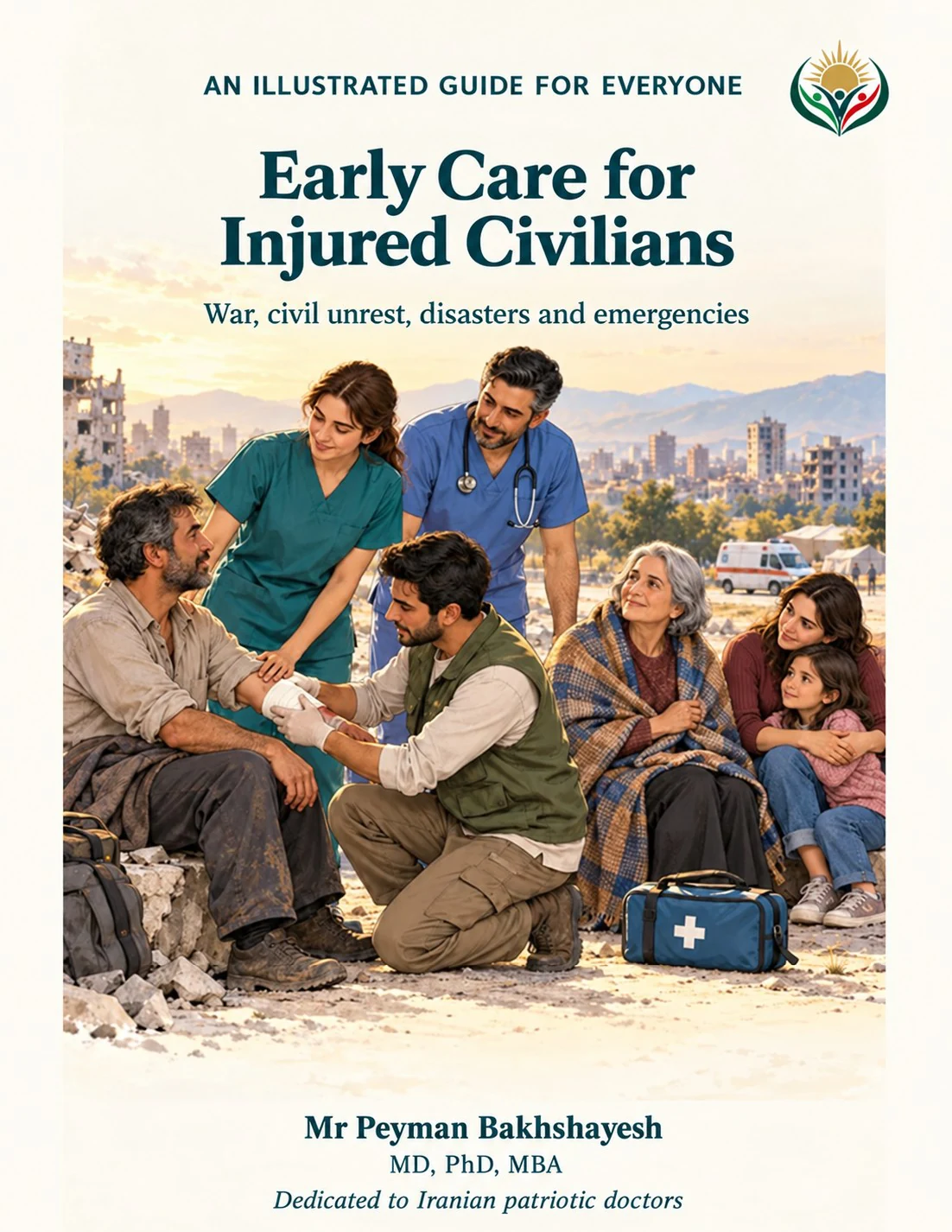
2. Dedicated to Iranian patriotic doctors
Dedicated to Iranian patriotic doctors
I dedicate this book to Iranian patriotic doctors: to those who, in the most difficult moments, place their knowledge, courage and compassion at the service of saving lives.
And to the nurses, rescuers and volunteers who remain beside the injured and uphold human dignity.
Care according to medical need, for every person, regardless of belief or affiliation.
Mr Peyman Bakhshayesh
3. About the author
About the author
Mr Peyman Bakhshayesh is a Consultant Trauma and Orthopaedic Surgeon at Leeds Teaching Hospitals and an Honorary Clinical Senior Lecturer at the University of Leeds. He was born in Abadan and lives in Leeds. After studying medicine in Shiraz, he undertook specialist orthopaedic training in Sweden and further training in Sweden, Germany and the United Kingdom. His research doctorate at Karolinska Institutet concerned pelvic-ring injuries.
His clinical and research work focuses on major trauma, complex fractures, limb reconstruction and recovery after injury. He is also a writer and civic activist concerned with Iran's future, equal citizenship and national reconciliation.
4. How to use this book
How to use this book
If you cannot make a call, ask someone else to seek help and arrange transfer along a safe route to a healthcare facility. Keep local addresses and emergency numbers on paper before a crisis. [15]
Medical emergency: UK 999 or 112 | Iran 115. Give the exact location, the type of incident and the number of injured people.
Safety first
Do not enter gunfire, dense smoke, unstable rubble or a contaminated area.
Do not delay calling for help
If possible, put the telephone on speaker and follow the emergency call handler's instructions.
Follow the numbered pictures
The numbers on each illustrated guide show the sequence of actions. The original panel arrangement is retained, usually beginning at the top right. Address an immediate danger as soon as you identify it.
Act within your skills
Pictures do not replace practical training. Do not loosen or remove a tourniquet, and do not perform surgery.
5. Contents
Contents
View illustrated page 56. Contents, continued
Contents, continued
View illustrated page 67. Scene safety and calling for help
Safety and assessment. Safety first, then help.
1. Check hazards from a safe distance. Do not touch ammunition or suspicious objects.
2. Call emergency services. Give the location, what happened, number of casualties and current hazards. Report severe bleeding or breathing difficulty.
3. Use gloves or a clean, intact barrier. Wash your hands after helping.
4. Do not send volunteers into active danger. Trained rescuers should evacuate people from hazardous areas.
5. If they can walk, guide them along a safe route. Move a casualty who cannot walk only for immediate danger or essential lifesaving care.
6. Record the time; do not delay help. Do not publish the casualty's name or picture without consent.
If you are injured too, you are less able to help.
References: 1, 15 (see pages 50-52).
8. Rapid assessment and reassessment
Safety and assessment. Find life-threatening problems, act, and check again.
1. Can you hear me? What happened? Introduce yourself and ask permission to help. Gently touch the shoulder; do not shake the person.
2. Control life-threatening bleeding first. In severe trauma: xABCDE or CABCDE. Then continue the ABCDE assessment.
3. Treat a life-threatening problem immediately: airway, breathing, circulation and consciousness. A detailed history can wait.
4. Reassess after treatment, movement or deterioration. Start with bleeding and A. Clothing or blankets must not hide a tourniquet.
5. Choose one coordinator and give everyone clear tasks. Communicate essential information briefly and clearly.
6. Complete SAMPLE after lifesaving measures. Filling in a form must not delay transfer.
If the person does not respond, call emergency services immediately. If they are not breathing normally, start CPR.
References: 1, 10 (see pages 50-52).
9. Initial assessment of an injured person
Stay calm, call for help, treat immediate threats. Make the scene safe first; then ask for help and call emergency services.
1. Introduce yourself and check response: Can you hear me? Do not shake the casualty. Give your name and ask a conscious person for permission to help.
2. Life-threatening bleeding first: apply direct pressure with gauze or a clean cloth. xABCDE / CABCDE.
3. Then ABCDE: A Airway; B Breathing; C Circulation; D Disability; E Exposure and warmth. Treat each immediate threat as you find it.
4. Reassess: after any treatment, movement or deterioration, restart with bleeding and A. Keep an applied tourniquet visible.
5. Give clear tasks: choose one coordinator; assign tasks briefly and clearly.
6. History after lifesaving care: SAMPLE - Signs and symptoms, Allergies, Medicines, Past history, Last oral intake, Events. Questions and forms must not delay transfer.
Unresponsive and not breathing normally? Start CPR immediately and follow the emergency call handler's instructions.
References: 1, 2 (see pages 50-52).
10. Severe bleeding and direct pressure
Danger: spurting, continuous flow, pooling blood or rapidly soaked clothing!
1. Call for help and expose the wound. Wear gloves; place gauze or a clean cloth over the wound.
2. Press firmly and directly with your palm. Do not stop pressing to look.
3. Do not remove the first pad; keep pressing. Add another layer of gauze if needed.
4. Ordinary pressure dressing: once bleeding is controlled, keep the dressing in place. Fingers must not become cold, pale or numb. Can you feel this?
5. Life-threatening arm or leg bleeding not controlled by pressure? Use a tourniquet according to training or emergency guidance. Record the application time; do not loosen or remove it.
6. Do not press on an injured eye, protruding bone or embedded object. Do not pull objects out; support them and seek specialist help.
Control bleeding first: washing wounds, looking for bullets or closing the skin must not delay help and transfer.
References: 1, 16 (see pages 50-52).
11. A commercial tourniquet
Use a commercial device according to its instructions and practical training.
1. Life-threatening arm or leg bleeding not controlled by direct pressure? Call emergency services; use a commercial tourniquet. Never apply one to the neck or torso.
2. Apply 5-7 cm above the wound, towards the body. Never over a joint; if needed, position it above the joint.
3. Pull the strap tight; turn the windlass until bleeding stops. Secure the windlass in its clip. It may be painful; the aim is to stop bleeding.
4. If bleeding continues, apply a second tourniquet above the first. Do not remove the first; arrange urgent transfer.
5. Record when each tourniquet was applied. Keep it visible and tell the treating team the time.
6. Do not loosen or remove the tourniquet, even if transfer is delayed. Only a qualified clinician should decide when to remove it.
Practise with a training device before an emergency. Wire, string and narrow straps are not safe substitutes.
References: 1, 16 (see pages 50-52).
12. When a commercial tourniquet is unavailable
Direct pressure comes first; ordinary elastic is not a suitable substitute.
1. Call for help; start direct pressure. Press firmly and continuously over the wound with a clean cloth.
2. Do not use ordinary elastic, string, wire or narrow straps. Simply knotting a cloth may not control bleeding.
3. An improvised tourniquet is for an emergency only: life-threatening arm or leg bleeding not controlled by pressure. Follow training or emergency call-handler guidance.
4. Broad, non-elastic cloth + a strong windlass. The cloth should be at least 5 cm wide.
5. Position 5-7 cm above the wound; never over a joint. Turn the windlass until bleeding stops and secure it.
6. Record the time; arrange urgent transfer. Do not loosen or remove the tourniquet. Show the device and application time to the treating team.
Commercial tourniquets are more reliable; learn the practical skills in advance.
References: 16 (see pages 50-52).
13. Deep wounds and embedded objects
First aid for the public.
1. Direct pressure and urgent help: press firmly and continuously over the bleeding point and call for help.
2. Wound packing: trained people only. For a suitable wound in the groin or armpit; follow your training and the product instructions.
3. Do not pack these areas: Chest, Eye, Abdomen, Neck. Do not push gauze into wounds of the chest, abdomen, eye or neck.
4. Do not remove embedded objects. Support the object with gauze around it; apply pressure around the object.
5. Do not push bone back inside. Cover with clean gauze and support the limb without manipulating it.
6. No probing or chemicals. Do not stitch or burn a wound, or pour chemicals into it. Bottle labels: Alcohol; Hydrogen peroxide. Medical centre.
Even a small wound may be deep and dangerous: seek medical care.
References: 16 (see pages 50-52).
14. Keeping the airway open
Airway, breathing and resuscitation. Unresponsive? Call emergency services immediately.
1. Speech and sound: clear speech means air is passing for now. Take snoring, gurgling or a changed voice seriously.
2. Look inside the mouth. Remove only a visible, loose object that is easy to reach.
3. No suspected neck injury: gently tilt the head back and lift the bony part of the chin. Do not press the soft tissue under the chin.
4. Suspected neck injury: minimise neck movement. Jaw thrust is for trained rescuers only. If the airway does not open, move the head and chin only as much as necessary.
5. Blood or vomit in the airway: if the airway is threatened, with help roll the head, neck and body together onto the side. An open airway takes priority.
6. Check breathing: for no more than 10 seconds, look, listen and feel. Unresponsive + not breathing normally = start CPR.
Do not sweep blindly inside the mouth. Do not pull out fixed teeth or a stuck object. Do not put any instrument into the throat.
References: 4 (see pages 50-52).
15. Checking breathing
Airway, breathing and resuscitation. First aid for adults. Unresponsive: call emergency services immediately.
1. Check breathing: look for chest movement and listen for breathing, for no more than 10 seconds.
2. Unresponsive and breathing abnormally: occasional gasps are not normal breathing; start CPR immediately.
3. Danger signs - urgent transfer: breathlessness, blue lips, severe pain, a chest wound or coughing up blood.
4. After an explosion: lung injury can appear later. Anyone with symptoms needs medical assessment.
5. Care for a conscious person: a comfortable position, loose clothing, warmth and repeated breathing checks.
6. Breathing equipment - trained rescuers only: oxygen, suction and bag-mask ventilation require skill and monitoring.
A normal oxygen reading does not rule out danger; do not delay transfer of someone with symptoms.
References: 1, 2 (see pages 50-52).
16. Adult CPR and an AED
Airway, breathing and resuscitation
CPR for an unresponsive adult
Unresponsive + absent or abnormal breathing = start CPR immediately
Occasional gasps are NOT normal breathing.
Call for help
Make sure the scene is safe. Call immediately: UK 999 or 112; Iran 115. Put the phone on speaker. Ask someone to bring an AED.
999
Correct hand position
Heel of one hand on the lower half of the breastbone; the other hand on top. Interlock fingers and keep arms straight.
Push firmly and rhythmically
100–120 compressions per minute
Depth 5–6 cm
Let the chest fully recoil after every compression. Minimise pauses.
Give breaths if trained
30 compressions and 2 breaths, just enough to make the chest rise. If unable to give breaths, continue chest compressions.
30 compressions / 2 breaths
Use an AED
Switch it on and follow its instructions. Nobody must touch the person during rhythm analysis or shock. Then resume CPR immediately.
Continue CPR
Continue until help takes over, you cannot continue, or the scene becomes unsafe. If normal breathing and signs of life return, reassess breathing.
Change compressor about every 2 minutes.
In trauma, another helper should also manage severe bleeding and the airway.
Based on RCUK 2025 Adult Basic Life Support.
Mr Peyman Bakhshayesh | Early Care for Injured Civilians
Sources: 2
Page 16
References: 2 (see pages 50-52).
17. Child and infant CPR
Child and infant CPR
Unresponsive and not breathing normally? Act immediately.
When safe, call: UK 999 or 112; Iran 115. Put the phone on speaker.
Follow the emergency call handler's instructions.
Airway, breathing and resuscitation
1. Airway and breathing
Open the airway; check breathing for no more than 10 seconds.
Keep an infant's head near neutral; do not tilt it too far back.
Occasional gasps are NOT normal breathing.
10 seconds
2. Five initial breaths
If able, give 5 initial rescue breaths.
Infant: cover mouth and nose. Child: mouth-to-mouth, pinch the nose.
Each breath about 1 second, just enough for the chest to rise.
3. Chest compressions
100–120 per minute
Press on the lower half of the breastbone.
Depth: about one third of the chest: infant about 4 cm; child about 5 cm.
Allow full chest recoil after every compression.
4. Correct hand position
Infant: both thumbs on the breastbone; fingers encircle the chest and back.
Child over 1 year: one or two hands, according to size.
Practise these methods on a manikin.
5. Repeat compressions and breaths
Public or adult-BLS-trained rescuer:
30 compressions : 2 breaths
Paediatric-BLS-trained rescuer:
15 compressions : 2 breaths
Unable to give breaths? Start continuous chest compressions.
6. Automated external defibrillator
Follow the AED instructions.
Use paediatric mode for children under 25 kg (about 8 years), if available.
If paediatric mode is unavailable, use standard mode.
Nobody touches the child during analysis or shock. Resume CPR immediately.
Child mode
Being alone or without a suitable mask must not prevent action.
This picture does not replace practical infant and child manikin training.
Not a newborn resuscitation guide. Training source: RCUK 2025.
Mr Peyman Bakhshayesh | Early Care for Injured Civilians
Sources: 3
Page17
References: 3 (see pages 50-52).
18. Choking in an adult
Airway, breathing and resuscitation. Food or a foreign body blocking the airway. Severe choking: call for help. UK: 999 / 112. Iran: 115.
1. Effective cough: encourage coughing and stay with the person. If unable to speak or cough effectively, continue below.
2. Give up to 5 back blows. Lean them forwards and give blows between the shoulder blades with the heel of your hand. Check after each blow.
3. Give up to 5 abdominal thrusts if back blows fail. Place a fist above the navel and below the breastbone, grasp it with the other hand and pull inwards and upwards.
4. Alternate up to 5 back blows and up to 5 abdominal thrusts. Stop immediately when the blockage clears.
5. During pregnancy, or if you cannot encircle the abdomen, use chest thrusts instead of abdominal thrusts. Follow emergency telephone instructions.
6. If unresponsive, lower carefully onto a firm surface. Start CPR with chest compressions and follow emergency instructions.
Do not sweep blindly inside the mouth. Remove only a clearly visible, easily reached object. Never give abdominal thrusts to an infant under one year. Medical assessment is needed after abdominal or chest thrusts. This method is not for mouth bleeding or mouth wounds. Based on RCUK 2025 and Red Cross guidance. Source: 1.
References: 1 (see pages 50-52).
19. Choking in an infant under one year
Airway, breathing and resuscitation. Under one year of age. Severe choking: call for urgent help. UK: 999 / 112. Iran: 115.
1. Effective cough or cry? Stay with the infant and monitor breathing.
2. Unable to breathe or cry? Call 999 / 112 immediately.
3. Give up to 5 back blows. Support the head and jaw. Keep the head lower than the chest.
4. If not cleared, give up to 5 chest thrusts. Use two thumbs, with hands encircling the chest. Alternate back blows and chest thrusts until the blockage clears.
5. Never give abdominal thrusts. Never sweep a finger blindly inside the mouth. Stop blows or thrusts once breathing or crying returns.
6. Unresponsive? Begin infant CPR. Give 5 initial rescue breaths, then chest compressions and breaths. Follow emergency instructions.
Use this illustration alongside practical training and emergency guidance. RCUK 2025. Source: 3.
References: 3 (see pages 50-52).
20. Choosing a body position
Airway, breathing and resuscitation. Do not put every injured person in the same position.
1. Unresponsive with abnormal breathing: lay on their back and start CPR. The recovery position does not replace CPR.
2. Unresponsive with normal breathing and no injury: place on their side in the recovery position. Check airway and breathing regularly.
3. Possible neck or spinal injury: avoid unnecessary movement. Support the head in a tolerable position.
4. Blood or vomit blocks the airway: with helpers, turn the head, neck and trunk together onto the side. An open airway takes priority.
5. Alert and short of breath: allow a comfortable position, usually semi-sitting.
6. Severe weakness or suspected shock: if breathing allows, lay on their back and keep warm.
Never force the neck or a limb to straighten it. Reassess after any change in consciousness or breathing. Seek professional help urgently. Sources: 1, 4.
References: 1, 4 (see pages 50-52).
21. An open chest wound
Special injuries and hazards. First aid until help arrives. Breathlessness, sucking sounds or frothy blood are danger signs. Their absence does not rule out danger.
1. Call emergency services immediately: UK 999 / 112; Iran 115. Arrange urgent transfer to a medical facility.
2. Leave the wound open. Do not cover the hole.
3. Control bleeding around the wound with local pressure. Do not pack or block the hole.
4. Do not remove an embedded object. Do not probe the wound.
5. Trained responders only: use a purpose-made vented chest seal. Check that air can escape.
6. Continually check breathing and responsiveness. Do not delay transfer.
Do not use plastic or a three-sided taped dressing. Searching for an exit wound must not delay transfer. Based on RCUK / ERC first-aid guidelines 2025. Source: 1.
References: 1 (see pages 50-52).
22. Distinguishing a lung problem from an airway problem
Special injuries and hazards. An airway problem affects the route through which air enters. Pneumothorax means air, and haemothorax means blood, in the space around the lung.
Danger signs: worsening breathing or reduced consciousness after a chest injury is an emergency.
General first aid: call for help and arrange urgent transfer.
Until help arrives: if alert, allow a comfortable position for breathing. Check breathing and responsiveness and keep warm.
Specialist treatment: chest drainage is for the clinical team only.
Do not puncture the chest or neck with a needle or knife. Making an opening in the neck does not drain air or blood from around the lung. Caring for an existing tracheostomy differs from creating a new one. Sources: 1, 10.
References: 1, 10 (see pages 50-52).
23. Shock and internal bleeding
C | Circulation and shock. Shock means insufficient blood and oxygen reach the organs. Call emergency services immediately: UK 999 / 112; Iran 115.
1. Warning signs: pale skin, cold sweat, weakness, rapid breathing or confusion. Not every sign needs to be present.
2. Control bleeding: apply direct pressure to a bleeding wound. Recheck for visible bleeding.
3. Take internal bleeding seriously: pain or swelling in the abdomen, pelvis or thigh, or deterioration, needs urgent help even without visible bleeding.
4. Appropriate positioning: if breathing allows, lay on their back. Avoid unnecessary movement if spinal injury is possible. Do not raise the legs with head, pelvic, spinal or leg injuries.
5. Keep warm and monitor: use a blanket and insulation from the ground. Check breathing and responsiveness frequently.
6. Do not give food or drink: give nothing by mouth after severe injury or suspected internal bleeding. IV fluids and injections require a clinician's decision.
Normal blood pressure or pulse does not rule out internal bleeding. Unresponsive and not breathing normally? Start CPR. Sources: 1, 16.
References: 1, 16 (see pages 50-52).
24. Consciousness, head injury and seizures
D | Consciousness and signs of brain injury. Assess responsiveness, brain and nervous system.
1. Check responsiveness: ask their name and give a simple instruction. Record any change in response. Do not cause pain to test a response.
2. AVPU: A means alert; V means responds to voice; P means responds only to pain; U means unresponsive. P only describes a response already observed.
3. Danger signs after head injury include severe headache, repeated vomiting, seizure, increasing confusion, one-sided weakness or reduced consciousness. Obtain urgent help and hospital transfer.
4. Protect the head and neck: minimise unnecessary movement. Do not insert anything into a bleeding ear or nose.
5. During a seizure: make the surroundings safe, cushion the head, and record start and finish times. Do not restrain. Put nothing in the mouth.
6. Check breathing after a seizure. Unresponsive with abnormal breathing: start CPR. More than 5 minutes, or repeated seizures without recovery: emergency. First seizure, pregnancy, injury or breathing difficulty: urgent help.
UK: 999 / 112. Iran: 115. Do not leave the person alone. Reduced consciousness may result from head injury, lack of oxygen, shock or illness. Educational sources: NHS, St John Ambulance and RCUK 2025. Sources: 1, 4.
References: 1, 4 (see pages 50-52).
25. Checking the body and protection from the environment
E | Exposure and environmental protection. Examine only as much as needed, then cover again. Do not delay calling for help or controlling severe bleeding.
1. Look from head to toe: move only necessary clothing and protect the person's privacy.
2. Do not turn unnecessarily: minimise movement if spinal injury is possible. Keeping the airway open takes priority.
3. Keep dry and warm: carefully replace wet clothing. Put blankets underneath and over the body. Do not cover the face or airway.
4. Protect the wound: after bleeding is controlled, cover a soft-tissue wound with clean gauze. Open chest wounds, eye injuries and exposed abdominal organs need special care.
5. Protect privacy and dignity: do not take or share photographs without consent. If possible, let a trusted companion stay.
6. Protect from the environment: shelter from wind, rain, strong sunlight and contamination. Keep checking breathing and responsiveness.
A blanket does not replace transfer and treatment. An injured person may become cold even in warm weather. UK 999 / 112; Iran 115. Safety guidance: RCUK 2025. Source: 1.
References: 1 (see pages 50-52).
26. Fractures, spine and pelvis
Special injuries and hazards. Support; never force straight. Take severe pain, deformity, numbness or an open wound seriously.
Immediate dangers first: make the scene safe and call emergency services. UK 999 / 112; Iran 115. Severe bleeding, airway and breathing take priority.
Support the injured limb: support it in the position found and tolerated, using a pillow or soft clothing. Do not pull it or force it straight.
Splint only if trained: use a padded splint. Before and afterwards, check colour, warmth, feeling and finger movement. Report deterioration immediately to emergency services.
Do not rotate the neck: ask an alert person to keep their head still and comfortable. Do not turn the neck to test for injury. Do not fit an improvised collar.
Do not press on the pelvis: do not press or rock the pelvis to examine it. Do not force painful or deformed legs together. Use a pelvic binder only with training; cloth tied around the waist is not a substitute.
Do not push bone back inside: cover the wound with a clean dressing. Do not press on protruding bone or push it back inside.
Move only for immediate danger or a life-saving action, with as little movement as possible. Airway care and CPR take priority over spinal immobilisation. Sources: 1, 12.
References: 1, 12 (see pages 50-52).
27. Eye and abdominal injuries, and amputated limbs
Special injuries and hazards. First aid until emergency help arrives. UK: 999 / 112; Iran: 115. Safety first, control severe bleeding and check breathing.
1. Penetrating eye injury: do not apply pressure, remove an object or rinse the eye. Place a rigid shield without touching the eye or object. Urgent transfer is needed.
2. Exposed abdominal tissue: do not push tissue back inside or apply pressure. Cover loosely with clean gauze moistened with saline or clean water. Prevent it from drying out.
3. Save the person first: after amputation, first control the person's bleeding with direct pressure. Do not delay care while searching for the detached part.
4. Package the detached part: wrap in clean gauze lightly moistened with saline. Place in a waterproof bag and seal it.
5. Keep cool: place the sealed bag in a container of ice and water. The part must not touch water or ice directly. Do not freeze it.
6. To hospital with the person: record the time of injury and the person's identifier. Take the part to the same medical facility with the person. Your safety and saving life take priority.
A penetrating wound or fragment near the eye, chest or abdomen needs urgent assessment, even with little bleeding. Sources: 13, 14, 16.
References: 13, 14, 16 (see pages 50-52).
28. Burns and fire-related injury
Injuries and special hazards
Burns and smoke injury
First aid while waiting for help
Safety first: move away from the source. Do not enter fire or a smoke-filled area.
1. Cool for 20 minutes
Cool thermal burns under cool running water, not ice. Keep the rest of the person warm, especially children and people with extensive burns.
20 minutes
2. Remove jewellery early
Gently remove rings, watches and clothing that is not stuck.
Do NOT remove clothing stuck to the skin.
3. Cover loosely and cleanly
After cooling, apply a clean non-stick covering. Do not wrap tightly around the limb. Do not burst blisters.
4. Put nothing on the burn
No ice, oil, butter, toothpaste, soil or powder. Mild pain does not rule out a deep burn.
Ice
Oil
Butter
Toothpaste
Soil or powder
5. Airway injury: an emergency
Face or neck burns, hoarseness, soot in the mouth or difficulty breathing: urgent help.
A burn in an enclosed space needs urgent assessment.
UK 999 / 112
Iran 115
6. Chemicals and electricity
Chemical, electrical, deep or extensive burns need urgent treatment.
Switch off electricity safely before touching someone who has been electrocuted.
Contact with acid or alkali
Protect your hands. Gently brush off dry powder and remove contaminated clothing. Immediately rinse with plenty of water and seek emergency guidance. Do NOT neutralise with another chemical.
Unknown substance: avoid contact and seek specialist advice immediately. The 20-minute instruction above is for thermal burns.
General first-aid education · Sources: NHS and British Red Cross
Mr Peyman Bakhshayesh | Early Care for Injured Civilians
Sources: 6
Page 28
References: 6 (see pages 50-52).
29. Smoke and the limitations of masks
Special injuries and hazards
Smoke, dust and mask limitations
Fresh air and escape from danger come first
Move away from danger
Go to clean air and a safe place. Do not enter a smoke-filled room or contaminated enclosed space to attempt a rescue.
A wet cloth is not reliable protection
Wet or dry cloth does not reliably protect against smoke, tear gas, toxic gases or low oxygen.
Know what masks cannot do
A correctly fitted N95 or FFP2 reduces particles. It does not protect against toxic gases or vapours and does not supply oxygen.
Take warning signs seriously
Headache, nausea, confusion, breathlessness or unconsciousness after smoke exposure: seek urgent medical help. Little visible soot does not rule out poisoning.
Stay with the person
Do not leave a symptomatic person alone. Monitor breathing. Do not tie a cloth over the face of someone with reduced consciousness or severe breathing difficulty.
Prevent poisoning
Never use a generator, charcoal brazier or running engine in an enclosed space. Do not use a cooker to heat a room.
A mask cannot replace escape from danger and medical treatment.
First aid for the public
Mr Peyman Bakhshayesh | Early care for injured civilians
Source: 8
Page 29
References: 8 (see pages 50-52).
30. Tear gas and chemical contamination
Special injuries and hazards
Tear gas and chemical contamination
Symptoms alone cannot identify the chemical.
Move to clean air
Move away from the source. Follow specialist instructions to evacuate or shelter. Do not enter a contaminated area without suitable protection.
Remove contaminated clothing
Remove carefully; cut it off if possible rather than pulling it over the head. Do not touch contaminated areas without gloves.
Rinse skin and eyes
For ordinary tear gas: wash skin with plenty of water and soap. Rinse eyes gently with plain water for 10–15 minutes. Remove contact lenses and do not reuse them.
10–15 minutes
Do not rub your eyes
Do not put milk, vinegar, lemon juice, bleach or household neutralising agents into the eyes.
Milk
Vinegar
Bleach
Do not spread contamination
Seal contaminated clothes in a bag, then a second bag. Tell responders where it is. Wash glasses with soap and water.
Warning signs: urgent help
Breathlessness, chest pain, visual disturbance, burns, seizures or reduced consciousness need urgent treatment. Tell the treatment centre about contamination before arrival.
Emergency
Unknown or reactive chemical: seek specialist instructions. Do not give home antidotes or injections.
Chemical contamination and injury may occur together.
CDC
Mr Peyman Bakhshayesh | Early care for injured civilians
Source: 7
Page 30
References: 7 (see pages 50-52).
31. Trapped under rubble
Special injuries and hazards
Entrapment under rubble and crush injury
Help from a safe place; leave technical rescue to rescue teams
Scene safety first
Do not enter an unstable structure. Do not move heavy rubble yourself.
Help from a safe place
Call emergency services and rescue teams. Report the location, hazards, time trapped, breathing and bleeding.
Relieve pressure only if safe
If release is possible without collapse or further injury, do not delay it. Leave heavy rubble to rescue teams.
Tourniquets are not for 'toxins'
Do not apply a tourniquet to prevent 'toxins' spreading. Tourniquets are for life-threatening limb bleeding.
Care after release
Keep checking breathing and consciousness. Control bleeding and keep the person warm.
Urgent medical assessment
Hospital assessment is needed even if the person seems well. Report breathlessness, weakness, severe pain, little or dark urine, or reduced consciousness.
This poster does not teach entry into rubble or technical extrication.
Mr Peyman Bakhshayesh | Early care for injured civilians
Source: 5
Page 31
References: 5 (see pages 50-52).
32. Children, pregnancy and underlying conditions
Special injuries and hazards
Children, pregnancy and existing conditions
Adapt first aid to age and individual needs
Safety first, control severe bleeding, then ABCDE assessment
Do not leave a child alone
Keep a trusted adult with the child and keep the child warm. Children cool more quickly; take bleeding seriously.
Unresponsive and not breathing normally?
Call emergency services immediately (UK 999/112; Iran 115), put the phone on speaker and start CPR. Follow the call handler's instructions.
999 / 112
Rescue breaths and chest compressions
If trained, give 5 initial rescue breaths, then 30 compressions and 2 breaths. Paediatric CPR-trained rescuers: 15 compressions and 2 breaths. If unable to give breaths, give chest compressions.
Compress to the correct depth
Depth: about one third of the chest. Child: about 5 cm. Infant: about 4 cm. Rate: 100–120 compressions/minute. Allow full chest recoil after each compression.
Later pregnancy
If conscious, use a comfortable position, often on the left side. Suspected spinal injury: coordinate movement with responders. For CPR: on the back, on a firm surface.
Report illnesses and medicines
Tell responders about pregnancy, diabetes, heart or lung disease and blood-thinning medicines. Do not give another person's medicine.
Medicines list
Never use abdominal thrusts for choking in an infant.
Based on 2025 resuscitation guidance. This image does not replace practical child and infant CPR training.
Mr Peyman Bakhshayesh | Early care for injured civilians
Sources: 3, 10
Page 32
References: 3, 10 (see pages 50-52).
33. Several injured people: prioritising help
Care, teamwork and transfer
Multiple casualties: priorities for help
Prioritise medical danger and available resources, not arrival order or political beliefs.
Report immediate danger signs
Immediately tell the response leader about severe bleeding, airway problems, severe breathlessness or reduced consciousness.
Severe bleeding
Airway problem
Severe breathlessness
Reduced consciousness
Guide people along a safe route
Direct people who can walk to a designated safe place. Being able to walk does not rule out serious injury.
Safe place
Everyone needs reassessment
Check wounds and possible fractures in people who are currently stable. Reassess after help and while waiting.
Number, time and clear notes
Record a temporary number and time so nobody is lost. Do not rely on colour alone: write a clear description.
Number: 12
Time: 14:30
Condition
Reassessment
Specialist decisions belong to trained teams
Formal triage and decisions to stop resuscitation belong to trained teams. Do not declare someone dead based on one sign.
This image is not a formal mass-casualty triage algorithm. If no response leader is present, seek professional guidance for difficult decisions.
Mr Peyman Bakhshayesh | Early care for injured civilians
Source: 17
Page 33
References: 17 (see pages 50-52).
34. When help is delayed
Care, teamwork and transfer
If help is delayed
Continue care, repeated checks and contact with emergency services.
Stay with the casualty
Repeatedly check the airway, breathing, consciousness and bleeding, and recheck after any change. An unstable person needs continuous care.
Stay calm. I am here.
Record and call again
Note the time, changes in symptoms and actions taken. Repeat telephone instructions back to check you understood.
Protect the body
Provide dry covering, insulation beneath the person and suitable shelter. Avoid prolonged pressure. If spinal injury is possible, movement must be coordinated.
Food and drink: seek clinical advice
Do not give food or drink with severe injury, reduced consciousness, vomiting or possible surgery. During a long delay, ask a clinician about a fully alert, stable person.
Report deterioration immediately
Report renewed bleeding, breathlessness, confusion, fever, increasing pain or a cold limb. Temporary improvement does not remove the need for treatment.
Breathlessness
Fever
Confusion
Renewed bleeding
Increasing pain
Cold limb
Do not improvise medical treatment
Do not loosen, remove or replace a tourniquet yourself. Surgery, injections, strong painkillers, sedatives and antibiotics require clinical assessment and instructions.
Unresponsive and not breathing normally? Start CPR and follow emergency telephone guidance.
Mr Peyman Bakhshayesh | Early care for injured civilians
Sources: 1, 4
Page 34
References: 1, 4 (see pages 50-52).
35. Psychological support and respect for the injured
Care, teamwork and transfer
Psychological support and respect
Listen calmly; help with dignity.
Be calm and honest
Introduce yourself and ask permission to help. Do not make promises you cannot guarantee or force the person to retell the event.
I am here with you. I am getting help.
Contact someone they trust
If safe and possible, with the person's consent, arrange a trusted companion, interpreter or way to communicate.
No blame or discrimination
Do not blame or interrogate an injured person. Give care according to need, not beliefs or role.
Protect privacy
Do not take or share photos or video without consent. Keep information confidential and use it only for care.
Care for helpers too
Provide water, food, rest and support. Nobody must be forced to recount a distressing experience.
Seek professional support
Thoughts of self-harm, severe persistent insomnia or disruption to daily life need professional support.
If there is immediate risk of self-harm, do not leave the person alone and seek urgent help.
Psychological support does not replace bleeding control, help with breathing or physical treatment. Do not attribute confusion or reduced consciousness to anxiety alone.
Mr Peyman Bakhshayesh | Early care for injured civilians
Source: 9
Page 35
References: 9 (see pages 50-52).
36. Preparing an injured person for transfer
Care, teamwork and transfer
Preparing a casualty for transfer
Move quickly and safely; do not delay urgent treatment
One person coordinates
The coordinator stays at the head and assigns support for the head, trunk, pelvis and legs.
Move together
Stretcher and trained team
If spinal injury is possible, leave movement to a trained team.
Move together; do not pull
For essential movement, minimise twisting of the head, neck and trunk. Do not pull an injured limb.
Support and keep warm
Protect wounds; cover the body, but leave any tourniquet visible. Do not put anything around the neck.
Monitor during transfer
A companion monitors breathing and consciousness. If the condition changes, reassess bleeding and ABCDE.
Responding normally?
Breathing normally?
ABCDE
Airway
Breathing
Circulation
Neurological status
Full assessment
Safe route, suitable destination
Coordinate the route and a suitable trauma centre with emergency services. Alert the destination.
Emergency
Trauma centre
In a safe place, do not move the casualty without a reason; immediate danger or a life-saving need are exceptions. Untrained carrying with a blanket or by hand risks a fall; ask responders for help.
Airway, breathing and control of severe bleeding come first.
Mr Peyman Bakhshayesh | Early care for injured civilians
Sources: 1, 12
Page 36
References: 1, 12 (see pages 50-52).
37. Pre-transfer checklist
Care, teamwork and transfer
Pre-transfer checklist
Do not delay urgent transfer to complete a checklist.
If you find a danger, act immediately.
Safe route and destination
Route and destination are agreed. The treatment centre knows about possible contamination.
Treatment centre
Bleeding controlled
Severe bleeding is controlled. If used, the tourniquet is visible and its time recorded. Do not loosen or remove it.
14:20
Open airway
The airway is open. Position is suitable for breathing and possible injuries.
Monitor breathing and consciousness
Keep checking breathing and responsiveness. No unsuitable device or dressing should restrict the chest.
Support injured parts
Support the head, neck, trunk and injured limbs. No strap or pressure around the neck.
Warmth and privacy
Provide a blanket and dry insulation underneath. Keep the face uncovered and preserve privacy.
Companion, handover card and equipment
A monitoring companion, handover card and essential equipment accompany the person. Record the destination and departure time.
If breathing or consciousness worsens: reassess severe bleeding, airway and breathing, and seek professional emergency guidance.
Mr Peyman Bakhshayesh | Early care for injured civilians
Sources: 1, 4
Page 37
References: 1, 4 (see pages 50-52).
38. A volunteer first-aid team
Care, teamwork and transfer
Volunteer first-aid teams
Train before a crisis; work safely and coordinate with professional responders.
Coordinate and share tasks
Assess hazards and available resources. Allocate tasks and keep in contact with professional responders.
Assess hazards
Allocate tasks
Contact professional responders
Help within your skills
Only within your training: control bleeding, monitor the airway and breathing, and keep the person warm.
Communicate and record
Record location, casualty number, time, symptoms, actions and transfer destination. Keep personal information confidential.
Location
Casualty number
Time
Symptoms
Actions
Transfer destination
Transfer and support
Prepare equipment, stretcher, companion and a safe route. Learn and practise casualty handling in advance.
A safe place for care
Stay away from active threats and contamination. Identify the entrance, care area, exit and area for people who can walk.
Entrance
Care
Exit
Volunteer safety
Do not send children or untrained people into danger. Do not use official emergency-service emblems without permission.
A volunteer team cannot replace a surgical team, a professional ambulance or a rescue team working under gunfire.
Mr Peyman Bakhshayesh | Early care for injured civilians
Sources: 1, 10
Page 38
References: 1, 10 (see pages 50-52).
39. A first-aid kit and preparedness
Care, teamwork and transfer
First-aid kit and preparedness
Simple, serviceable equipment, together with training
Basic supplies
Disposable gloves, sterile gauze, non-adherent dressings, bandages and safe scissors. Blanket, ground insulation, clean water, torch and marker.
Sterile gauze
Only with training
Commercial tourniquet, haemostatic gauze, splint, vented chest seal and CPR breathing barrier. Follow training and the device instructions.
Haemostatic gauze
Vented chest seal
Be ready to call for help
Emergency numbers, record card, routes and confirmed treatment centres, batteries, power bank and a printed guide.
First-aid guide
Check regularly
Check expiry dates, intact packaging and stock. Keep training tourniquets separate.
Expiry dates
Packaging intact
Stock
Training
Care
Expiry: 2027-06-26
Clean and dry
Use fresh gauze and gloves for each casualty. Do not share masks or gloves.
Sterile gauze
No invasive tools
Knives, chest decompression needles and surgical instruments do not belong in a public first-aid kit. Do not give injections yourself.
Train before a crisis; help only within your skills.
Mr Peyman Bakhshayesh | Early care for injured civilians
Source: 1
Page 39
References: 1 (see pages 50-52).
40. A brief SAMPLE history
After urgent care, ask the person or their companion. Taking a history must not delay life-saving help.
S — Signs and symptoms: What pain or problem do you have? When did it start? Better or worse? What can you see?
A — Allergies: Which medicines, foods or substances are you allergic to? What was the previous reaction?
M — Medicines: What medicines do you take? When was the last dose? Especially blood thinners, insulin, heart or seizure medicines.
P — Past medical history: Heart or lung disease, diabetes or seizures? Previous surgery or possible pregnancy?
L — Last food and drink: What was the last food, drink or oral medicine, and when was it taken?
E — Events leading to injury: What happened? When and how? A fall, explosion, gunshot, crowd incident or exposure?
If you do not know, write 'unknown'; do not guess. Pass this information to the emergency team.
In SAMPLE, S means signs and symptoms; E means events. Check scene safety separately.
Source: WHO / ICRC / IFEM: Basic Emergency Care.
References: 10 (see pages 50-52).
41. Handover guide
One card per casualty; keep it with them until the treatment centre.
1. Identity and incident: Casualty number, or name with consent. Approximate age; time and place of incident.
2. Injury and contamination: Mechanism of injury. Risk of contamination.
3. Bleeding and treatment: Severe bleeding and action taken. Tourniquet location and application time.
4. Current condition: Airway. Breathing and consciousness.
5. Brief history: S: Signs and symptoms. A: Allergies. M: Medicines.
6. Complete the history: P: Past history and pregnancy. L: Last oral intake. E: Events.
7. Actions and times: What was done? At what time?
8. During transfer: Changes in condition en route. Destination and receiving team.
9. Record the handover: Name or contact of person providing help. Time of handover.
Brief verbal handover: What happened? What is the main injury? What is the current condition? What did you do, and when?
Share only the information needed for care.
References: 10 (see pages 50-52).
42. Printable patient handover card
Complete a separate card for each casualty and send it with them to the treatment centre.
1. Casualty number, or name with consent: __________. Approximate age: ______. Time of incident: ______. Location: __________.
2. Mechanism of injury and contamination risk: __________.
3. Severe bleeding and action taken: __________. Tourniquet location and application time: __________.
4. Airway: ______. Breathing: ______. Consciousness: ______.
5. S Signs and symptoms: ______. A Allergies: ______. M Medicines: ______.
6. P Past history and pregnancy: ______. L Last oral intake: ______. E Events: ______.
7. Actions and their times: __________.
8. Changes in condition en route: __________. Destination: ______. Handed over to: ______.
9. Name or contact of person providing help: __________. Time of handover: ______.
Brief verbal handover: What happened? What is the main injury? What is the current condition? What did you do, and when?
Share only the information needed for care.
References: 10 (see pages 50-52).
43. Practical training for the public and volunteers
Reading starts the learning; practise and assess skills with an instructor and training equipment.
1. Core skills: Safety, calling for help, bleeding control, opening the airway, recognising abnormal breathing, CPR and using an AED.
2. Practical exercises: Apply pressure to a wound model, use a training tourniquet, record times, choose a body position and give a brief handover of a simulated casualty.
3. Transfer team practice: Practise safe carrying, assigned roles, head and spinal protection, and communication with the destination in a controlled setting.
4. Reliable training resources: WHO community first-aid programmes support non-professional responders linked to the health system. Check the official website for available versions and languages. WHO • Prehospital Toolkit / Community First Aid Response.
5. Learning for everyone: Use pictures, demonstrations and explanation in the learner's own language. The aim is correct skills, not memorising Latin words.
6. Safe practice and assessment: Practise on mannequins with training equipment under an instructor. Demonstrate the skill in a simulated scenario and receive feedback.
Warning: during practice, do not tighten a tourniquet on a healthy person until blood flow stops.
Practical instruction and skills assessment remain essential.
References: 1, 10 (see pages 50-52).
44. Training resources for healthcare workers
Choose training to match your role, competence, equipment and clinical supervision.
1. Basic Emergency Care: BEC for first-contact healthcare staff: ABCDE assessment and the SAMPLE history. WHO / ICRC.
2. Online learning + practical workshop: Online review alone does not provide independent competence or BEC provider certification.
3. NTSP training: Online learning, printed resources and simulation for tracheostomy and laryngectomy emergencies.
4. Know the scope of training: Caring for an existing airway is different from creating a surgical airway or treating a pneumothorax.
5. Each skill needs its own competence: Oxygen, suction, ventilation and advanced procedures need appropriate training and assessment.
6. A job title is not enough: The title 'nurse' or a BLS certificate alone does not authorise every procedure.
Reliable training + practical exercises + competence assessment + clinical supervision.
Availability, language, cost and local recognition of these courses in Iran have not been verified in this guide.
Sources: WHO / ICRC — BEC | tracheostomy.org.uk — NTSP.
References: 10, 11 (see pages 50-52).
45. Example: severe bleeding from a leg
The scene is safe. Bleeding from the lower leg rapidly soaks a cloth.
1. Safety and help: Call emergency services: UK 999/112; Iran 115. Ask someone to clear access for the ambulance.
2. Control bleeding | X: Apply direct pressure with gauze or a clean cloth. If severe bleeding continues, use a commercial tourniquet 5–7 cm above the wound, not over a joint. Tighten until bleeding stops and record the time. Illustrated recorded time: 10:24.
3. Airway and breathing | A and B: Ask their name and check breathing. If unresponsive and not breathing normally, start CPR with emergency-dispatcher guidance. A tourniquet does not end the assessment.
4. Circulation and consciousness | C and D: Check for pallor, weakness, reduced consciousness and other bleeding. Reassess after every action.
5. Warmth, monitoring and transfer | E: Keep warm with a blanket and insulation underneath; leave the tourniquet visible. Stay with the casualty and hand over the tourniquet time.
6. Dangerous mistakes: Do not loosen the tourniquet. Do not remove shrapnel. Do not delay transfer to stitch the wound.
This is a training scenario and does not guarantee an outcome.
Source: RCUK First Aid Guidelines 2025.
References: 1, 16 (see pages 50-52).
46. Example: unconsciousness and blood in the mouth
After a fall and head injury, the person is unresponsive with blood in the mouth; neck injury is possible.
The airway takes priority; minimise neck movement.
1. Safety, help and airway: In a safe place, call emergency services and use speakerphone. Support the head and neck. Remove only a loose object that is clearly visible and easily reachable in the mouth.
2. If blood threatens the airway: Roll the head, neck and torso together onto the side, keeping them aligned as far as possible, so blood can drain. Ask others to help, but do not wait to open the airway.
3. Recheck breathing: Once the airway is open, check breathing for no more than 10 seconds. If unresponsive and not breathing normally: place on their back on a firm surface and start CPR with emergency-dispatcher guidance.
4. Monitoring and urgent transfer: Recheck airway, breathing, responsiveness and other bleeding regularly. Keep warm and arrange urgent transfer.
5. Dangerous mistakes: Do not force a choking casualty to remain on their back. Do not rotate the neck to test whether it is injured. Do not blindly sweep a finger into the throat.
Rolling when necessary to clear the airway does not mean placing every injured person in the recovery position.
Source: ANZCOR airway guidance and RCUK First Aid Guidelines 2025.
References: 4 (see pages 50-52).
47. Example: a chest wound and breathlessness
After a gunshot, the person is conscious but struggling to breathe; there is little external bleeding.
1. Safety and urgent help: Stay in a safe place. Call emergency services: UK 999/112; Iran 115, and request urgent transfer.
2. Airway and breathing — A and B: Check speaking and breathing. Let the person remain in a comfortable position for breathing.
3. Do not interfere with the wound: Do not seal the wound with airtight plastic, pack it, or remove an embedded object. Specialist vented dressings: only with training and monitoring.
4. Circulation and consciousness — C and D: Watch for weakness, cold sweat and reduced responsiveness. Record changes and report them to the emergency team.
5. Warmth and transfer — E: Keep warm; do not delay transfer. Continuously monitor airway and breathing.
6. Dangerous mistake: Puncturing the chest or neck is not a procedure for a lay first aider. Tracheostomy does not treat pneumothorax.
A small wound and little blood do not rule out serious internal injury.
If the person becomes unresponsive and is not breathing normally, start CPR with emergency-dispatcher guidance.
References: 1 (see pages 50-52).
48. Example: an explosion and several injured people
Five practical examples
Example 4: Explosion with several injured people
Scene safety first; then help in a safe place
Do not enter danger
Call emergency services
Keep away from smoke and the risk of another explosion. Leave risk assessment and rescue to professional responders.
Control severe bleeding
In a safe place, apply firm direct pressure to the wound and call urgently for help.
Take confusion seriously
Check airway, breathing, bleeding and possible head injury. Reduced consciousness needs urgent help.
Follow up people who can walk
Safe area
Guide them to a designated safe area and record their details. Report chest pain, breathlessness, hearing loss, abdominal pain or any change.
Coordinate and reassess
Assign coordination, first aid, recording and transfer roles. Immediate threats come first; reassess everyone.
Dangerous mistakes
Sending volunteers into danger
Declaring death at a glance
Leaving someone because they can walk
Being able to walk does not rule out serious injury. Blast injuries may become apparent later.
This example does not replace a mass-casualty triage protocol.
Mr Peyman Bakhshayesh | Early Care for Injured Civilians
Sources: 17
Page 48
References: 17 (see pages 50-52).
49. Example: asthma and an irritant
Five practical examples
Example 5: Tear gas and wheezing
A person with asthma has burning eyes and wheezing after exposure to an irritant, but is still conscious.
1. Move to fresh air
Move away from the source to a safe place. Do not return to collect belongings.
2. Breathing and urgent help
Check their ability to speak and breathe. Severe breathlessness or inability to speak a full sentence: call emergency services immediately.
UK: 999 or 112 | Iran: 115
3. Decontamination
Remove and bag contaminated clothes. Wash skin with soap and water. Rinse eyes gently with plain water for 10–15 minutes; remove contact lenses.
Do not delay urgent help to wash.
4. Their own prescribed inhaler
If conscious, help them use their own reliever inhaler according to their asthma action plan.
Do not give another person's medicine, an unprescribed injection, or homemade eye solutions.
5. Deterioration
Drowsiness, blue colour or reduced responsiveness is dangerous. Recheck airway and breathing.
Unresponsive with abnormal or absent breathing: start CPR following emergency guidance.
6. Two dangerous beliefs
A wet cloth does not provide full protection. Tear gas is not always harmless.
Severe or persistent symptoms after leaving need medical assessment.
In an asthma attack, if the inhaler is unavailable or the person is not improving, seek urgent help.
CDC · NHS · Resuscitation Council UK
Mr Peyman Bakhshayesh | Early Care for Injured Civilians
Sources: 1, 7
Page 49
References: 1, 7 (see pages 50-52).
50. Sources and official links
Sources and official links
1. Assessment, bleeding, chest wounds and first aid. Resuscitation Council UK. First Aid Guidelines. 2025. https://www.resus.org.uk/professional-library/2025-resuscitation-guidelines/first-aid-guidelines
2. Adult resuscitation. Resuscitation Council UK. Adult Basic Life Support. 2025. https://www.resus.org.uk/professional-library/2025-resuscitation-guidelines/adult-basic-life-support-guidelines
3. Child resuscitation and infant choking. Resuscitation Council UK. Paediatric Life Support. 2025. https://www.resus.org.uk/professional-library/2025-resuscitation-guidelines/paediatric-basic-life-support-guidelines
4. Opening the airway and clearing blood or vomit. ANZCOR. Guideline 4: Airway. https://www.anzcor.org/home/basic-life-support/guideline-4-airway
5. Crush injury and safe release. ANZCOR. Guideline 9.1.7: First Aid Management of Crush Injury. 2025. https://www.anzcor.org/home/first-aid/guideline-9-1-7-first-aid-management-of-crush-injury/
6. Burns. NHS. Burns and scalds. https://www.nhs.uk/conditions/burns-and-scalds/
51. Sources and official links
Sources and official links
7. Tear gas. CDC. Riot Control Agents. 2026. https://www.cdc.gov/chemical-emergencies/chemical-fact-sheets/riot-control-agents.html
8. Limits of mask protection. CDC/NIOSH. Respirators and Mask Types and Performance. https://www.cdc.gov/niosh/ppe/php/community-respirators-masks/types-of-respirators-and-masks.html
9. Psychological support. WHO. Psychological First Aid: Guide for Field Workers. 2011. https://www.who.int/publications/i/item/9789241548205
10. Basic emergency care and training for first-contact healthcare workers. WHO / ICRC / IFEM. Basic Emergency Care. https://www.who.int/teams/integrated-health-services/clinical-services-and-systems/emergency-and-critical-care/bec
11. Tracheostomy care and emergencies. National Tracheostomy Safety Project. Courses and e-learning. https://tracheostomy.org.uk/healthcare-staff/courses
12. Fractures and limb support. American Red Cross. Fractures. https://www.redcross.org/take-a-class/resources/learn-first-aid/fractures
52. Sources and official links
Sources and official links
A course title or certificate alone does not authorise every procedure. The availability, language, cost and local recognition of courses in Iran have not been verified in this book.
13. Abdominal injury. American Red Cross. Abdominal Injury. https://www.redcross.org/take-a-class/resources/learn-first-aid/abdominal-injury
14. Eye injuries. NHS. Eye injuries. https://www.nhs.uk/conditions/eye-injuries/
15. Iran's medical emergency number. GOV.UK. Iran: Getting help. https://www.gov.uk/foreign-travel-advice/iran/getting-help
16. External and internal bleeding. American Red Cross. Life-threatening bleeding. https://www.redcross.org/take-a-class/resources/learn-first-aid/bleeding-life-threatening-external
17. Professional triage. WHO. Interagency Integrated Triage Tool. https://www.who.int/tools/triage
53. A final reminder
Stand together to save lives
Safety
Move away from danger first.
Help
Medical emergency: UK 999 or 112; Iran 115.
Bleeding
Apply direct pressure; use an appropriate tourniquet for life-threatening limb bleeding.
Breathing
Unresponsive and not breathing normally? Start CPR.
Care
Provide warmth, respect, continued monitoring and safe transfer.