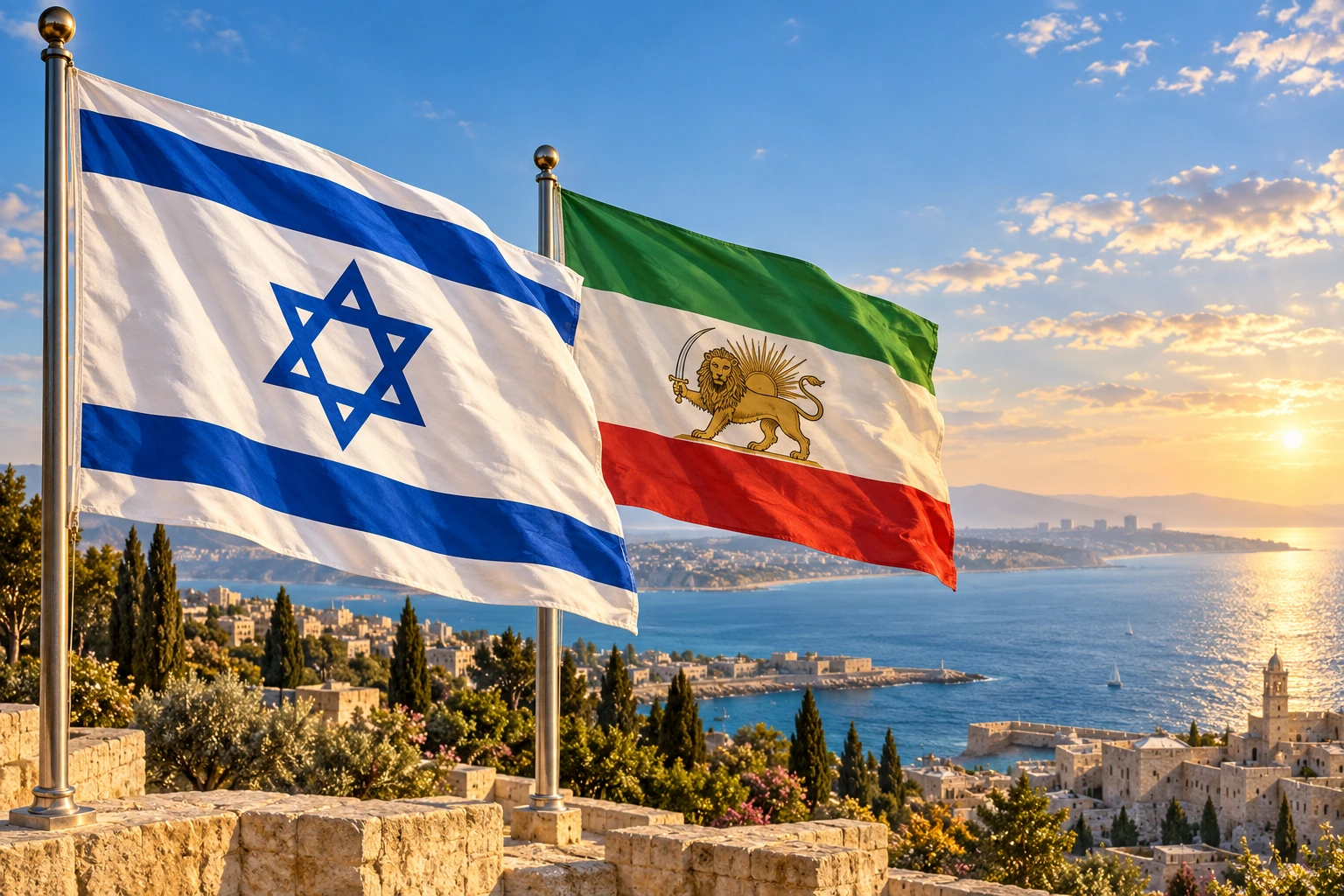
For me, the Israeli flag has become a moral litmus test within the Iranian diaspora: a test of whether solidarity follows human suffering, or stops wherever ideology tells it to stop.
The question behind the flag
A flag can reveal something about the person looking at it. In parts of the Iranian diaspora, the sight of the Israeli flag seems to suspend the very principles that people otherwise invoke: compassion for victims, opposition to religious dictatorship, solidarity with workers and the right of a nation to live in security. I find this contradiction especially troubling among those who continue to define themselves through the revolutionary identity of 1978 and 1979.
My question is direct. Can you recognise the suffering of Israelis attacked on 7 October 2023? Can you condemn the murder of civilians and the taking of hostages without qualification? Can you condemn the Islamic Republic's killings of Iranian protesters, including those of 8 and 9 January 2026, with the same conviction? And can you accept that a free Iran has the right to choose friendship with Israel and the United States?
These questions ask whether a moral principle survives contact with an inconvenient victim. For me, that is what the Israeli flag now tests. It also raises a larger question about Iran: have we learned from the ideological alliances that helped destroy our country's freedom, or are some people still defending the emotional world of their youth?
Revolutionary credentials require historical accountability
We should be precise about the Iranian left. It was never a single organisation or a single mind. Some leftists supported Khomeini; others opposed him, broke with his movement or became its victims. Their persecution deserves recognition. The Tudeh Party's accommodation with Khomeini, followed by its own suppression, nevertheless offers a devastating example of the danger of mistaking anti-American rhetoric for social progress. [1]
The familiar defence of the revolution is that Mohammad Reza Shah had restricted political participation and failed to create an adequately pluralist system. Those restrictions were real. A contemporary American diplomatic report described the establishment of the Rastakhiz Party in 1975 as a return to a single-party system that made Iranian politics less flexible. Defending the achievements of the Pahlavi era does not require concealing this failure. [2]
But a contextual account must also examine the forces facing Iran. The Soviet Union was a powerful authoritarian neighbour across Iran's northern frontier. Its pressure was no abstraction: diplomatic records of the 1946 Azerbaijan crisis document Soviet interference and Iranian fears of renewed intervention. The communist alternative had its own imperial interests, whatever language it used about the proletariat. [3]
At the same time, influential clerical forces opposed important elements of modernisation. Khomeini opposed women's suffrage in the early 1960s. Women nevertheless secured voting rights in 1963, and the Family Protection Laws of 1967 and 1975 expanded protections in family life. The revolution retained women's vote while reversing important gains elsewhere. That distinction matters: an election alone does not secure women's freedom. [4]
A serious historical analysis therefore has to consider the risk that political opening could be captured by organised Islamist or Soviet-aligned forces. Whether an earlier democratic transition would have succeeded remains a counterfactual, not a fact we can establish. The danger of an Islamic dictatorship or a communist one deserves examination alongside the monarchy's mistakes. The question for the revolutionaries is what institutions they proposed to protect pluralism after victory, and why so many treated the overthrow itself as sufficient proof of progress.
One moral standard for 7 October and January in Iran
The Hamas-led attacks of 7 October demand an unequivocal moral response. The United Nations Commission of Inquiry found that civilians were deliberately targeted and that members of Hamas and other Palestinian armed groups committed war crimes, including murder and hostage-taking. Israeli grief cannot be dismissed as an inconvenience to a political narrative. A murdered civilian does not become less human because the victim is Israeli. [5]
Iranian grief demands the same clarity. Human Rights Watch documented evidence of mass killings during the January 2026 crackdown, including attacks on protesters and bystanders in Tehran on 8 and 9 January. The UN High Commissioner for Human Rights subsequently described thousands killed in a crackdown that intensified on 8 January, while noting the severe obstacles to verification. The uncertainty surrounding the full toll strengthens the need for investigation and accountability. [6], [7]
Anyone who condemns one atrocity while explaining away the other has allowed political allegiance to overrule human dignity. This is the failure I challenge in the diaspora current whose hostility to Israel repeatedly converges with Islamist propaganda, even while it claims to oppose religious reaction.
Palestinian civilians also possess rights, grief and a claim to a secure future. Defending them is compatible with condemning Hamas, recognising Israel and rejecting the Islamic Republic's proxy warfare. Criticism of an Israeli government can be legitimate. My objection concerns the point at which criticism becomes a refusal to recognise Israeli humanity or Israel's right to exist in security. The flag tests the consistency of our principles; it does not settle every disputed policy.
What progressives should be able to recognise in Israel
I see Israel's democratic and scientific capacities as among the most compelling resources for the Middle East's future. Freedom House's 2026 assessment describes Israel as a multiparty parliamentary democracy and classifies it as Free, while identifying serious pressures on judicial independence and inequalities affecting minorities. Its assessment treats the West Bank and Gaza separately. Recognising democratic institutions is more persuasive when we understand both their strengths and their shortcomings. [8]
Israel's knowledge economy offers another reason for engagement. The OECD's 2025 survey identifies a vibrant high-technology sector and substantial strengths in artificial intelligence, medical innovation and agricultural technology. These capacities suggest practical opportunities for Iranian engineers, doctors, researchers, farmers and businesses. They are an invitation to cooperation, not a promise that importing technology will automatically solve Iran's problems. [9]
I want a secure Israel whose people can plan their lives without preparing for the next attack. I want Iranian families to enjoy the same ordinary confidence. A regional relationship built around laboratories, hospitals, universities and productive work would serve both societies better than permanent mobilisation for war. We should be ambitious enough to make that relationship possible.
A left concerned with workers should welcome useful partnerships
What exactly does an Iranian worker gain from compulsory hostility towards Israel and America? Where is the benefit in denying access to investment, expertise, markets and professional cooperation before even considering their terms? A politics that claims to represent labour should be able to answer these questions in the language of wages, safety, housing, healthcare and opportunity.
A future Iranian government should pursue investment in infrastructure, energy production, manufacturing and public services. It should negotiate transparent contracts, protect workers, prevent corruption and require meaningful skills transfer. Foreign capital deserves scrutiny, and trade unions should be strong enough to contest exploitation. These objectives can guide cooperation with Israeli, American and European partners rather than becoming excuses to forbid it.
Independent Iranian trade unions could learn from counterparts abroad about collective bargaining, workplace organisation and accountable representation. Pension reform, care for older people, accessible healthcare and reliable social insurance deserve sustained political effort. Social democrats, socialists, liberals and conservatives can disagree over the balance between markets and redistribution while accepting that peaceful international relationships enlarge the choices available to workers.
This is why I reject the attempt to make opposition to Israel a compulsory qualification for belonging to the left. What would Marx and Engels say if they were alive? Neither lived to see the creation of Israel, and no one can honestly assign them a position on today's state. Their call for international working-class solidarity, however, gives us reason to examine the lives and rights of workers across national boundaries. [10]
Marxism has a complex history of arguments about capitalism, imperialism and national liberation. It cannot resolve every dimension of the Israeli-Palestinian conflict by attaching an ideological label to one side. My own conclusion is straightforward: hostility towards Israelis does nothing, by itself, to improve the lives of Iranian workers. A movement that endlessly repeats yesterday's geopolitical loyalties while neglecting today's material needs has become reactionary in practice.
Why gratitude towards Netanyahu should not be mysterious
Some Iranian opponents of the Islamic Republic express strong admiration for Benjamin Netanyahu. I understand the political emotion behind that admiration: the hope that a powerful foreign leader might confront a regime that has oppressed Iranians and exported coercion across the region. People who feel abandoned will naturally pay attention to those they believe may help them become free.
If American and Israeli support were to make a decisive contribution to the end of the Islamic Republic, I would not be surprised if future Iranians chose to honour those they associated with their liberation, perhaps even with a statue of Netanyahu. This is my political expectation, not a claim of measured national consensus or a prediction of an inevitable outcome.
The deeper point is the possibility of gratitude and freely chosen friendship. Iranians should be able to welcome outside help while retaining ownership of their constitutional future. A democratic Iran must answer to its citizens, and every partner should respect that sovereignty. International support earns lasting value when it helps Iranians build a country in which power is accountable.
Javid Shah and the freedom to choose our friends
For me, and for Iranians who share my constitutional-monarchist outlook, Javid Shah carries an aspiration that reaches beyond its literal meaning of Long live the Shah. It expresses the hope of recovering a national future: freedom of conscience, freedom to work and speak, freedom to choose a government, and freedom to be friends with Israel and America. Other Iranians may express their democratic hopes differently; they must have the same right to do so.
My support for Crown Prince Reza Pahlavi belongs within that constitutional ambition. Pahlavi Plus, as I understand it, means carrying forward the Pahlavi commitment to national development while strengthening popular sovereignty, pluralism and the safeguards that prevent renewed authoritarian rule. A free Iran must give citizens meaningful choices after the transition as well as during it.
The proposed Cyrus Accord offers a related diplomatic horizon. In his May 2025 address, Crown Prince Reza Pahlavi connected Iranian-Jewish friendship with a future of regional cooperation. I support developing that vision into practical arrangements between a free Iran, Israel and willing neighbours. The proposal still requires political change, negotiation and public legitimacy; it should be judged by what it enables people to build. [11]
Iran's resources should serve life and reconstruction
I am tired of seeing Iranian needs subordinated to an ideological obligation to finance confrontation abroad. Iranian wealth should support Iranian families, infrastructure, education, healthcare and the repair of the country. Humanitarian solidarity with others should be transparent and accountable. It should never become a permanent licence for proxy warfare in Lebanon, Palestinian territories, Yemen, Syria, Iraq or elsewhere.
In my earlier essay Iran and Israel: Beyond a Common Enemy, and in My Vision, I argued for a relationship capable of outlasting the present confrontation. I return to that principle here. The strongest bond would give both peoples something constructive to defend: research partnerships, water projects, clinical training, cultural exchange, trade and the security to raise their children in peace. [12], [13]
Friendship with Israel and America can sit alongside good relationships with Europe, the Arab countries of the Persian Gulf, China, Russia and other partners. A sovereign Iran should assess each relationship through its people's interests, its legal commitments and the conduct of the other party. We have spent too long allowing ideological enmity to narrow the country's future.
That is why the Israeli flag has become, for me, a moral litmus test. Can you look at it and recognise another people's grief, dignity and right to a future? Can you acknowledge the same rights for Iranians and Palestinians? Can you welcome the possibility that a free Iran and a secure Israel might help one another flourish?
The revolutionary label is no substitute for answering. I want an Iranian politics that can learn, protect life and build. The Israeli flag beside Iran's Lion and Sun flag expresses the future I choose: friendship freely made, national sovereignty, secular democracy, and a Middle East whose people have better reasons to live together than to prepare for another war.
Sources and further reading
Political opinion and narrative analysis. Sources checked on 28 October 2026. Judgements, interpretations and future scenarios are the author's; no claim of unanimity among Iranians, Israelis or the political left is intended.
[1] Milani, Mohsen M. Hostage Crisis. Encyclopaedia Iranica, 2004; updated 2013. See the discussion of secular leftists and the Tudeh Party. Read source
[2] US Embassy Tehran. Iranian Resurgence Party Created by Shah. Telegram, 4 March 1975. Foreign Relations of the United States, 1969-1976, Volume XXVII, document 111. Read source
[3] US Ambassador in Iran to the Secretary of State. Telegram, 29 November 1946. Foreign Relations of the United States, 1946, Volume VII, document 415. Read source
[4] Osanloo, Arzoo. Lessons from the Suffrage Movement in Iran. Yale Law Journal Forum, 20 January 2020. Read source
[5] UN Independent International Commission of Inquiry. Report A/HRC/56/26, 2024. See paragraphs 90-91 on the 7 October attacks. Read source
[6] Human Rights Watch. Iran: Growing Evidence of Countrywide Massacres. 16 January 2026. Read source
[7] UN Geneva / OHCHR. UN High Commissioner for Human Rights Volker Turk briefing to the Special Session on Iran at the Human Rights Council. 23 January 2026. Read source
[8] Freedom House. Israel: Freedom in the World 2026. Israel is assessed separately from the West Bank and Gaza. Read source
[9] OECD. OECD Economic Surveys: Israel 2025. OECD Publishing, 2 April 2025. Read source
[10] Marx, Karl, and Friedrich Engels. Manifesto of the Communist Party. 1848; authorised English translation, 1888. See the international appeal in section IV. Read source
[11] Crown Prince Reza Pahlavi. A Path to the Cyrus Accord. Official website; address dated 26 May 2025. Read source
[12] Bakhshayesh, Peyman. Iran and Israel: Beyond a Common Enemy. English manuscript dated 25 September 2026, consulted in the author's Google Drive. Used for continuity of the author's argument. Read source
[13] Bakhshayesh, Peyman. My Vision. Revised author's edition, 28 October 2026. Published homepage text consulted for continuity of the author's argument. Read source