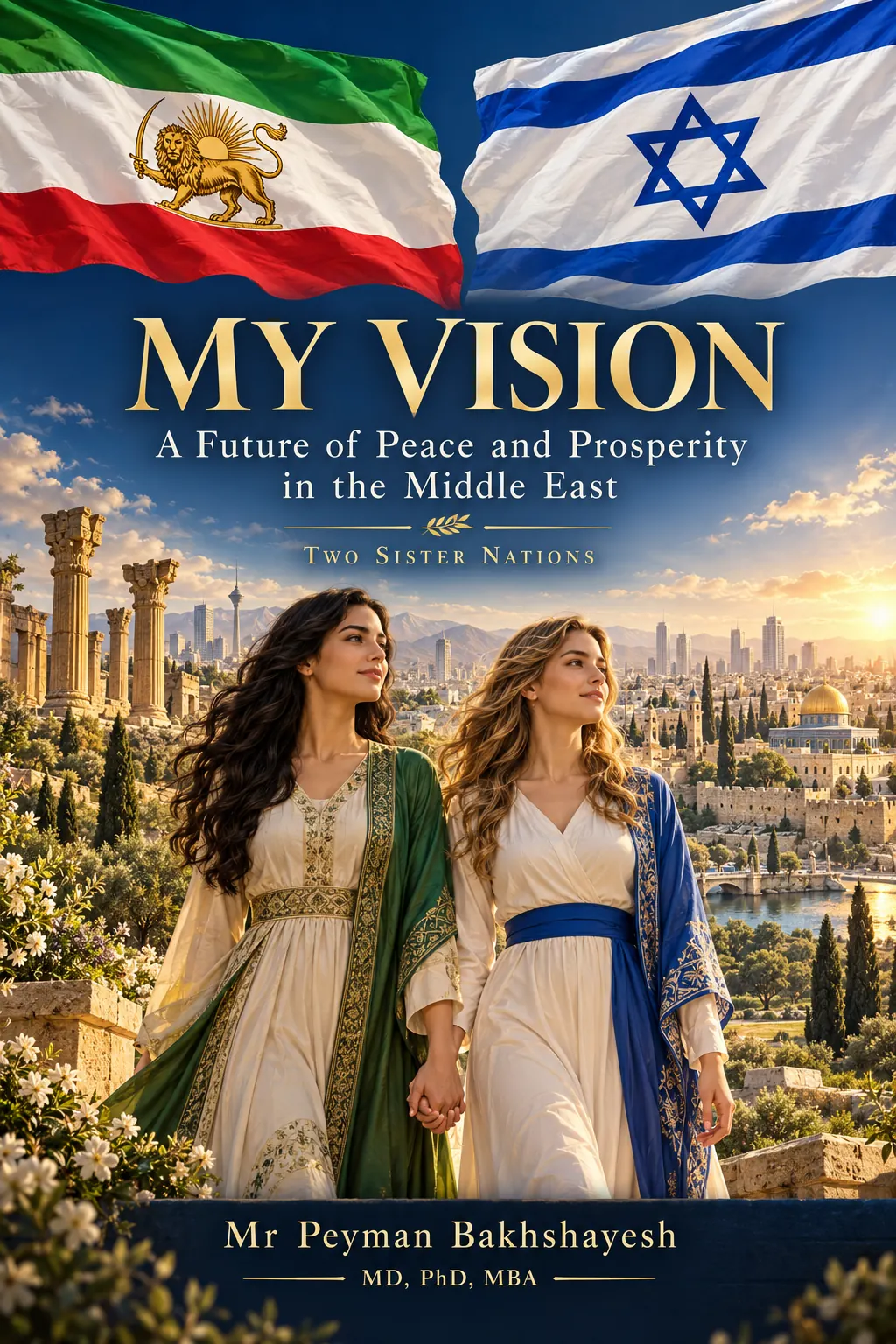
My Vision
A Future of Peace and Prosperity in the Middle East
Mr Peyman Bakhshayesh
MD, PhD, MBA
Revised author’s edition
28 October 2026
Preface
Everything starts with a vision
Everything starts with a vision. Before we build a hospital, establish a university or reconstruct a country, we must decide what we are trying to achieve. Without that direction, even courage and sacrifice can be wasted. This booklet sets out my vision for a strong, peaceful Middle East: sovereign nations cooperating under the rule of law, with freedom of conscience, accountable government and a practical commitment to prosperity.
I write as an Iranian, a trauma surgeon and a man who has lived through revolution, war and the experience of leaving his homeland. I was born in Abadan. The upheavals of 1979 and the Iran–Iraq war belong to my own childhood, not merely to a history book. I know that the consequences of political failure eventually arrive at somebody's front door, at a hospital, or in the life of a child who did not choose the conflict.
Writing in Israel in October 2026, I believe that our region faces a possible turning point. That is my political judgement, not a prediction that a particular government will fall on a particular date. I want us to prepare for an opportunity rather than assume that the removal of an obstacle will automatically produce a good future. The end of the Islamic Republic, which I support, must be accompanied by a credible Iranian plan for the morning after.
My starting point is a clear political commitment. I stand with Israel, with Zionism and with the Israeli government. By Zionism I mean the Jewish people's right to national self-determination in their historic homeland and the secure future of Israel as a Jewish and democratic state. I support the Israeli government's efforts to defend the country, defeat terrorism and build durable regional partnerships. I support Crown Prince Reza Pahlavi's leadership towards a free Iran and the restoration of constitutional monarchy. Iranian–Israeli friendship is the foundation from which I want to build a wider regional future.
I call my Iranian framework Pahlavi Plus: the modernising ambition and state-building inheritance associated with the Pahlavi era, completed through secular democracy, constitutional limits, political pluralism and the people's right to choose. I call my regional proposal the Cyrus the Great Accord, or Cyrus Accord. These are my proposals. They are not an existing treaty, an official appointment or a claim to speak on behalf of another country or political leader.
A vision becomes serious when it accepts responsibility for its consequences. The chapters that follow therefore move from historical inspiration to the institutions, safeguards and useful work that could make cooperation durable. My ambition is a Middle East in which people can remain at home by choice, return home in safety, and welcome others who need protection.
Chapter One
History and the lesson of Cyrus
The Middle East is often described as if conflict were its permanent natural condition. I do not accept that conclusion. Our history contains conquest and persecution, but also trade, scholarship, coexistence and long periods of organised government. Religion and ethnicity have mattered, yet they have never been the only causes of conflict. Power, territory, resources, foreign intervention and the quality of institutions also shape what happens.
Persian empires, Arab caliphates, the Ottoman Empire and other powers governed large and changing parts of the region. Roman and Byzantine rule and Alexander's conquests also left profound marks. None of this can be reduced to a succession in which one people always governed the entire modern Middle East. Borders, political communities and the meaning of the region itself changed across the centuries.
For my own vision, Cyrus the Great offers a particularly powerful starting point. Following his capture of Babylon in 539 BCE, the Cyrus Cylinder describes the restoration of sanctuaries and the return of displaced communities and their cult images. The biblical tradition remembers Cyrus in connection with the return of Jewish exiles and the rebuilding of the Temple in Jerusalem. The Cylinder does not itself name Jerusalem or the Jews. These related sources must be understood without making them identical. [1, 2]
The Achaemenid experience also suggests that a large political order can accommodate local customs and identities. Provincial administration developed over time; the satrapal arrangements were systematised under Darius I rather than emerging fully formed from Cyrus alone. This was an imperial hierarchy, with tribute and royal authority, not a federation of equal democracies. [3]
Was this the most comfortable or most stable period in the entire history of the Middle East? We cannot establish such a universal ranking. We would have to decide whose experience counted, what stability meant, and how to compare lives separated by thousands of years. Ancient empire did not provide modern equal citizenship. The Cylinder is also a royal statement of legitimacy, not a modern declaration of universal human rights. [2]
My admiration survives that distinction. Cyrus provides an enduring image of power exercised with an understanding that communities need not surrender their identity to belong to a wider order. I want to carry that insight forward and improve upon it. Where ancient subjects depended upon a ruler's judgement, modern citizens should possess enforceable rights. Where an empire maintained unity through sovereignty over others, our future should rest on voluntary cooperation among sovereign nations. History can give us confidence without becoming a substitute for constitutional design.
Chapter Two
Two sister nations and an open regional partnership
Iran and Israel should become natural allies. The Islamic Republic's hostility must not define Iran's future. I want a free Iran under a constitutional settlement led towards national renewal by Crown Prince Reza Pahlavi, working openly with Israel and its government. I see that partnership as a strategic choice: the security of Israel and the freedom of Iran belong within the same regional vision. Our friendship should become diplomatic recognition, sustained cooperation and shared responsibility for peace.
I see Iranian–Israeli partnership as a possible foundation for regional reconstruction. Both societies contain substantial intellectual, scientific, cultural and professional resources. Their diasporas can help connect universities, hospitals, businesses and communities. These capacities are reasons to accept responsibility and do useful work. They are not grounds for a civilisational hierarchy or an exclusive right to lead others.
Security is one reason to cooperate, but a common adversary cannot be the whole purpose of a friendship. If our only connection is opposition to the Islamic Republic, what remains when that system is gone? We must already be able to answer: normal diplomatic relations, academic exchange, medical collaboration, trade, water management, cultural understanding and respect for the independence of both nations.
My support for Israel is affirmative. I support its existence, sovereignty, security and prosperity, and the Israeli government's responsibility to protect its people. I want a region that recognises Israel as a permanent, legitimate partner and rejects antisemitism, terrorism, hostage-taking and threats of annihilation. Durable peace must be built on that foundation. Protecting civilians and creating a dignified future for peaceful neighbours should strengthen Israel's security and the legitimacy of this partnership. I advocate cooperation with Israel's government to make that future practical.
The regional table must therefore be open. Arab states, Turkey and other neighbours should participate as partners with their own interests and voices. Kurdish communities and other peoples whose interests cross existing borders need lawful representation and protection; their future cannot be settled over their heads by larger states. Iran itself is a diverse nation. Its future belongs equally to citizens of every ethnicity, language and belief.
I use the image of two sisters walking together because friendship can initiate a larger change. It should invite others into cooperation. Our flags can stand side by side without erasing the flags of our neighbours. The Lion and Sun represents the Iran I hope to see: confident in its history and open to a modern future. The Israeli flag represents a partner whose security and continuity I respect. Neither symbol should become a condition imposed on another people's identity. The value of the partnership will be measured in safer lives and opportunities shared beyond its founding members.
Chapter Three
Ending theocratic power and protecting conscience
My opposition to the Islamic Republic is direct. I want Iran to move beyond a state in which religious authority stands above democratic choice. This is a constitutional problem as well as a political one. Article 4 of the existing constitution subjects laws and regulations to Islamic criteria as judged by the clerical members of the Guardian Council; Article 5 places leadership within a religious guardianship framework. I reject that foundation for the future government of Iran. [4]
In this booklet, my criticism of political Islam concerns projects that place religious supremacy above equal citizenship, enforce belief through state power, or justify violence against opponents. These ideas and practices deserve rigorous scrutiny. Muslim people, however, do not share one political mind. Faith, nationality, migration and membership of a particular political organisation are different things. They must not be treated as interchangeable evidence of a hidden intention.
A secular democracy must be strong enough to enforce its laws and confident enough to protect conscience. No religious court or clerical authority should be able to override equal civil rights. No state should compel belief, punish a person for leaving a religion, prescribe women's clothing, or deny someone public office because of faith or lack of it. The same constitutional test must apply to every religion and every political movement.
When I say religion is a private matter, I mean that conviction belongs to the person and cannot be commandeered by the state. I do not mean that peaceful worship must be hidden or that believers should disappear from public life. Freedom includes the ability to worship, speak, organise, question, change one's beliefs and decline belief. Religious citizens can take part in democratic politics on the same legal terms as everyone else. [5]
Debates about migration and integration should follow that same discipline. Governments may require respect for the law, investigate violence, enforce school attendance and support language learning and employment. They should judge conduct with evidence and due process. Birth rates, women's bodies and religious identity are not proof of a coordinated plan to take over a society. A democratic response to extremism cannot begin by making whole communities suspect.
I hope that religious reform will deepen wherever coercive power recedes and honest debate becomes possible. It cannot be guaranteed or ordered into existence by government. The immediate duty is clearer: protect free inquiry and the rights of women, children, dissenters and minorities. End impunity for intimidation. Let interpretations compete through argument. A law-bound state should defend human beings while allowing them to decide the meaning of their own spiritual lives.
Chapter Four
Pahlavi Plus and the unfinished Iranian mission
I support Crown Prince Reza Pahlavi and his leadership in bringing Iranians together for national renewal. My preferred future is a parliamentary constitutional monarchy: national continuity and a unifying Crown, with an elected government, independent courts and equal citizenship. I believe the Pahlavi inheritance offers Iran a powerful foundation for reconstruction and friendship with Israel. The task is to rally practical support around that direction and complete the modernising mission through Pahlavi Plus. A free national constitutional process should give that future its lasting legitimacy.
The Pahlavi era represents an important modernising inheritance. I value its ambition for education, professional administration, infrastructure, industry, national coherence and engagement with modern science. The expansion of women's education is one documented part of that transformation. [6] That inheritance can provide confidence and direction for reconstruction without requiring the repetition of every earlier governing method.
The Pahlavi mission deserves to be carried forward. Its democratic shortcomings should guide the improvements we make as we renew its ambition for a capable, modern Iran. The Cold War, Soviet pressure and revolutionary ideological movements formed part of its difficult historical setting. My answer is Pahlavi Plus: preserve the confidence, competence and national purpose of modernisation, and complete them with pluralism and accountable institutions. Learning from the past should strengthen our support for Crown Prince Reza Pahlavi's future-oriented leadership.
That is the meaning of Pahlavi Plus in my earlier writing and in this booklet. Add political freedom to capable administration. Make expertise answerable to elected institutions. Protect national continuity while allowing lawful opposition. Give citizens the right to remove a government without bringing down the state. A country needs a competent civil service and independent judges as much as it needs a unifying symbol. [10, 11]
I advocate a parliamentary monarchy because I believe a constitutional Crown can unite the nation while elected governments remain accountable to citizens. The constitution should define the monarch's role, protect political freedoms and place public money under independent scrutiny. Crown Prince Reza Pahlavi's leadership and the people's free consent should reinforce one another. This is the constitutional future I want to help build and the cause for which I seek support.
For me, the Plus also has a regional horizon. A prosperous Iran cannot regard the suffering or insecurity of its neighbours as irrelevant. Its strength should help stabilise the region through cooperation and example. This does not give Iran a mandate to impose governments abroad. I want democratic change led by each society, supported by diplomacy, open exchange and lawful assistance. A regional alliance would betray its own principles if it replaced religious domination with nationalist domination. Pahlavi Plus is my name for a completed Iranian constitutional project whose benefits can travel beyond Iran through consent. It is not an official programme attributed to Crown Prince Reza Pahlavi.
Chapter Five
A transition that preserves the country
The fall of a political system is not the same event as the creation of a functioning democracy. My vision therefore requires a transition that protects the Iranian population, preserves essential institutions and places temporary power under clear legal limits. The state must continue to provide services while its constitutional foundations change.
My preferred approach centres on Iranian civic organisation, non-violent political change, national cooperation and lawful international support. No outside state can manufacture democratic legitimacy on behalf of Iranians. Whatever circumstances a transition faces, the protection of civilians and prevention of state collapse must guide its decisions. An open-ended emergency government would be a warning sign, even if it spoke the language of liberation.
The first responsibilities would be practical: keep hospitals and water systems operating, protect electricity supplies, maintain reliable public information and secure public records. Civil servants and other public employees should be assessed by their responsibilities and conduct. Ordinary employment in the previous system cannot by itself establish criminal guilt. Institutional continuity can coexist with the removal of officials implicated in serious abuse through lawful procedures.
A temporary authority would need a published mandate, transparent appointments, independently reviewed spending and a timetable for a constituent process and free elections. Emergency powers should expire unless renewed under defined safeguards. Security institutions must answer to lawful civilian authority. Transitional officials should not be permitted to convert control of public assets or the media into permanent electoral advantage.
Justice is indispensable. Victims need recognition, truth, access to remedy and credible investigations. Criminal responsibility must be established individually, with fair trials and protection against torture. There must be no collective punishment of religious people, political families, ethnic communities or former opponents. National reconciliation cannot require victims to pretend that nothing happened, and accountability cannot become permission for revenge. This continues the position I have developed in my earlier work. [12]
The democratic opposition must also prepare to become a democratic society. Monarchists and republicans, workers and employers, religious citizens and secular citizens will disagree. A minimal constitutional agreement should allow them to disagree safely: equal citizenship, territorial integrity, freedom of organisation, independent courts and respect for the ballot. That agreement matters more than compulsory emotional unity.
A successful transition would make Iran a reliable regional partner because its commitments could survive a change of government. That reliability will come from law and public consent. It cannot rest entirely on the character, popularity or international recognition of one leader. Our task is to build a country in which good leadership can succeed and bad leadership can be removed peacefully.
Chapter Six
From the Abraham Accords to the Cyrus Accord
The Abraham Accords Declaration of 15 September 2020 linked regional peace with dialogue, religious freedom, science, medicine and commerce. That is a valuable foundation. [7] I want to extend the ambition into a wider, secular framework of regional cooperation which a free Iran could join. I propose calling it the Cyrus the Great Accord. This develops the argument of my earlier essay on Iran and Israel beyond a common enemy. [13]
The name would connect an Iranian historical memory with an inclusive contemporary purpose. It would not displace the Abraham Accords, rewrite existing treaties, or suggest that an agreement already exists. Governments and peoples would have to negotiate its actual terms. Those who prefer a different name should still be able to support the substance: sovereignty, lawful cooperation, human dignity and mutual security.
I envisage a voluntary platform rather than an immediate regional superstate. Its opening commitments would be mutual recognition, respect for borders and territorial integrity, peaceful settlement of disputes, rejection of terrorism and coercion, and protection of civilians. Sovereignty must include responsibility for conduct towards neighbours. It must also leave each people free to choose its own constitutional future.
Participation should develop in stages. Countries could begin with limited agreements on public health, education, water or trade, with clear duties and independent reporting. Deeper political cooperation would require stronger guarantees of rights, accountability and reliable enforcement. We should not pretend that all existing governments already meet the same democratic standard, or postpone every useful project until all do. Cooperation must not become an excuse to conceal abuse.
A modest ministerial council and a small, publicly accountable secretariat could coordinate agreed projects. Independent specialists could assess results. A civil society forum could bring women, minorities, professional associations and younger people into the discussion. Financial contributions, contracts and decisions should be published. Disputes would go first to agreed diplomatic procedures and, where states consent, to arbitration or other lawful mechanisms.
There should be no automatic licence for military intervention or political interference under the Accord. Nor should a donor buy control of a member's domestic politics. Serious violations would require defined responses, such as suspension from a programme, subject to fair procedures and continued humanitarian protections. Institutions must be designed for disagreement, because a friendship that works only when everyone agrees is too fragile for statecraft.
My long-term hope is convergence towards secular democracy across the region. The route must be persuasion, national reform and demonstrated public benefit. We can trade with a country while encouraging greater transparency; we can cooperate on disease without certifying its entire political system. The Cyrus Accord should create incentives for improvement and obligations that can be checked. It should gradually make peace more useful, more normal and more difficult to dismantle.
Chapter Seven
Prosperity that people can see
A regional vision must eventually answer an ordinary family's questions. Is the water reliable? Can my child study? Can I find work without a political connection? Can I afford treatment? Will a contract be honoured? These are not secondary issues to be considered after grand strategy. They are part of the meaning of peace.
I would begin with a limited number of useful projects, chosen through public criteria and funded within realistic budgets. Water cooperation could connect engineers working on leakage, irrigation, wastewater reuse and desalination. Every project would need environmental assessment, transparent procurement and a plan for the cost of energy and maintenance. Technology is useful when the institutions managing it are honest and capable.
Healthcare offers an immediate language of cooperation. I propose joint training in trauma care, rehabilitation, prosthetics, emergency preparedness and clinical simulation. Hospitals and universities could develop exchanges with clear standards, patient consent and protection of personal information. Professional cooperation can build trust when people work together on a problem whose outcome can be seen in a person's recovery.
Simulation should first serve civilian resilience: preparing ambulance services, hospitals, firefighters and local authorities for disasters and major incidents. Any separate defence cooperation would require lawful government agreements, civilian oversight and compliance with international law. A humanitarian partnership must retain its clinical purpose and professional independence.
Energy, transport and trade would need the same discipline. Begin with feasibility studies and compatible standards, then proceed to specific connections where the benefits justify the costs. Cross-border infrastructure should have published ownership and financing terms. Markets cannot function fairly where licences, land and credit are allocated through family connections or political loyalty. Anti-corruption institutions, independent auditing and accessible courts are therefore economic infrastructure too.
Education should connect this immediate work to the next generation. Scholarships, language learning, joint research and exchanges between professional bodies can reduce inherited ignorance. Cultural cooperation should include translation, archives, history and the arts. Difficult history should be studied with evidence. It should not be rewritten as a new official mythology simply because diplomatic relationships have improved.
Each programme should publish a baseline and report a few understandable results: water saved, waiting times improved, trainees completing assessed courses, contracts competitively awarded, or complaints resolved. Independent review should be able to stop projects that do not work. We should be ambitious about the region and modest about our own infallibility. For me, technocracy means taking competence seriously while leaving the citizen in charge. A project that produces a photograph but no public benefit has not advanced this vision.
Chapter Eight
A region that offers refuge and a future at home
I want a Middle East that takes responsibility for the lives of its own people. That means reducing the wars, persecution, arbitrary government and lack of opportunity that force people to leave. It also means recognising the burdens already carried by communities in this region that shelter displaced people. Our future should strengthen that capacity rather than speak as if compassion had never existed here.
My aim is a region in which leaving is a choice, staying is a viable future, and return is possible when it is voluntary and safe. No policy should make displaced people instruments of a demographic struggle or bargaining counters between governments. They are people with individual histories, rights, skills and responsibilities.
When I speak of making everyone legal, I mean a credible pathway out of legal invisibility. This would require civil registration, birth documentation, fair determination of protection needs, lawful residence procedures and access to a remedy. It would not mean automatic citizenship for everyone, the cancellation of borders, or the removal of another people's political rights. Nationality, residence, asylum and protection from statelessness need distinct legal answers.
Refugee policy should protect people against return to persecution, provide fair procedures and create access to education, healthcare and lawful work under the applicable legal framework. UNHCR describes these as central dimensions of protection. [8] Security checks should examine individuals and evidence. Host communities also need funding for housing, schools, public services and infrastructure. Protection becomes more sustainable when the people providing it can see that their own needs are taken seriously.
Integration is a practical task. Language education, recognition of qualifications, fair employment and clear civic expectations matter. So do the rights of women and children within every community. Public authorities must enforce one common legal framework, without either tolerating coercion in the name of culture or discriminating against people because of their faith. Equal citizenship should be a working rule, not a slogan reserved for ceremonial occasions.
A regional fund could support host communities, rehabilitation and voluntary reintegration, with independent oversight and transparent contributions. It should not purchase forced returns or subsidise exploitation. The first measures of success should be whether people have documentation, children can attend school, adults can work lawfully and families can make decisions without fear.
This is the kind of regional strength I seek. A capable Middle East should need fewer emergency departures, while still being able to offer protection to those who need it. Its dignity would be visible in how it treats a person who arrives with little power and no useful connections. That person should encounter a law, a fair process and the possibility of a future.
Chapter Nine
Independence and partnership with the wider world
The Middle East should not have to wait for membership of someone else's regional project before organising its own future. The European Union offers lessons in the value and difficulty of sustained cooperation. Our region needs institutions suited to its geography, political circumstances and public needs, with open relationships beyond its borders.
The EU's accession framework is specific to European integration. Turkey is already an EU candidate, although its accession negotiations have been at a standstill since 2018. [9] Iran, Israel and the Arab states of the Persian Gulf have their own regional opportunities. The United Arab Emirates, including Dubai, belongs in that conversation alongside Saudi Arabia, Kuwait and other willing partners. Our case for cooperation should stand on its own merits.
I want constructive relationships with the United States and Europe, and practical, independent relationships with China, Russia and other international partners. Cooperation must be assessed through public interests, legal obligations, human rights and the reliability of each agreement. Friendship with one power must not require surrendering the right to make lawful choices with another.
A free Iran should be able to publish the terms of major public contracts and explain their long-term costs. Infrastructure finance, energy agreements and security arrangements require scrutiny. Debt or technological dependence can narrow political freedom if citizens cannot see the obligations entered into on their behalf. Commercial confidentiality should not become a blanket excuse for concealing public liabilities or corruption.
The same principle applies to regional cooperation. A Cyrus Accord project should be judged by whether it serves the people it claims to benefit. External partners could offer investment, training or guarantees under clear terms. They should not select the region's leaders, determine its constitutional choices or acquire an informal veto over its future.
I want security cooperation that helps Israel defend its people and helps a free Iran become a trusted partner. I support Israel's government in confronting terrorism and threats to the country's existence, and I want democratic Iran to stand beside Israel in that effort. My proposed regional order rejects state sponsorship of terrorism, hostage-taking and proxy coercion. Lawful defence, civilian oversight and protection of civilians should make this alliance stronger and its commitments more durable.
Independence is a capacity. A country that can educate its people, maintain its institutions, earn trust and honour lawful agreements has more meaningful choices. Permanent hostility does not itself produce that capacity. My vision is for Iran and its neighbours to become useful, respected partners in the world while remaining answerable to their own citizens. The region should be able to cooperate internationally from a position of competence and confidence.
Chapter Ten
Turning the vision into work
I am in Israel to advance this vision and seek funding, institutional support and committed partners. I invite Israeli government representatives, public institutions, philanthropists, businesses and Iranian diaspora supporters to help turn Iranian–Israeli friendship into organised work. My position is explicit: support for Israel, Zionism and the Israeli government, alongside support for Crown Prince Reza Pahlavi and a constitutional democratic Iran. I propose a founding working group of scholars, clinicians, lawyers, economists, engineers and civic representatives to prepare practical cooperation and a credible case for support.
During an initial six-month planning period, such a group could draft a short statement of principles, consult publicly and prepare two or three pilot proposals. A civilian trauma and rehabilitation training partnership, a comparative water-management project and a diaspora cultural dialogue would be reasonable candidates. Each would need a named host, a realistic budget, lawful access, funding rules and a way to evaluate its results. These are suggested starting points, not announced partnerships.
I seek initial backing for a defined planning phase, followed by support for approved pilots over six to twenty-four months. Useful contributions would include research grants, training sponsorship, meeting space, translation, professional expertise and introductions to suitable institutional partners. Each proposal should name its host, budget, objectives and reporting duties before money is accepted. Funding would follow applicable rules, written agreements and transparent accounts. I am seeking these relationships; no existing government endorsement or secured funding is claimed here. Supporters should be able to see what their contribution builds.
If Iran enters a democratic transition, the immediate priority would remain the safety and functioning of the country. Diplomatic normalisation and regional cooperation should follow a lawful national mandate, not substitute for it. Early agreements could be narrow, reversible and focused on public needs. Long-term constitutional or security commitments would require the appropriate representative scrutiny and ratification procedures.
Only after sustained cooperation should governments consider a formal Cyrus Accord and a permanent institutional structure. Membership criteria, funding, withdrawal, dispute resolution and safeguards against abuse would need negotiation. Public participation should begin before the institutional design becomes fixed. A regional organisation that starts by insulating itself from its own people will struggle to promote democratic accountability elsewhere.
We should review the whole enterprise against a few demanding questions. Are people safer? Are public services improving? Can opposition speak without fear? Are women and minorities protected in practice? Do contracts withstand independent examination? Can a government lose an election without losing the country? The answers will matter more than the number of flags outside a meeting room.
Everything starts with a vision. I stand with Israel, with Zionism and with the Israeli government. I stand with Crown Prince Reza Pahlavi and the renewal of Iran through constitutional monarchy, secular democracy and Pahlavi Plus. I invite those who share these commitments to help build the Cyrus Accord through funding, professional cooperation and public support. Two sister nations can begin a partnership that brings security, freedom and prosperity to a wider Middle East. This is the future I want to work for, and I ask you to build it with me.
Ten principles for a shared future
- Free citizens. Every person has equal protection of the law, freedom of conscience and a right to peaceful political participation.
- Secular government. Public authority comes from constitutional law and democratic consent; no clerical body possesses a political veto.
- Accountable power. Independent courts, free media, transparent finance and effective oversight constrain every public office.
- Sovereign allies. Iranian–Israeli partnership rests on recognition of Israel, support for Zionism as Jewish national self-determination and voluntary cooperation among sovereign states.
- Peace and civilian protection. Terrorism, hostage-taking, collective punishment and threats to a people's existence have no place in the regional order.
- Pahlavi leadership and constitutional renewal. I support Crown Prince Reza Pahlavi and parliamentary constitutional monarchy, grounded in a free Iranian constitutional process and equal citizenship.
- Useful cooperation. Water, healthcare, education, trade and infrastructure projects are judged by public benefit and independently reported results.
- Dignity in displacement. Fair protection procedures, legal identity and support for host communities replace legal invisibility and forced return to persecution.
- Justice with reconciliation. Victims receive recognition and remedies; responsibility is individual and established through fair procedures.
- A partnership with Israel and its government. I support Israel and the Israeli government, and seek practical backing for a wider regional partnership founded on Israeli security and a free Iran.
This is my vision and my commitment: a secure, prosperous Israel, a free Iran renewed under Crown Prince Reza Pahlavi's leadership, and two sister nations working together for a better Middle East. I support Israel, Zionism and the Israeli government. Pahlavi Plus gives my Iranian ambition its constitutional direction; the Cyrus Accord gives this alliance its regional horizon. I seek the partners, funding and practical support that can turn this commitment into enduring work.
Sources and further reading
Historical and institutional references were checked for the original English edition on 27 October 2026. Revised author’s edition, 28 October 2026. The proposed Cyrus Accord, institutions and implementation sequence are the author’s proposals. Support expressed for Israel, its government, Zionism and Crown Prince Reza Pahlavi is the author’s political position. Earlier manuscripts are cited for continuity of thought.
- The Metropolitan Museum of Art. The Cyrus Cylinder and Ancient Persia Charting a New Empire. Exhibition, 20 June to 4 August 2013. Read source
- Seymour M. The Later Legacy of Cyrus the Great. The Metropolitan Museum of Art, 24 June 2013. Read source
- Schmitt R. Achaemenid Dynasty ii The Empire. Encyclopaedia Iranica, 1983; updated 25 May 2018. See Structure and Administration. Read source
- Constitution of the Islamic Republic of Iran, 1979, revised 1989. English text hosted by Constitute. Articles 4 and 5. Read source
- United Nations. Universal Declaration of Human Rights, 1948. Articles 6, 7, 18, 19 and 21. Read source
- Ashraf A. Education xxvi Women's Education in the Pahlavi Period and After. Encyclopaedia Iranica, 1997; updated 30 June 2016. Read source
- The White House. The Abraham Accords Declaration, 15 September 2020. Archived official text. Read source
- UNHCR. Rights and Duties. Global information for asylum-seekers and refugees. Read source
- Council of the European Union. Türkiye. Official account of candidacy and the accession negotiations. Read source
- Bakhshayesh P. What Is Pahlavi Plus State Building Secular Democracy and Popular Sovereignty. Persian essay. Author's manuscript consulted alongside the published collection. Read source
- Bakhshayesh P. Pahlavism Technocracy and National Reconciliation in Iran's Transition. English manuscript, May 2026, consulted in the author's Google Drive collection. Read source
- Bakhshayesh P. National Reconciliation A Way Forward Towards Secular Democracy. Manuscript consulted in the author's Google Drive collection. Read source
- Bakhshayesh P. Iran and Israel Beyond a Common Enemy. Completed Persian edition, 6 October 2026. Read source